OnlyFans without an agency: keep your margin
You can run OnlyFans without an agency and keep the 30 to 50 percent they take. Here is how to handle DMs, posting and sales solo from your own machine.
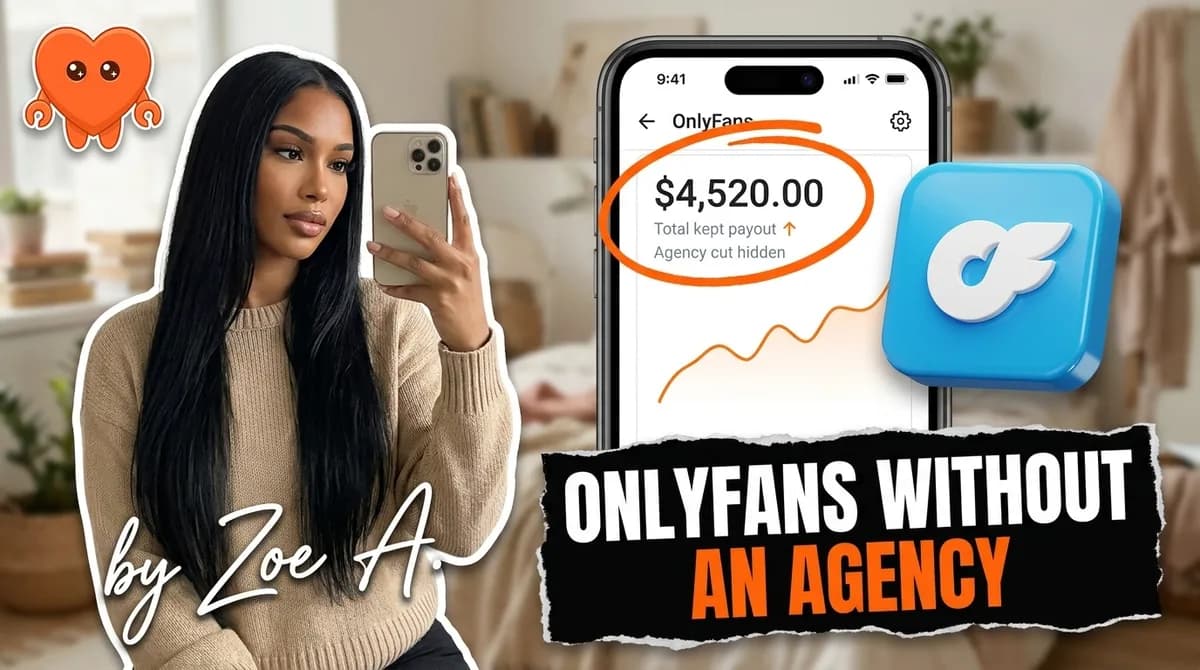
Yes, you can run OnlyFans without an agency. The only reason most creators sign one is the workload: hundreds of daily DMs, a posting schedule that never stops, and a sales layer that demands constant attention. That workload is now solvable on your own machine, without giving a cut to anyone.
This is the practical guide to doing exactly that.
What an agency actually does for you, and what it costs
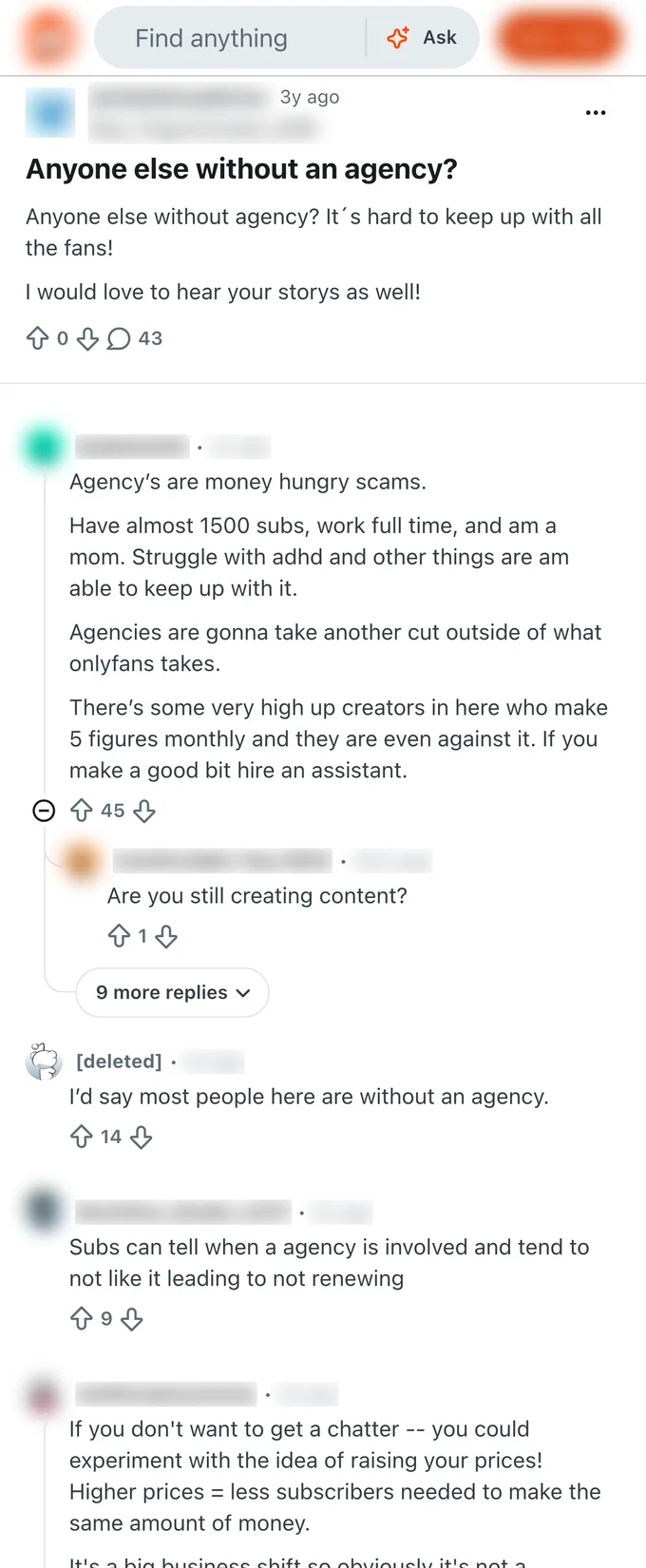
Agencies sell a bundle. At the core are four things: chatting with fans in your name, scheduling and posting content, running PPV campaigns and upsells, and occasionally managing paid acquisition or cross-platform promotion.
Each of those tasks has a real cost in time. A moderately active account generates 100 to 300 DM threads a day. Posting to OnlyFans and Fansly on a consistent schedule takes two to four hours on top of filming. PPV pricing and fan segmentation require ongoing attention to your subscriber data. For a creator doing all of this alone, a 16 to 18 hour day is not unusual in the first few months.
The real cost of agency margins
The agency pitches this as a solved problem. Pay a cut and the hours disappear.
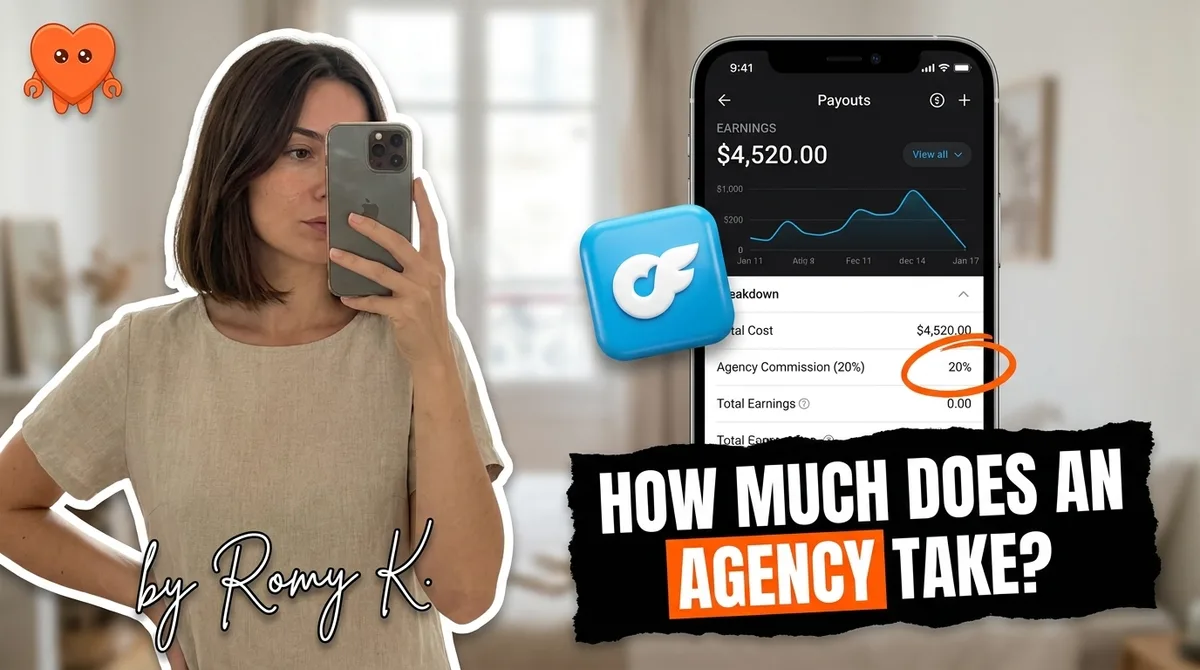
The math is harder than it sounds. OnlyFans takes 20 percent off the top. An agency adds another 20 to 50 percent on top of that, with 30 to 35 being the most common structure right now. At 35 percent, you need your gross revenue to grow by roughly 54 percent just to net the same amount you earned before signing. That is not a partnership designed to benefit you. That is a partnership designed to survive on your growth.
At $5,000 per month gross before fees, a 35 percent agency cut leaves you with $2,325 after both the platform and the agency take their share. The same $5,000 solo, after the platform fee only, is $4,000. You would need to be pulling close to $7,700 gross under agency management just to match your solo net. Most agencies do not come close to delivering that lift consistently.
Run your numbers first with the free OnlyFans tax calculator so you know what to set aside.
The "fair" agency deals that actually make economic sense for creators tend to sit at 20 to 25 percent and come with genuine distribution advantages: a real paid acquisition channel, cross-promotion with other accounts, or a chatting team that meaningfully increases conversion. Those deals exist, but they are not the median pitch.
The hidden cost of going solo the old way
The math strongly favors going solo. So why do most creators eventually sign an agency?
Because the solo path, done manually, is unsustainable.
A solo creator with a growing account wakes up to 200 or more unread DMs. She works through them, films content, edits, uploads, captions, schedules, then comes back to another pile of messages at night. Revenue leaks in every offline hour: a fan in a different time zone who sent a PPV request at 2am and got a reply at 11am has usually already unsubscribed. A $50 custom that sits for eight hours goes cold. The personal touch that made the account work in the first place becomes the thing that breaks the creator.
Burnout is the number one reason creators quit the business entirely. The 2 to 3 month window is real: most solo creators who try to do everything manually without any automation hit a wall before the account has a chance to compound.
The agency offers an exit from that wall. It is a rational decision under real exhaustion. But it is not the only exit.
How to run OnlyFans solo without burning out
The workload problem that agencies exploit is a solved problem in 2026, and the solution does not require giving away a third of your income.
Automate DMs in your own voice, on your own machine
DMs are the highest-leverage part of your business and the most time-consuming. A properly structured inbox workflow handles most of the volume automatically: a welcome message to every new subscriber, a follow-up for fans who opened but did not act, a re-engagement nudge for subscribers who have gone quiet, and a PPV sequence built on your actual content library.
The key phrase is "in your own voice." Automation that sounds like you does not get flagged by fans or by the platform. Automation that sounds like a script written by someone who has never heard of you is what burns accounts and ends relationships.
There is a second key phrase: "on your own machine." Every established chatting tool on the market today, including Supercreator, Infloww, and similar services, takes your OnlyFans login and runs your fan conversations through its own system, whether servers, proxies, or shared team sessions. A company you have never met can read your fans' messages and act as you from infrastructure you have no visibility into. If their systems get flagged, your account carries the risk.
FanClaw works differently. The agent runs on your laptop. Your login and your fan data never leave your machine. No third party holds your credentials, reads your conversations, or can act as your account. You keep the keys. That is the durable difference, and it is worth understanding before you hand your login to any tool.
To see how the DM layer specifically works, the guide on how to automate your OnlyFans DMs covers the mechanics in detail, including what is allowed, what gets accounts banned, and how to structure flows that sound like you.
Schedule posts and keep a human approval step
Content posting is the second biggest time sink. Uploading, writing captions, setting prices, timing releases across OnlyFans and Fansly, and keeping up with a posting cadence that the algorithm rewards requires daily attention if you do it entirely by hand.
Scheduling fixes the daily friction. Build a content queue a week at a time, set release windows that match your subscribers' activity patterns, and let the posting happen automatically. You stay in the loop for the decisions that matter: pricing, caption review, PPV selection. The mechanical work runs without you.
The approval step is not overhead. It is the thing that keeps automation from becoming a liability. Keep a human checkpoint on anything that involves money, a new piece of content, or a reply to a fan who has sent a sensitive message. Automation handles volume; your judgment handles the moments that matter.
Use fan data to drive PPV pricing and upsells
Solo creators who outperform agency-managed accounts almost always have one thing in common: they understand their fan base at a data level. Which fans have spent the most, which ones are lapsed, which ones respond to previews, and which price points unlock at the highest rate.
A value ladder that climbs gently, something like $15, $25, $45, $70, $120, converts better than a flat catalog because it meets fans at different spending levels. Preview images lift unlock rates 40 to 60 percent compared to text-only PPV. Pricing too high too early collapses unlock rate across the board.
You do not need an agency's chatters to execute this strategy. You need the data and the automation to act on it. Running on your own machine means your fan data stays local, you own the insights, and no third party is mining your subscriber list to inform their other clients.
Download FanClaw and run the first session locally to see what your inbox and fan data actually look like before you make any decisions.
Solo versus agency: a decision framework
Not every creator should go solo. The honest version of this guide includes the cases where an agency actually makes sense.
Go solo if:
- Your agency takes 30 percent or more and has not materially grown your revenue since you signed.
- You have ever felt uneasy about the agency holding your OnlyFans login, whether because of turnover, lack of transparency, or simply not knowing who actually has access.
- Your account is in a stable growth phase and the workload is the only real blocker. Automation solves the workload; it does not fix an account that has not found its audience.
- You are early in your career and the margin loss compounds against you every month.
Keep an agency (or consider one) if:
- You are scaling faster than you can manage alone and the agency is genuinely delivering a distribution advantage you cannot replicate: paid acquisition that converts, cross-promotion with large accounts, or a chatting team that demonstrably increases revenue beyond the cut they take.
- Your contract gives them a fair 20 to 25 percent, they are transparent about what they do, and you can terminate cleanly on 30 days notice with your credentials and subscriber data returned to you.
- You have verified those terms in writing and you trust the people involved.
Most creators who are unhappy with their agency situation are unhappy because they signed a 35 to 50 percent deal under stress, without reading the termination clause, and are now discovering that leaving is harder than they expected.
The data and control argument
There is an argument for going solo that has nothing to do with margins, and it matters enough to state clearly.
When an agency manages your account, they hold your OnlyFans login. They have access to your subscriber list, your fan message history, and your earnings data. Most contracts include data-retention clauses that let them keep some of that information after you leave. Some impose 6 to 12 month non-competes or charge transition and audit fees when you try to exit.
Your subscriber list is the most valuable asset your business has. In a standard agency arrangement, you do not fully own it while the contract is active, and you may not cleanly recover it when you leave.
The same logic applies to the cloud tools that rank highest in Google searches for creator software. Every one of them is a cloud service that asks for your login. Your fan conversations, your subscriber data, and your revenue history all pass through infrastructure you do not control. If the company pivots, gets acquired, or suffers a data breach, you have no recourse.
Running on your own machine means the data stays with you. The login stays with you. If you stop using the tool, nothing leaves with it.
That is the real reason the solo path, done with the right infrastructure, is not just financially better. It is structurally safer.
- q: "What does an OnlyFans manager do, and do you need one?" a: "An OnlyFans manager handles the day-to-day you offload: messaging fans, scheduling, and promotion, in exchange for a cut of your revenue. You do not need one to succeed. Most of what a manager does is increasingly software, so many creators run solo and keep the cut, using a tool to handle the messaging and posting instead of paying a person 30 to 50 percent."
Frequently asked questions
Yes. The only thing an agency reliably solves is the workload: DMs, posting, and marketing hours you do not have. All of that work is now automatable on your own machine, which means the core reason to sign an agency has changed. Thousands of solo creators run six-figure accounts today with no agency at all.
Most charge between 20 and 50 percent of your OnlyFans earnings on top of the 20 percent platform fee. The market is settling around 30 to 40 percent, with 30 to 35 being the most common pitch. At 35 percent, you need roughly a 54 percent revenue increase just to earn the same net as you did before signing.
An agency handles chatting, posting, scheduling, PPV strategy, and sometimes paid acquisition. None of those tasks require a third party in 2026. Scheduling and DM flows can run automatically. Posting can be queued in advance. PPV pricing can be guided by your fan data. The only thing genuinely hard to replicate solo is a full-time human chatter on a completely unstructured inbox, which is also the highest-risk thing to outsource.
Running both platforms solo is the 2026 standard. Each takes 20 percent and has different strengths. The workload doubles only if you manage both manually. With scheduling and DM automation in place, operating two platforms from your own machine is manageable and protects your diversification.
Automation. A properly built welcome flow, a follow-up sequence, and a re-engagement nudge handle the majority of inbox volume without you being awake. Fans in other time zones are spending while you sleep; automation ensures they get a response in your voice rather than silence. Sensitive or high-value conversations still route to you for a human reply.
Some contracts include data-retention clauses that give the agency rights to your subscriber data after you leave. Others impose 6 to 12 month non-competes or audit and transition fees. Read the termination clause before signing anything, document every conversation with the agency, and consult a lawyer for any contract above low four figures.
Burnout, not bad strategy. The math of going solo works; the daily volume of 200-plus unread DMs, 16 to 18 hour workdays, and zero offline hours is what breaks creators in 2 to 3 months. Solving the workload problem with automation is the prerequisite for everything else.
Keep an agency if you are scaling very fast and genuinely cannot oversee a build-out yourself, or if you have a trustworthy partner who takes 20 percent or less and handles genuine distribution. Go solo if your agency takes 30 percent or more, if you have ever felt uneasy about them holding your login, or if your account is stable enough that the workload is the only real blocker.