How much does an OnlyFans agency take?
OnlyFans agencies take 20 to 50 percent on top of the platform's 20 percent. Here is what each tier buys, the real math, and how to tell fair from theft.
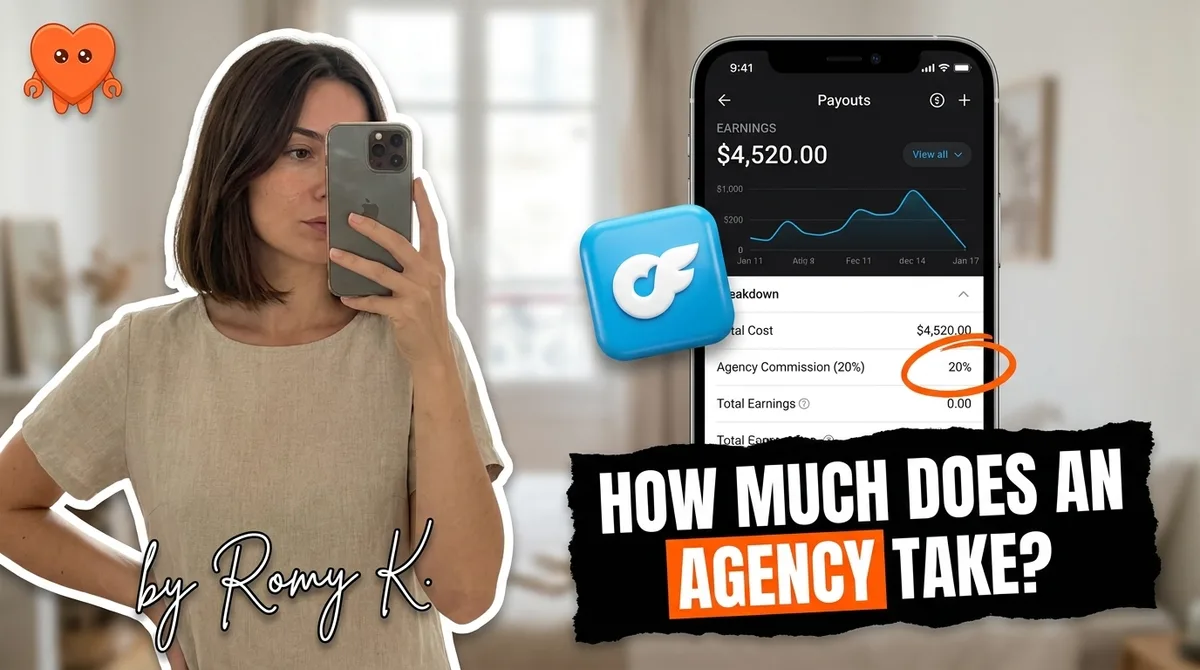
Most OnlyFans agencies take between 20 and 50 percent of your revenue, with the market settling around 30 to 40 percent as the standard range. That comes on top of the 20 percent OnlyFans already keeps, which means at a typical 35 percent agency rate you are handing over more than half of every dollar a fan pays before you see a cent. This article breaks down what each commission tier includes, how the math actually works on gross versus net, and where the hidden costs appear that most contracts bury in the fine print.
The commission tiers: what you pay and what you should get
Not all agency percentages are equal. The figure in your contract means nothing without understanding what it buys. Here is how the market breaks down in 2026.
Budget tier: 15 to 25 percent
Agencies at this level are usually newer, smaller, or competing on price. What you get varies widely. Some offer a basic chatter covering peak hours and a monthly call. Others deliver little more than message templates and an account manager who responds slowly. At this range, expect limited strategic input, no paid acquisition, and offshore chatters with inconsistent voice quality.
The low cut sounds attractive. The real cost shows up in plateaued revenue, because no one is running a strategy for you.
Standard tier: 25 to 40 percent
This is where most agencies operate, and where the 30 to 35 percent contracts live. At the lower end of this range (25 to 30 percent), you should receive dedicated chatters with reasonable coverage hours, a basic posting calendar, and periodic revenue reviews. At the upper end (35 to 40 percent), the expectation is full-time coverage, active PPV strategy, and some paid promotion.
Whether you actually receive that depends on the individual agency. The standard tier is also where the biggest gap exists between what is promised and what is delivered. Ask for references from current clients at similar revenue levels before signing.
Premium tier: 40 to 50 percent
Premium agencies typically offer 24/7 chatter coverage, dedicated account managers, content production support, paid traffic, and a strategy team with real data behind it. For creators doing seven figures annually, these agencies can justify their cut. For anyone under $20,000 per month, the math rarely works in your favor.
Exploitative tier: 50 percent and above
Any contract asking for more than half your gross revenue is a red flag without an extraordinarily clear justification. Fifty percent of gross, after OnlyFans' own 20 percent, means the creator keeps 40 cents of every dollar a fan spends. This structure exists primarily in contracts signed under pressure, often at the start of a creator's career when she does not know what is standard.
Gross versus net: the math that matters
The percentage in your contract is only half the story. The other half is the base it is applied to.
Gross commission is calculated on the full amount a fan pays. If a fan pays $100, the agency takes their percentage of $100, and then OnlyFans takes its 20 percent of $100. The creator pays two cuts on the same dollar.
Net commission is calculated after the platform fee. The agency takes their percentage of what remains after OnlyFans' cut. The creator is only paying the agency on money that could actually reach her.
Here is what that looks like on a $100 fan payment:
| Structure | Agency takes | OnlyFans takes | You keep |
|---|---|---|---|
| 35% on gross | $35 | $20 | $45 |
| 35% on net | $28 | $20 | $52 |
The difference is $7 on every $100, every month, forever. On a $10,000 per month account that is $700 a month, decided by a single clause in your contract. If the agreement is ambiguous about gross versus net, assume gross and negotiate from there.
See your real take-home with the free OnlyFans tax calculator.
The break-even question: how much extra do you need to earn?
The most important number agencies never show you is the break-even figure: how much more revenue you would need to generate with the agency compared to running your account solo, just to come out at the same take-home pay.
At a 35 percent agency commission on gross, your effective take-rate is 45 percent (80 percent after OnlyFans, minus 35 percent agency cut). Running solo, your effective take-rate is 80 percent. To earn the same net income with an agency as you would keep going solo, the agency would need to grow your gross revenue by roughly 78 percent (because 80 divided by 45 is about 1.78). A good agency can do that. Many cannot, and you carry the cut either way.
That is not impossible. A well-run agency with quality chatters and real paid acquisition can grow accounts meaningfully. But the question to ask is whether your specific agency is actually doing that, or whether the revenue growth you have seen is from your own audience, your own content, and your own consistency.
If the agency is running chatters and posting but you are generating the growth yourself, you are paying 35 percent for a task layer you could replace at a fraction of the cost. The OnlyFans without an agency guide walks through exactly what that setup looks like in practice.
Ask any agency for its 78 percent number in writing: how much it expects to grow your gross, and over what timeframe. A confident operator will give you a range. A vague answer tells you the cut is buying you a task layer, not growth.
Hidden and extra fees that do not show up in the percentage
The stated commission is rarely the full story. Agencies have learned to keep the headline number competitive and recover margin elsewhere. Common additions:
- Onboarding fees. A one-time setup charge, sometimes framed as a "profile audit" or "branding package." Ranges from a few hundred to several thousand dollars.
- Content production fees. If the agency provides photography, editing, or script writing, this is often billed separately from the commission. Some contracts include it; many do not.
- Ad spend pass-through. Paid promotion billed at cost plus a percentage markup. A $500 ad campaign may appear as $600 to $700 on your statement.
- Chatter overage fees. Some contracts include a base volume of messages per month and charge per message above that threshold. High-revenue months with heavy DM traffic can trigger meaningful extra costs.
- Transition and audit fees. Charged when you leave. Framed as covering the cost of account handover, reporting, or data export. This is also where agencies enforce their contractual leverage the most aggressively.
Read the full fee schedule, not just the commission rate. Ask specifically: what happens when I want to leave, what does that cost, and what data do you keep? If those questions are met with vague answers, treat it as a signal.
What you are actually paying for, and the alternative
When you sign with an agency at 35 percent, you are buying three things: chatters who reply to fans, a posting schedule, and someone to think about your strategy. Those are real services. The question is whether you need to pay a percentage of your revenue forever to get them.
Chatters are the largest line item in any agency's cost structure. An agency with twenty creators can spread chatter labor across accounts. The economies of scale benefit the agency, not the creator. You pay a percentage that scales with your success; their cost per creator is roughly flat.
The alternative that has emerged in 2026 is running the same work on your own machine. Software today can handle fan DM replies, follow-ups, PPV sends, posting, and acquisition without you sitting at a keyboard for sixteen hours. The key difference from tools like Supercreator or Infloww is where the work happens. Tools that take your OnlyFans login and run your fan messages through their own systems (servers, proxies, or shared team sessions) expose you to the same credential risk as an agency, with less accountability. A local tool runs on your computer: your login never leaves your machine, your fan conversations stay private, and no one else has access to your account.
That is the gap FanClaw is built to fill: the full scope of what an agency does (DMs, posting, acquisition, pricing) running automatically on your own machine at a flat monthly cost. Instead of paying a percentage that grows every time your revenue grows, you pay a fixed amount regardless of how well your account performs. You can see exactly what that covers on the FanClaw pricing page.
The math is straightforward. At $5,000 per month with a 35 percent agency cut, you pay $1,750 per month to the agency. At $10,000 per month, you pay $3,500. The agency's revenue scales with yours. A flat-rate tool costs the same whether you earn $3,000 or $30,000, which means every dollar you grow past your break-even is a dollar you keep.
That is not an argument that agencies are never worth it. For creators who need hands-on coaching, creative production support, or paid acquisition expertise they genuinely cannot run themselves, the right agency at the right price can accelerate growth. The argument is to know exactly what you are paying, what you are getting, and whether the same output is available at a fixed cost that does not scale against you.
The agency economy built itself around creators who did not have a better option. That option now exists.
- q: "What does an OnlyFans management company actually do?" a: "A management company, often called an OFM agency, runs the parts of the business a creator hands off: chatting with fans, scheduling posts, promotion, and sometimes content planning. In return they take a cut on top of the platform's 20 percent, commonly 30 to 50 percent. Whether a management company is worth it depends on how much they genuinely add versus what a creator can now run herself with software from her own machine."
Frequently asked questions
Most agencies charge between 20 and 50 percent of your gross revenue, with the market settling in the 30 to 40 percent range. That comes on top of OnlyFans' own 20 percent cut, so at a 35 percent agency rate you are keeping less than half of every dollar a fan pays.
Thirty percent sits at the lower end of the standard tier and can be fair if the agency provides active chatters around the clock, a posting strategy, paid acquisition, and regular performance reporting. If you are doing your own content, your own strategy, and the chatter is offshore and low quality, 30 percent is still too much.
Gross commission is calculated on the full amount a fan pays before any deductions. Net commission is calculated after the platform's 20 percent fee. A 30 percent cut on gross leaves you 50 cents per dollar (you lose 20 to the platform and 30 to the agency); the same 30 percent cut on net leaves you 56 cents (the agency takes 30 percent of the 80 cents left after the platform). Always confirm which base your contract uses.
Yes. Many agency contracts include data-retention clauses that let them keep your subscriber contact records after you leave. Some also impose a 6 to 12 month non-compete that prevents you from working with a competing agency or signing directly. Read the termination clause before you sign anything.
Common add-ons include onboarding fees, content production fees, ad spend passed through at a markup, extra charges for chatter coverage above a certain message volume, and transition or audit fees when you leave. Some agencies bundle these into the percentage; others itemize them as separate line items.
Multiply what a fan pays by 0.80 to remove the platform cut, then multiply by one minus the agency percentage. At 35 percent agency commission on gross: a $100 fan payment leaves $80 after OnlyFans, and the agency takes $35 of the original $100, leaving you $45. That is a 55 percent total take-rate on every dollar.
Yes, with the right tools. Agencies bundle chatting, strategy, and posting into one service because doing each manually is exhausting. Software that runs on your own machine can handle DM replies, scheduling, and acquisition automatically, at a flat monthly cost instead of a percentage of everything you earn.
The math favors leaving at almost any level, because the agency's cut scales with your revenue while your costs for running it yourself do not. At $5,000 per month with a 35 percent agency cut you are paying $1,750 per month. Flat-rate automation tools cost a small fraction of that, and the gap widens every month you grow.