OnlyFans creator burnout: how to run solo
Burnout is the number one reason creators quit OnlyFans. Here is how to run your account solo without 16 hour days, and what to hand off first.
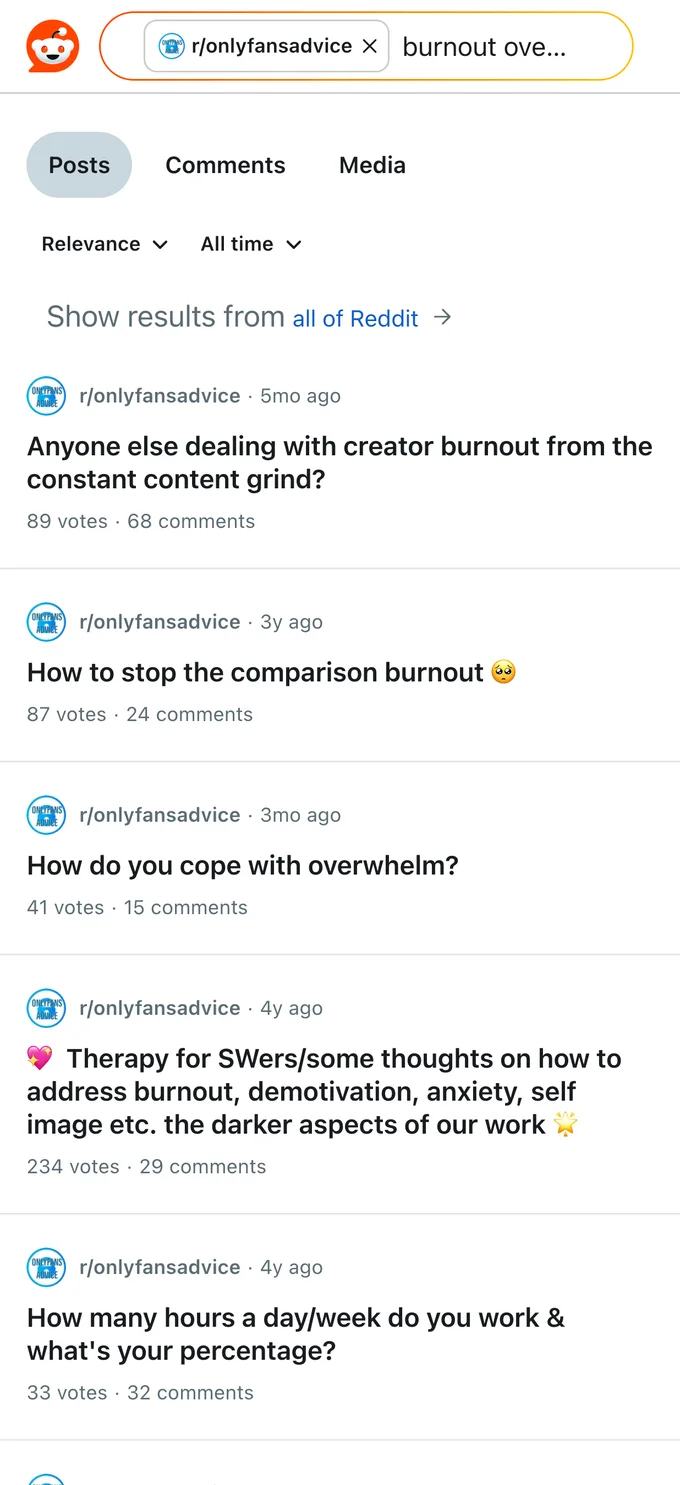
Burnout is the number one reason creators quit OnlyFans. Not poor results, not low subscribers, not bad content. The hours. It is not just an OnlyFans problem either: in one industry survey, more than half of creators (52 percent) said they had experienced burnout as a direct result of their career, and 37 percent had considered leaving the profession over it. Waking up to 200 unread DMs, filming all afternoon, and answering fans until 2am is not a pace anyone sustains for long. The good news is that you do not have to choose between your income and your sanity. Most of the work that is draining you can run without you in the room.
This is the honest version of how to manage OnlyFans solo: what is actually eating your time, what to hand off first, and how to set boundaries that hold without costing you revenue.
Why running OnlyFans solo burns people out
The math sounds simple: build a subscriber base, post good content, reply to fans, earn. The reality is a different calculation entirely.
A full-time solo creator typically manages the inbox first thing every morning, sometimes before she is out of bed. By the time she has cleared the overnight messages, it is late morning and filming has not started. She films. She edits. She schedules posts. She checks back on DMs. She handles PPV follow-ups, re-engages fans who went quiet, answers custom requests, and then stays up to catch the late-night crowd. Sixteen to eighteen hour days are the norm, not the exception.
Within two to three months of that pace, the burnout is physical. The inbox that once felt like opportunity starts to feel like a sentence. Filming stops being creative and becomes transactional. Some creators start avoiding the app entirely, which accelerates the problem: a slow inbox costs money, which creates anxiety, which makes opening the app worse.
The trap has a specific shape. Creating content and responding to fans are both full-time jobs. When one person tries to do both at full intensity, neither gets done well, and both feel terrible.
The create-versus-respond trap
Most creators start because they enjoy making content. The audience grows, the inbox fills, and the math shifts: responding to fans becomes the higher-revenue activity per hour. So she spends more time in DMs and less time filming. The content quality drops. New subscriber growth slows. The existing fan base asks for more custom work. The inbox gets heavier. The trap closes.
The only way out is to stop treating DM response as something that requires constant manual attention. It does not. The inbox needs coverage, not presence.
The math nobody tells you
Every hour you are offline, fans in other time zones are awake. That matters because DMs are the single biggest revenue lever on OnlyFans. A custom request that sits for eight hours often goes cold. A new subscriber who does not get a welcome message in the first few minutes is already cooling off. A fan who sent a message yesterday and heard nothing has probably moved on.
Solo creators feel this acutely. They cannot log off without the sense that they are leaving money on the table, because they often are. The anxiety is not irrational. It is a predictable response to a real structural problem.
The solution is not to be awake for more hours. It is to have your account active when you are not. A welcome message that fires the moment someone subscribes, a follow-up that lands a few hours later, a re-engagement nudge to anyone who has been quiet for a week: these are not replacements for genuine fan relationships. They are the infrastructure that keeps the relationship alive between your real interactions.
When those flows are in place, going offline for eight hours does not mean eight hours of lost revenue. It means eight hours of coverage, with you reviewing what happened when you come back.
What to hand off first
Not all tasks carry the same risk, and not all tasks require the same level of your judgment. The highest-leverage, lowest-risk work to automate is the repetitive, time-sensitive communication that follows a predictable pattern every single time.
Welcome messages and new subscriber flows
Every new subscriber is at their most engaged in the first few minutes. A warm, personal welcome that arrives immediately, in your voice, with a natural next step converts better than the same message arriving three hours later. You write it once. It runs every time someone new subscribes, whether you are filming, sleeping, or offline for the weekend.
Follow-up sequences
Most sales happen after the first message. A single timed follow-up to anyone who opened but did not buy recovers a meaningful share of conversations that would otherwise die quietly. Set it once. Let it run.
Re-engagement for quiet fans
Fans who have gone silent for a week or two rarely come back on their own. A scheduled, on-voice nudge brings a measurable number of them back without you manually tracking who has been quiet or when to reach out. The message should sound like you checking in, not a mass blast.
These three flows handle the work that currently takes up your mornings and your late nights. For a deeper look at how to set them up without getting flagged, see how to automate your OnlyFans DMs.
Scheduling and posting
Content creation and content publishing are two separate jobs. Filming on demand, editing immediately, and posting the same day keeps you in a permanent reactive loop. Batching changes that entirely: film two or three days of content in one dedicated session, edit and queue it all, and let it publish on schedule while you focus on something else. This is standard practice among creators who stay in the business for years.
A reusable tip menu removes one daily decision: build it once, paste it forever.
Boundaries that actually hold
Telling a creator to "set boundaries" is easy advice. The harder question is how to set boundaries that do not immediately cost you revenue, because for a solo creator, being offline usually means earning less. The answer is to decouple your presence from your account's activity.
Define your real working hours
Pick the hours when you are genuinely good at fan interaction, creative, and present. Those are your actual working hours. Outside them, your account should still be active, but through automation that covers the inbox in your voice while you are away. The key distinction is between your account being live and you being available. Both can be true at different times.
Batch content in dedicated sessions
Instead of filming whenever inspiration strikes or a fan asks for something, schedule two or three content sessions per week. Everything else, including fan interaction, goes in a different part of the day. The two jobs stop competing for the same mental space.
Let an agent cover the hours you are away, with your approval on what matters
The model that actually works for long-term solo creators is not full manual control and not fully delegated automation. It is a middle path: an agent on your own machine handles the high-volume, repetitive work, and you review and approve anything that involves real money, a sensitive conversation, or a decision that needs your judgment.
This is what it means for FanClaw to run locally. The work happens on your machine, your fan data never leaves it, and you stay in the loop on what matters without staying in the inbox for sixteen hours. You approve the decisions. You keep the margin. Download FanClaw and run the first week free to see how that split actually feels in practice.
The critical difference from a chatting service is who holds your login. Every major competitor, including Supercreator and Infloww, takes your login and acts as you through their own systems (servers, proxies, or shared team sessions). That means a company you have never met can read your fan conversations and access your account. Automation on your own machine removes that exposure entirely.
Signs you are already burning out, and a recovery plan
Burnout does not announce itself. It arrives gradually, and most creators rationalize the early signs as a temporary busy period.
The warning signs to watch for:
- Dreading the inbox. If opening OnlyFans produces anxiety before you even see what is waiting, the volume has exceeded what you can sustainably manage.
- Filming feeling like a chore. When content creation stops being the part you enjoy and starts being another obligation, creative quality follows downhill quickly.
- Replying out of obligation. Responding to fans because you have to rather than because you want to is a reliable signal that the emotional load is past a sustainable level.
- Inability to take time off. If the idea of a full day away from the app feels financially impossible, you have a structural problem, not a willpower problem.
- Physical symptoms. Disrupted sleep, persistent fatigue, and the sense of being always partially at work are late-stage signals. By this point the burnout is already affecting your output.
If you recognize yourself in several of these, the recovery plan is straightforward, even if it is not easy.
Take a real break first. A few days offline will not end your account. Fans who care will still be there. Then, before you return at full pace, audit where your hours actually go. Most creators find that DMs and manual follow-ups account for sixty to eighty percent of their working time. Set up the three core flows described above. Define your working hours and put them somewhere visible. Batch your next content session instead of filming on demand.
Then return at a pace you can hold for six months, not the pace you held for the first six weeks.
Running a successful OnlyFans account solo is genuinely possible. Thousands of creators do it without agencies, without chatters, and without burning out. The difference is not talent or content quality. It is structure: knowing what to hand off, setting up the infrastructure that makes your account active even when you are not, and reserving your real presence for the work that actually requires it.
Frequently asked questions
Most solo creators who manage everything by hand hit serious burnout within two to three months of going full-time. The cycle is predictable: strong start, then 16 to 18 hour days catch up fast. The warning signs show up before you fully crash, which is why recognizing them early matters.
Yes, but not by doing everything manually. The creators who sustain it long-term use some form of inbox automation for welcome messages, follow-ups, and re-engagement, and they batch their content so filming and scheduling are separate from responding. The key is handing off the repetitive, time-sensitive work so your energy goes where it actually matters.
Start with the welcome message to every new subscriber, a same-day follow-up to anyone who did not engage, and re-engagement nudges to fans who have gone quiet. These three flows handle the highest-volume, most time-sensitive work and are the lowest risk to automate because they follow patterns you define in your own voice.
Not if you do it right. Automation that uses your real wording, your timing patterns, and your emoji style does not read as a bot. What kills the personal feel is generic, instant, off-voice replies. When automation sounds like you on a good day, most fans cannot tell the difference, and many appreciate faster responses.
Yes. With a welcome flow, follow-up sequence, and re-engagement messages running automatically, your account continues converting while you are away. Fans in other time zones still get timely replies. The key is setting up those flows once, on your own machine so your data stays with you, and then letting them run.
The clearest signs are dreading opening the inbox, filming feeling like a chore rather than a creative act, replying to fans out of obligation rather than engagement, and feeling like you cannot take even a few hours off without your revenue dropping. Physical exhaustion, resentment toward fans, and the urge to just quit are late-stage signals that the situation has been unsustainable for a while.
An agency or chatter solves the hours problem but creates new ones: you hand over your login, your fan conversations, and often 30 to 50 percent of your revenue. Some creators find the trade-off worth it short-term, but most who leave agencies regret the margin they gave away. Automation that runs on your own machine is a middle path: the hours come back without handing your credentials to a stranger.
Take a genuine break first, even a few days. Then audit where your hours actually go: most creators find DMs and manual follow-ups account for 60 to 80 percent of their time. Set up the three core automation flows before you return, define clear offline hours, and start batching content into dedicated sessions rather than filming on demand. Slow the pace before you rebuild it.