

How many hours do OnlyFans creators work? (2026)
How many hours OnlyFans creators really work in 2026, by stage: a weekly time breakdown, why DMs eat the most time, where to cut hours, and burnout signs.
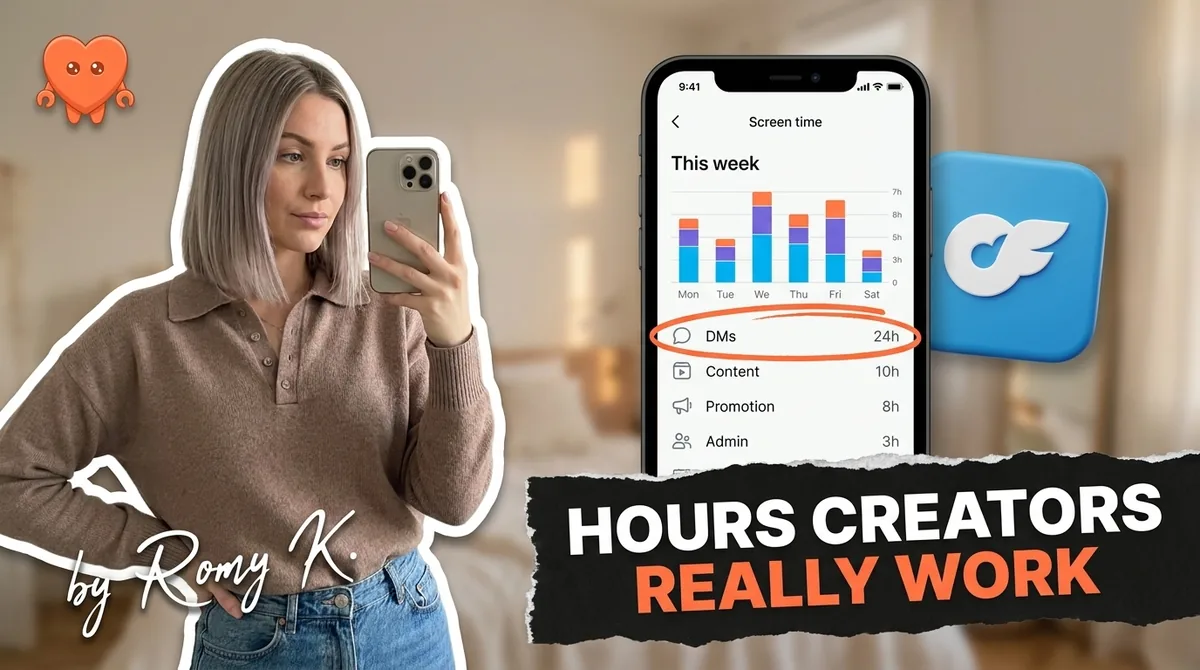
OnlyFans creators work anywhere from a few hours to 70 hours a week, depending on their stage. Beginners typically report 15 to 25 hours, part-time creators a similar range, and a full-time solo creator doing everything by hand commonly reports 45 to 70 hours. For the full-time creator, the biggest single block is not filming. It is DMs, often 20 to 30 hours a week.
Those numbers surprise people on both sides. Outsiders assume the work is a few photos a day. New creators assume the work is mostly content. The real week is dominated by promotion early on and by the inbox later. Below is a realistic breakdown by stage, where the hours go, whether OnlyFans is a full-time job, where you can cut time, and the signals that the hours are costing you more than they earn.
OnlyFans does not publish creator working hours, and no large survey tracks them for OnlyFans specifically. The ranges below are typical ranges creators report for their own weeks. Use them to benchmark your week, not as official statistics.
How many hours a week do OnlyFans creators work?
Most creators fall into one of four stages, and each has a different weekly load. A beginner spends roughly 15 to 25 hours, mostly on promotion. A part-time creator with steady income spends about 17 to 30. A full-time solo creator running everything by hand spends 45 to 70. An agency-managed creator spends fewer hours, but pays for it in margin and control.
| Stage | Who it describes | Typical weekly hours | Where most time goes |
|---|---|---|---|
| Beginner | First months, small subscriber base | 15 to 25 | Promotion |
| Part-time | Steady side income, another job or studies | 17 to 30 | Promotion and DMs |
| Full-time solo, by hand | Main income, no agency, no automation | 45 to 70 | DMs |
| Agency-managed | Chatters and promo handled by an agency | 11 to 25 | Filming to content quotas |
Launch weeks, holidays and big PPV drops push any of these higher. Solo creators describe 16 to 18 hour days in their first full-time months, which is exactly the pace that leads to burnout within two to three months.
Where the hours go: a weekly time breakdown
A creator's week splits into six jobs: content production, editing, posting, promotion, DMs and admin. Early on, promotion takes the largest share because there are few fans to talk to. As the page grows, DMs overtake everything else, because each new subscriber adds messages that need a timely, personal reply.
| Task (hours per week) | Beginner | Part-time | Full-time solo, by hand | Agency-managed |
|---|---|---|---|---|
| Content production (filming, shooting) | 3 to 5 | 4 to 6 | 6 to 8 | 8 to 12 |
| Editing and captioning | 2 to 3 | 2 to 4 | 4 to 7 | 0 to 3 |
| Posting and scheduling | 1 to 2 | 1 to 2 | 7 to 10 | 0 to 1 |
| Promotion (Reddit, X, Instagram, TikTok) | 6 to 9 | 4 to 6 | 7 to 10 | 1 to 3 |
| DMs (welcomes, PPV, customs, follow-ups) | 2 to 4 | 5 to 10 | 20 to 30 | 0 to 3 |
| Admin (analytics, payouts, taxes, planning) | 1 to 2 | 1 to 2 | 3 to 5 | 2 to 3 |
| Total | ~15 to 25 | ~17 to 30 | ~47 to 70 | ~11 to 25 |
Why DMs become the biggest block
DMs are the single biggest revenue lever on OnlyFans, and they do not batch. A growing account can wake to 200 or more unread messages. New subscribers are warmest in their first minutes, and a $50 custom that sits for eight hours often goes cold. So the inbox pulls a creator back all day and into the night, when fans in other time zones are spending. Most of those 20 to 30 hours are not deep conversations. They are the same welcome, the same follow-up and the same check-in, typed again and again.
Why posting balloons for full-time creators
Posting looks small on a beginner's week and large on a full-time one for a simple reason: volume and platforms. A full-time creator usually runs a paid feed, mass messages and PPV drops on OnlyFans, often a second platform like Fansly, and teasers on several traffic platforms. Posting live, one piece at a time, across all of that is where 7 to 10 hours go.
What agency-managed creators still do
An agency takes over chatting and most promotion, which is why the DM and promotion rows shrink. What does not shrink is filming. Agencies typically ask for steady content volume, so production often rises. The trade is fewer hours for a 30 to 50 percent cut of revenue, on top of the platform's 20 percent, and your login and fan messages in someone else's hands.
Is OnlyFans a full-time job?
OnlyFans is a full-time job for a minority of creators and a part-time income for most. Income is spread unevenly, and hours alone do not decide where you land. Treat it as full-time only when your earnings are steady for several months and your weekly hours are something you could hold for a year.
The numbers point the same way. A fall 2025 survey of more than 550 adult creators in the US and UK, reported by JRL Charts, found a median annual income of about $30,000 and an average of about $58,700, with creators of five years or more averaging around $111,000 and new creators around $16,000. And OnlyFans' own fiscal 2025 figures, covered by Variety, counted about 5 million creator accounts, of which roughly 2.5 million were active. Many accounts are side projects or dormant.
More hours do not automatically mean more money either. In Linktree's creator survey of 9,500 creators across the creator economy, 52 percent of those earning $50,000 to $100,000 spent fewer than 10 hours a week creating content, while 32 percent of those earning up to $10,000 spent more than 10. The data is from 2022 and not specific to OnlyFans, but the lesson holds: the creators who earn more are not always the ones working longer.
The creators who last are not the ones working the most hours. They are the ones whose hours go to the work only they can do.
For a deeper look at what creators earn by tier, see our OnlyFans average income breakdown.
What an OnlyFans creator schedule looks like at each stage
A workable schedule has two layers at every stage: a short daily loop and a few weekly blocks. What changes between stages is what fills them. Beginners spend the daily loop on promotion. Full-time creators spend it on the inbox. In both cases, filming and editing should live in weekly blocks, not in every day.
Beginner and part-time schedule
- Daily (1.5 to 3 hours): one or two promotion tasks (a Reddit post, X replies, a short video), a quick inbox check, one scheduled post confirmed.
- Weekly: one filming session of two to four hours, one editing and scheduling session, 30 minutes reviewing which promotion sent subscribers.
- Rule: pick a schedule you can hold for three months. Consistency is what the platforms reward and what your first fans notice.
Full-time solo schedule, by hand
- Morning (1.5 to 2 hours): clearing overnight DMs, custom requests and PPV follow-ups.
- Afternoon (3 to 5 hours): filming or editing, posting, promotion.
- Evening and night (1.5 to 2.5 hours): back in the inbox for the late crowd and other time zones.
- Weekly: admin, payouts, planning, and whatever did not fit.
This is the schedule that turns into 16 hour days, because the inbox has no natural end.
Agency-managed schedule
- Weekly filming blocks sized to the agency's content requests.
- Short check-ins on content plans and performance.
- Little or no inbox time, because chatters answer as you.
Fewer hours, but less control over what fans hear in your name.
Where can OnlyFans creators cut hours?
The biggest time savings come from three moves: batching content, queuing posts, and covering the routine inbox with flows in your own words. Together they can pull a full-time solo week from 45 to 70 hours toward 15 to 25 hours of real work, without handing your account to an agency.
- Batch production. Film a week or two of content in one session and edit it all in a second. Filming and posting stop being daily tasks.
- Queue posts in advance. Schedule feed posts and plan PPV drops at the start of the week. The 7 to 10 hours of live posting becomes one or two.
- Cover routine DMs with flows. A welcome for every new subscriber, a same-day follow-up for anyone who opened but did not buy, and a re-engagement nudge for fans who went quiet. Write them once, in your own wording.
- Keep yourself on the money conversations. Customs, big spenders and upset fans get your attention. Everything else runs on the flows. This is where most of the 20 to 30 DM hours come back.
- Cut promotion that does not convert. Track new subscribers and first month spend per channel, then drop the channel that sends nothing after a fair test.
- Batch admin. One weekly session for analytics and payouts, one monthly session for taxes and records.
The inbox step is where the tool you choose matters. Most chatting tools that rank today (Supercreator, Infloww and the rest) take your OnlyFans login and read your fan messages through their own systems (servers, proxies, or shared team sessions). FanClaw takes the opposite approach. It is a local-first app that runs a creator's DMs, posting, acquisition and monetization from her own machine, text-only, drafting in her editorial style while she approves what involves money. Your login and fan data never leave your laptop. You can download FanClaw and see how much of your DM block comes back during the 7-day free trial.
Burnout signals: when your hours are telling you something
Burnout is the number one reason creators quit, and long hours are the most common path to it. The problem is rarely one hard week. It is a schedule with no off switch, repeated until your body and your fan relationships start to show it.
It is not only an OnlyFans pattern. In a 2025 survey of 1,000 creators in the US and UK, 52 percent said they had experienced burnout as a direct result of their career, and 37 percent had considered leaving.
Watch for these signals:
- Dreading the inbox before you have even opened it.
- Filming feels like a chore instead of the part you enjoy.
- Replying out of obligation, with shorter and flatter messages.
- No day off feels possible, because every offline hour feels like lost money.
- Sleep and energy slipping, or resentment toward fans who are simply messaging.
If several apply, count your hours for one normal week using the six categories above. Most creators find the inbox is the block that grew without anyone deciding it should. For a full recovery plan and the boundaries that hold, read our guide to OnlyFans creator burnout. The goal is not a heroic 70 hour week. It is a week you could run for years.
Frequently asked questions
It ranges widely. A beginner or part-time creator often works two to four hours a day, while a full-time solo creator doing everything by hand commonly reports 7 to 10 hours a day, with 16 to 18 hour days during launches or busy weeks. Most of the extra time goes to answering DMs, not making content.
For some creators, yes, but for most it is part-time income. A fall 2025 survey of more than 550 adult creators in the US and UK put median annual income around $30,000, with experienced creators earning far more than new ones. Treat it as a full-time job only once income is steady for several months and your hours are under control.
For growing and full-time creators, direct messages. Welcomes, follow-ups, PPV conversations, custom requests and re-engagement add up to 20 to 30 hours a week when done by hand. Beginners spend proportionally more time on promotion, because they have few fans to message yet.
Around 15 to 25 hours a week is a realistic starting range, with the largest share on promotion (Reddit, X, Instagram, TikTok) rather than production. Keep a fixed schedule you can hold for three months. A consistent 15 hours beats a 40 hour first week followed by silence.
Usually on DMs and promotion, yes, because chatters and the agency's team take over those. But creators often still spend 11 to 25 hours a week, most of it filming to the agency's content quotas, and they pay 30 to 50 percent of revenue on top of the platform's 20 percent. They also hand over their login and their fans' messages.
Batch content into one or two sessions a week, queue posts in advance, and cover routine DMs with welcome, follow-up and re-engagement flows written in your own words. Keep yourself on the money conversations only. Creators who do this report pulling a full-time week toward 15 to 25 hours of real work.
A sustainable schedule has a daily loop of one to three hours (inbox review, one post, one promotion task) and weekly blocks for filming, editing and planning. The key is that filming and posting are not daily tasks. They happen in batches, and the daily work is mostly review.
Watch for dreading the inbox, filming that feels like a chore, replying to fans out of obligation, and feeling unable to take a single day off without losing money. Disrupted sleep and resentment toward fans are later signs. If several apply, the workload is structural, not a willpower problem.