Should i chat my own OnlyFans? an honest take
Should you chat your own OnlyFans? Keep your voice and your fan relationships. When to self-chat, why it pays, and how to cover the inbox without a stranger.
The reason a fan pays you month after month is simple: he thinks you are the one typing. "She actually talks to me" is the whole product. So should you chat your own OnlyFans? Yes. The voice and the relationships should stay yours. The catch is that the inbox never sleeps and you do, and messaging drives roughly half of creator income, so "just answer everything myself" quietly stops working the moment you grow. The real question is not self versus outsource. It is how to keep your voice while covering the hours you cannot.
This guide covers whether creators really chat their own pages, why doing it yourself pays more than handing it off, what fans can actually tell, the time math that breaks solo creators, and the third option that protects both your voice and your nights.
Should you chat your own OnlyFans? The short answer
Chat your own OnlyFans as long as you can. The personal connection is what fans pay for, and it is the single hardest thing to fake well. Hand off the inbox only when volume forces you to, and even then, protect your voice and your fan data. The mistake is not getting help. The mistake is outsourcing the relationship itself to someone your fans will never know exists.
At a small page, this is not even a debate. Under a few hundred subscribers, answering your own DMs is easy enough and it is your edge. You remember names. You catch the regular who tips when you ask about his week. That memory is worth more than any script.
The decision gets real later, around the point where the inbox becomes a second full-time job. Most creators hit two bad defaults there. They grind themselves into burnout doing every message by hand, or they rent their voice to an agency that signs in as them. There is a third path, and it is the point of this whole piece.
Do creators actually chat their own OnlyFans?
Some do, many do not, and it depends almost entirely on size. Creators under a few hundred subscribers usually answer their own messages because the volume is manageable and the personal touch is the product. Many mid-size and large creators hand the inbox to chatters who work in shifts and often cover three or four accounts at once. No rule forces them to tell fans, so you usually cannot be sure who is typing.
The scale of the outsourcing surprises most people. Reporting by Vice has shown agency chatters working eight-hour shifts, each assigned several creator inboxes at a time, with one worker describing being handed as many as seven accounts at once. The warm midnight message a fan reads may come from a shift worker with notes on four different women open in other tabs. That is the part of the business kept out of view, and it is worth understanding before you decide where you stand. If you want the full breakdown, here is what an OnlyFans chatter is and what one actually costs.
Here is the honest comparison of your three real options:
| Approach | Chat it all yourself | Hire a chatter or agency | On-device automation in your voice |
|---|---|---|---|
| Authenticity | Fully you | A stranger posing as you | Your wording, learned from your own messages |
| Coverage | Only your waking hours | Around the clock, in shifts | Runs while you sleep or film |
| Cost | Your time and your sleep | 30 to 40 percent of gross, on top of the 20 percent platform fee | A flat app cost, no revenue cut |
| Who reads your fans | Only you | Rotating shift workers, on their servers | No one but you, data stays on your machine |
| Your login | Stays with you | Handed to the agency | Never leaves your laptop |
Most advice frames this as the first two columns only: burn out or pay a cut. The third column is the one nobody selling you a service mentions.
Why chatting your own OnlyFans makes more money
Because the DMs are where the money is, and because authentic chat converts better than a copy-paste blast. Messaging drives roughly half of creator income by most 2026 estimates, and 60 to 80 percent for top earners. The reason fans spend there at all is the feeling of a real connection, so anything that erodes that feeling erodes your pricing power directly.
The economics reward knowing your fans. By common industry estimates, roughly 17 percent of the fans who chat drive about 70 percent of messaging revenue, and the bulk of a fan's first spending lands within the first 48 hours of a real conversation. The creator who actually reads her own inbox prices and times a pay-per-view far better than a shift worker who met that fan an hour ago and gets handed a different account at the end of the day.
Two things you do for free that a chatter cannot:
- You remember. "How did the move go" lands because you were there for the first message. Continuity is the difference between a relationship and a transaction.
- You read the room. You feel when a fan is warming up to a custom and when he is annoyed by another offer. That read is the entire skill, and it does not transfer well to a rotating team.
Picture two creators with the same 300 fans. One knows that the guy who tips on Fridays just got back from a deployment and that another regular collects a specific kind of custom. She times one well-judged offer and it lands. The other handed the inbox to a service that sends the same ladder to all 300 on a schedule. The first creator earns more from fewer sends because she is spending relationship capital she actually built. That capital is the asset, and it does not show up on any dashboard until it disappears.
This is why so many creators who outsourced their inbox describe revenue going flat or fans going cold. The hours got covered. The connection that made the hours valuable did not.
Can fans tell when you're not the one replying?
Increasingly, yes, and the detection gets better every year. Fans cannot be certain who is typing, but they have learned the patterns, and they swap them openly in communities. The common tells:
- Replies that forget something you said an hour ago.
- Identical lines that obviously went out to everyone.
- A constant, slightly impatient push toward the next unlock.
- A tone that shifts between shifts, because a different person is at the keyboard.
The deeper a conversation goes, the more the cracks show. Fans report that 20 or 30 minutes in, a managed inbox starts to feel hollow, missing the memory and the small reactions a real person gives. Skeptical fans even run their own tests. A common one is asking for a quick, specific photo on the spot (touch your ear, hold up two fingers), something a script or a shift worker juggling other inboxes cannot produce on demand. When a fan realizes the "girlfriend experience" he paid for was a rotating team, he does not just stop spending. He feels deceived, and that story travels. The reputational cost of getting caught is the part the agency pitch leaves out.
This is not a fringe worry. Former chatters interviewed by Vice and Mel Magazine described the job plainly: build an intimate relationship with each fan, time the next unlock, and let him keep believing he is talking to the creator. Anti-exploitation groups now label the practice deception, and as of 2026 OnlyFans expects disclosure when replies are AI-generated. The gap between who a fan thinks he is paying and who is actually typing is the risk you inherit the day you hand off your voice.
This is the case for keeping your voice, not necessarily every keystroke. Fans are not testing whether you typed each word at 3am. They are testing whether the person on the other end is consistent, present, and actually you. That is a bar you can clear without chaining yourself to the inbox.
The catch: you can't be in the DMs 24/7
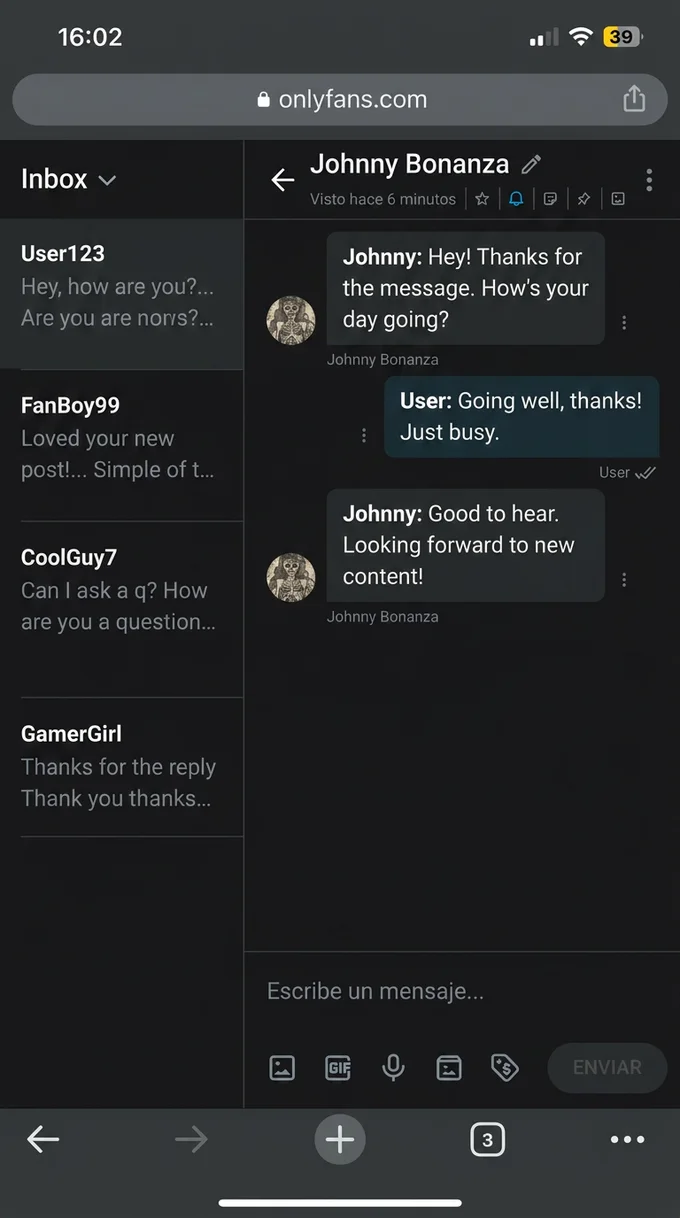
You cannot, and pretending otherwise is how solo creators burn out. The most profitable task on OnlyFans is also the least scalable one. A growing page can pile up 200 or more unread messages overnight while fans in other time zones are awake and ready to spend. A $50 custom that sits eight hours usually goes cold. Agencies openly say full coverage takes 16 hours a day or more of active chatting, which is exactly why they sell the service, and exactly why no one person can match it.
So the inbox forces a choice, and the usual escape hatches both have a price:
- Hire a chatter or agency. You buy coverage, but you give up 30 to 40 percent of your gross on top of the platform's own 20 percent cut, plus the authenticity risk above. Those chatters can also read your entire message history: the intimate photos, the personal details, everything a fan ever sent believing it was private. On a median income, that cut leaves almost nothing.
- Use a cloud chatting tool. It signs in as you from its own servers and reads every fan message. Handing your login to a third party is the credential-sharing pattern platforms watch for, and using outside chatters technically cuts against the terms. You traded the exact privacy and account safety you were trying to protect for time saved.
Burnout within two to three months is common enough to be the leading reason creators quit, often right before their promotion would have started compounding. The inbox is not a willpower problem. It is a coverage problem, and the two default solutions each cost you something you did not want to give up.
How to chat your own OnlyFans without doing it all yourself
Keep the relationship, automate the repetition, and do it on your own machine. That is the third column of the table, and it is what closes the gap between "stay authentic" and "stay sane." You write and approve the moments that matter. The routine welcomes, follow-ups, and re-engagement run in your own wording while you film or sleep.
This is what FanClaw is built for. FanClaw is a local-first app that runs a creator's DMs, posting, acquisition, and monetization from her own machine, text-only, with her fan data never leaving the device. Instead of a stranger logging in as you, an agent learns your editorial style, your openings, pacing, and emojis, and drafts replies that read like you, with you approving anything sensitive. "Voice" here means your editorial style, the way you actually type, never an audio voice.
It answers the three real costs at once:
- No outside human reads your fans. The work happens locally, so your messages never sit on an agency's servers and no shift worker scrolls your inbox.
- It writes like you, not a script. There is no rotating tone because there is no rotation. The voice is yours, learned from your own past messages.
- You keep your login and your margin. Nothing to hand over, and no 30 to 40 percent cut. The revenue your inbox generates stays yours.
For the mechanics of doing this safely, what the platform allows and what actually gets accounts flagged, see automate OnlyFans DMs without getting banned. When you are ready to keep your voice and reclaim your nights, you can download FanClaw and run a full first night on your own account before you commit to anything.
So, should you chat your own OnlyFans? Chat the relationship, always. Automate the repetition, on your own machine, in your own words. The fans who pay you for being real never have to meet anyone but you.
Frequently asked questions
Yes, for as long as you can. The personal connection is what fans pay for, and it is the hardest thing to fake well. Self-chatting is also free and gives you the best read on what your fans want to buy. Hand off the inbox only when volume forces you to, and even then, keep the voice and the relationships yours rather than renting them to a stranger.
Some do, many do not, and it depends mostly on size. Creators under a few hundred subscribers usually answer their own DMs. Many mid-size and large creators hand the inbox to chatters who work in shifts and often cover three or four accounts at once. There is no rule that forces a creator to disclose this, so a fan usually cannot tell for sure.
Messaging is the main revenue engine, not subscriptions. By most industry estimates, DMs (pay-per-view, tips, and customs) drive roughly half of creator income, and as much as 60 to 80 percent for top earners. That is exactly why the inbox is worth doing well, and why outsourcing it carelessly is so costly.
Increasingly, yes. The common tells are replies that forget what you said earlier, copy-paste lines that clearly went to everyone, a relentless push toward the next unlock, and a tone that shifts between shifts because a different person is typing. Fans trade these red flags in communities, and the resentment when they feel deceived spreads.
Using a chatter is not banned by itself, but the usual setup is risky. Staffing your inbox means handing your login to an agency so chatters can sign in as you from their own machines, and credential-sharing is the pattern platforms watch for. As of 2026, OnlyFans also expects disclosure when replies are AI-generated.
More than most people expect. A small page is manageable in under an hour a day, but covering the inbox the way an agency does means active chatting across most of the day, with agencies citing 16 hours or more to capture every time zone. A solo creator who also films, edits, and promotes simply cannot match that alone, which is the whole tension.
Both solve coverage, but they cost very different things. A chatter agency takes 30 to 40 percent of your gross and puts a stranger in your inbox. On-device automation drafts replies in your own wording, runs while you sleep, and keeps your data and login on your machine for a flat cost. If you want coverage without giving up your voice or your margin, automation is the lighter trade.
Yes. Automation that learns your editorial style, your wording, pacing, openings, and emojis, reads like you on a normal day, not like a script. The tell is not automation itself, it is automation that sounds robotic. Authored flows and an agent that drafts in your voice, with you approving anything sensitive, keep the inbox personal without you typing every line.