

Best OnlyFans agencies, ranked (2026)
The best OnlyFans agencies ranked by model and cost in 2026: full-service, boutique, and chatting-only, what fair commission looks like, plus the no-cut option.
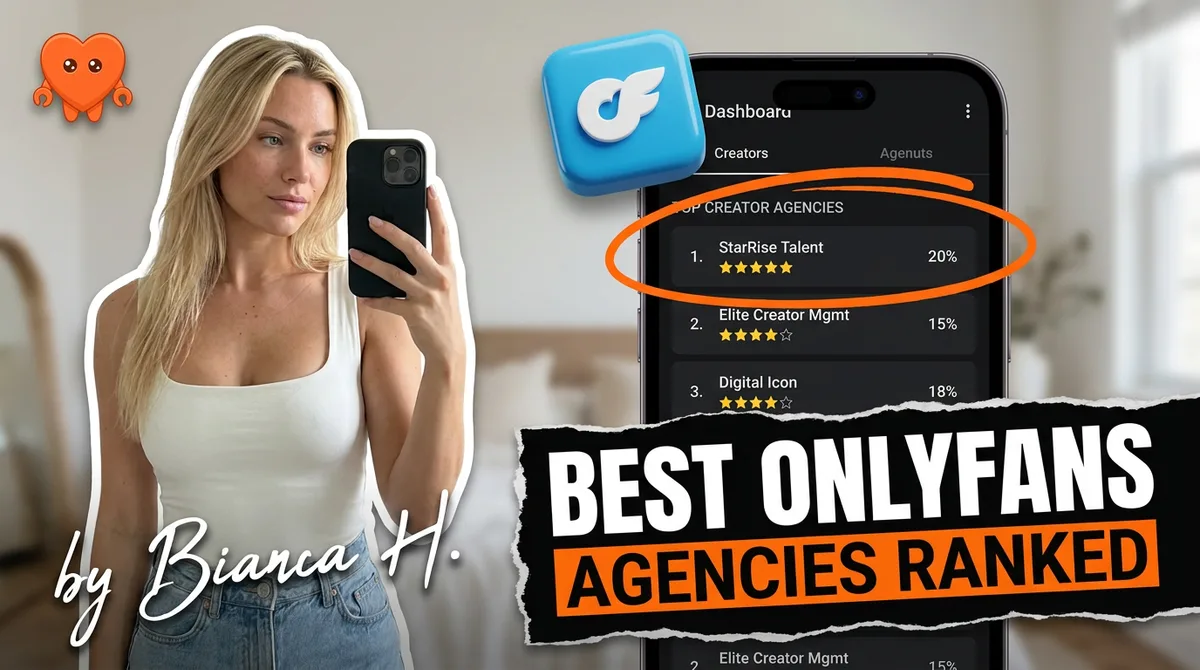
The best OnlyFans agency is not a brand name, it is a set of terms: a clear scope of work, month-to-month commitment, transparent communication, and a commission that leaves you with the majority of your earnings. Full-service management commonly takes 25 to 50 percent of your net, boutique agencies take 15 to 25 percent, and software replaces the cut entirely with a flat fee. The smartest move in 2026 is to rank agencies by what they deliver against what they take, then ask whether you need one at all.
This guide ranks agencies by model, shows what fair pricing looks like, flags the scams, and lays out the no-cut alternative honestly.
What the best OnlyFans agencies actually do
A good agency sells labor and expertise you do not have time for. The full-service ones handle five things, and understanding them tells you what you are really paying for.
- Chatting and DM sales. Answering fan messages, running pay-per-view offers, and closing customs. This is where most of an account's revenue is made, and it is the most labor-intensive task.
- Content scheduling. Planning and posting a consistent feed across platforms.
- Promotion and marketing. Driving new subscribers from Reddit, X, Instagram, and elsewhere.
- Pricing strategy. Setting subscription, PPV, and tip-menu prices to maximize take-home.
- Analytics. Tracking what works and adjusting.
Boutique agencies pick one of these, usually marketing or chatting, and go deep. The honest point most listicles skip: every one of these functions can now be handled by software you run yourself, which is why the "do I even need an agency" question is more open than it used to be.
It helps to know where the money actually comes from before you pay anyone a cut of it. On most accounts, the subscription price is a foot in the door, not the prize. The real revenue lives in the inbox: pay-per-view unlocks, tip-menu items, custom requests, and the slow re-engagement of fans who went quiet. A full-service agency justifies its cut by claiming it works that inbox harder than you can, around the clock, with trained chatters who know how to pace an offer instead of dumping a price on a cold fan. That is the genuine value when it exists. The problem is you usually cannot see whether it exists until after you have signed, because the chatting happens behind a login you handed over. When you evaluate an agency, ask exactly how the chatting is staffed, how many accounts each chatter covers at once, and whether the people answering your fans are writing in something close to your own voice or running a generic script across every creator on the roster. A chatter juggling fifteen inboxes is not building the kind of relationship that turns a $6 subscriber into a $200-a-month regular, and that gap is the difference between an agency that earns its share and one that just collects it.
OnlyFans agencies ranked by model
Rank by model first, because the model determines your cost, your control, and your risk far more than the logo does. Here is the landscape in one table.
| Model | Typical cost | What you get | Best for |
|---|---|---|---|
| Full-service management | 25 to 50% of net | Chatting, content, marketing, pricing, analytics | Creators who want hands-off and are already earning |
| Boutique / marketing-only | 15 to 25% of net | One focus area done well, usually growth | Creators who only need promotion or only need chatting |
| Chatting-only service | 10 to 30% of net or per-shift | DM sales coverage, often 24/7 | Established pages with high inbox volume |
| Software / self-managed | $50 to $300/month flat | Tools to do the work yourself, no revenue share | Creators who want to keep their margin and control |
The industry default for full management hovers around 50 percent of net, which after OnlyFans' own 20 percent platform commission leaves you keeping roughly 40 cents of every dollar a fan pays. That is the number to benchmark every offer against. A 30 to 35 percent cut for genuine full service is the fair end. Anything approaching 50 percent should come with exceptional, provable results.
What separates a good agency from a bad one
Once you have the model, judge the agency on how it treats you. The green flags are consistent across every reputable operation in 2026.
- Fair, transparent commission. You should keep the majority of your earnings, and the split should be stated plainly, with no hidden fees buried in the contract.
- Short or flexible terms. Trial periods, month-to-month deals, or performance-based agreements. Good agencies earn loyalty through results, not legal leverage.
- Personalized strategy. A real plan for your niche and audience, not a template applied to every creator on the roster.
- Open, regular communication. You know who manages your account, you can reach them, and they report honestly.
- A verifiable track record. Real creators who will vouch, not just screenshots that could belong to anyone.
The simplest test: a confident agency proves its value before it asks you to commit. One that leads with a long contract is protecting itself from its own performance.
How to vet an agency before you sign
Green flags are the theory. Here is the practical due-diligence I wish someone had handed me before my first contract. Run all of it before you give anyone access to your account.
- Ask for two current creator references and actually message them. Not screenshots, not a testimonial page. Real people you can reach on the platform. Ask them three questions: what split do you actually pay after every deduction, how fast does the agency respond when you raise a problem, and would you sign again. If the agency cannot or will not connect you, that is your answer.
- Read the deduction stack, not just the headline percentage. A "30 percent" agency that also bills "ad spend," "chatter fees," and a "platform tool subscription" on top can quietly land north of 50 percent. Make them write down, in numbers, what you take home on a hypothetical $10,000 month after every line item. If they dodge the arithmetic, walk.
- Demand the exit terms in writing first. Before niceties, ask: how do I leave, how much notice, who keeps the content I produced, and is there a non-compete or a clause that forfeits recent earnings. Coercive exit terms are the single most reliable marker of a bad actor, so read them before you read anything else.
- Pin down account access in concrete terms. Ask whether they need your raw login or operate through a tool, where they sign in from, and who on their team can read your fan messages. "We handle everything" is not an answer. A stranger reading every private conversation with your fans is a real exposure no matter how the access is dressed up.
- Start with the shortest term they offer and a defined success metric. A month-to-month trial with a number you both agree to measure (net revenue, new subscribers, response time) lets the results, not the contract, decide whether you stay. If they only sell long lock-ins, you have learned what they think of their own work.
Do this homework with three agencies side by side and the good one usually separates itself by the second question. The ones that flinch at references, refuse to do the math, or rush you past the exit clause are screening themselves out for you.
Agency red flags to walk away from
The agency space has a serious exploitation problem, and the patterns are predictable. Reporting by Rolling Stone documented creators whose managers took far larger cuts than promised, locked them out of their own accounts, and used coercive contract clauses to threaten anyone who tried to leave. Treat any of the following as a reason to stop the conversation.
Walk away if an agency asks for an upfront "setup fee," guarantees a specific income like "$10K a month," wants your password directly, has no verifiable track record, pushes a 24 to 36 month lock-in contract, describes its services vaguely, or pressures you to sign now. Scam agencies frequently take 40 to 60 percent while delivering nothing.
A legitimate agency does none of these. It charges a fair share of what it actually earns you, lets you leave, and never needs your raw login. If leaving feels designed to be hard, you are looking at the contract structure of a bad actor. For what that exit can involve, see our guide on how to leave an OnlyFans agency before you sign anything.
The no-cut alternative: self-management software
Here is the option the agency listicles rarely rank fairly, because it competes with them. You can get the core of what a full-service agency does, the chatting, the follow-ups, the posting, the pricing, from software you run yourself, for a flat fee instead of a quarter to a half of your income.
The math is stark. At a 35 percent agency cut you need roughly a 54 percent revenue increase just to break even versus going solo. Put real numbers on it. Say you net $5,000 a month solo after OnlyFans takes its share. Hand 35 percent to an agency and you keep $3,250 of that same $5,000, so the agency has to grow your net to about $7,700 just to put you back where you started. Everything above $7,700 is the only part that actually rewards you for giving up a third of your income, and everything below it means you are paying for the privilege of earning less. A flat-fee tool changes the equation entirely: it costs the same whether you make $2,000 or $20,000, so every dollar of growth stays yours and the break-even point arrives almost immediately. The catch with most software is the same risk the agencies carry: cloud chatting tools sign in as you from their own servers and read every fan message, so you trade a revenue cut for a security exposure.
This is the gap FanClaw is built for. It is a local-first app that runs your DMs, posting, acquisition, and monetization from your own machine, in your own voice, with your fan data never leaving your device. It does the repetitive agency work, the welcomes, follow-ups, pay-per-view offers, and scheduling, without taking a percentage and without holding your login. You keep the full margin and you keep control. You can download FanClaw and run a full week against your own account before deciding whether you need an agency at all.
How to decide
The honest decision framework comes down to three questions.
- Are you earning enough that a percentage cut is worth real, hands-off help? If a great agency can grow you more than 54 percent, the cut can pay for itself. If not, it is just a tax.
- Do you value time over margin, or margin over time? Be honest. An agency buys time and sells your margin. Software buys back time at a flat cost and keeps the margin.
- How much control and privacy do you need? Handing an agency or a cloud tool your account means a stranger reads your fan conversations. If that matters to you, the local route wins.
The best OnlyFans agency for a top earner who hates the inbox is a fair, month-to-month, full-service one. The best choice for everyone else is increasingly to keep the work in-house, on fair terms, and stop giving away a third of every dollar. For the full case on doing it yourself, here is running OnlyFans without an agency and exactly what it takes.
Frequently asked questions
There is no single best agency for everyone. The best one for you matches your stage and keeps you on fair terms: a clear scope of services, month-to-month or short trial terms, transparent communication, and a commission that leaves you with the majority of your earnings. Ranking agencies by model, full-service versus boutique versus chatting-only, matters more than any brand name.
Full-service management commonly takes 25 to 50 percent of net revenue, after OnlyFans' own 20 percent. The fair sweet spot is generally 30 to 35 percent for genuine full service. Boutique or marketing-only agencies charge 15 to 25 percent, and software-only options replace the cut with a flat monthly fee of roughly $50 to $300.
An agency is worth it only if the growth it creates exceeds the cut it takes. At a 35 percent cut you need roughly a 54 percent revenue increase just to break even versus going solo. A great agency can clear that bar; an average one cannot. Many creators do better keeping the margin and using software instead.
Legitimate agencies have a verifiable track record, transparent terms, no upfront fees, and reasonable commission. They offer trial periods or month-to-month deals and never ask for your password directly. Red flags are guaranteed earnings, 24 to 36 month lock-in contracts, vague service descriptions, and pushy sign-now tactics.
A full-service agency typically handles chatting and DM sales, content scheduling, promotion and marketing, pricing strategy, and analytics. Boutique agencies focus on one area, usually marketing or chatting. The value is the labor and expertise, but you can now get most of those functions from software you run yourself.
Reputable ones should never ask you to hand over your raw login. Many operate through tools that require account access, which is itself a risk. Any agency or service that wants your password and signs in from its own servers is a security exposure, because a third party then holds the keys to your income and reads every fan message.
It depends on whether you value the time savings more than the margin. An agency removes work but takes 25 to 50 percent and often locks you in. Doing it yourself keeps every dollar but costs hours. The middle path is self-management software that does the repetitive work for a flat fee while you keep control and margin.
Short. The best agencies offer trial periods, month-to-month terms, or performance-based agreements, earning loyalty through results. Treat any contract longer than a few months, and especially 24 to 36 month lock-ins with no performance clause, as a serious warning sign.