

Patreon vs OnlyFans: which is right for you?
Patreon vs OnlyFans for creators: fees, content rules, audience and payouts. Why the explicit-content policy usually decides it for you.
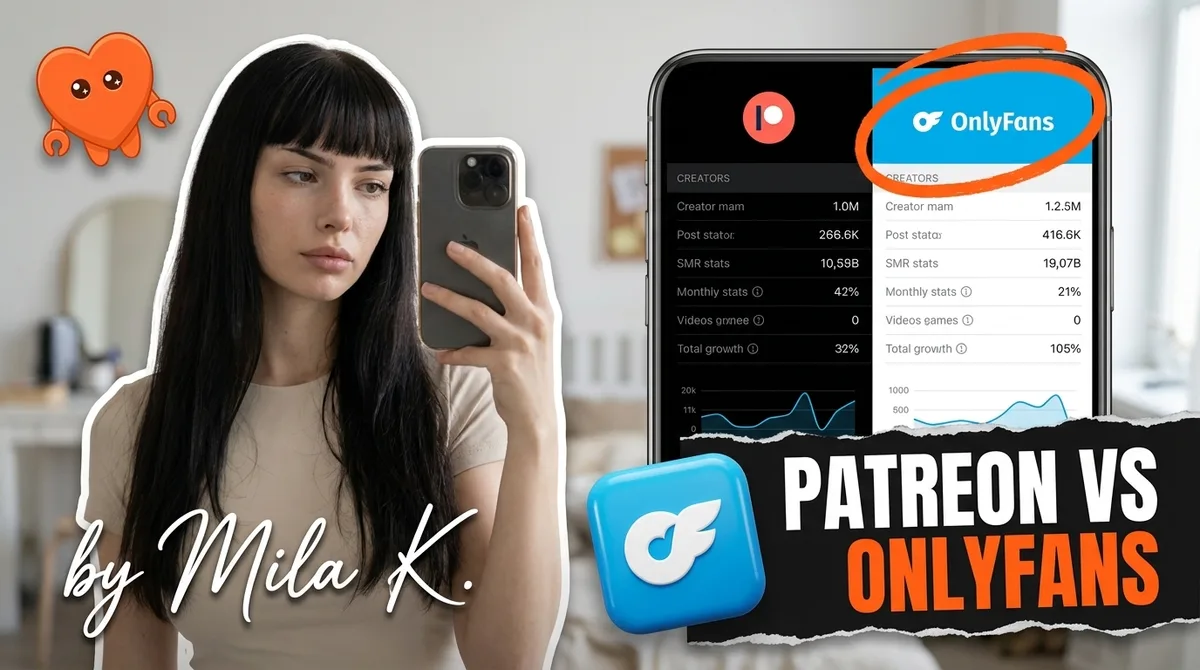
The short answer: Patreon and OnlyFans are built for different businesses. Patreon is a membership platform for SFW content creators, educators, podcasters, and artists who want recurring patron support. OnlyFans is a subscription-plus-PPV platform that grew specifically around adult content, where explicit material is the norm and the revenue mechanics are built for it. For adult creators, the content policy alone decides the question. For SFW creators, the fee structure and audience dynamics matter a lot more.
This comparison covers fees, content rules, payout speed, audience fit, and who belongs on each platform.
Fees compared: Patreon's tiered history vs OnlyFans' flat 20 percent
OnlyFans keeps its pricing simple. The platform takes 20 percent of everything: monthly subscriptions, PPV messages, tips, and custom content requests. Creators keep 80 percent with no tiers, no upgrades, and no surprises.
Patreon's fee structure changed significantly in August 2025. The platform moved to a single flat rate of 10 percent of creator earnings, replacing the old tiered plans (which ran from 5 percent at the low end up to 12 percent at the top). Creators who launched before August 4, 2025 keep their legacy rate as long as their page stays published. Payment processing adds approximately 2.9 percent plus a small per-transaction fee, so most active creators land between 12 and 14 percent total.
A practical comparison at $5,000 monthly revenue:
- OnlyFans: $4,000 kept after the 20 percent fee.
- Patreon (10% + ~3% processing): roughly $4,350 kept.
On paper Patreon's take is lower. In practice, the two platforms monetize differently. OnlyFans compounds revenue through PPV and tips on top of subscriptions. Patreon's model is closer to a flat recurring membership, so the comparison is not quite apples to apples. A creator running a high-volume PPV business on OnlyFans typically earns more total, even after the higher platform cut.
One important caveat on Patreon: fans who pay through the iOS app trigger Apple's 30 percent cut. Patreon automatically raises iOS prices by about 43 percent to compensate, which can make your tiers look more expensive to mobile subscribers.
Content policy: the factor that decides everything
This is the real differentiator, and it is not subtle.
Patreon does not allow explicit sexual content or nudity on public-facing pages. Adult content, including nudity, is permitted only behind a paid subscription paywall, and only when every depicted person is verified as 18 or older with documented written consent. That is a meaningful restriction. In practice it means a creator cannot post anything explicit as a free sample, cannot run a public teaser grid, and cannot lean on the discovery traffic that explicit previews generate.
OnlyFans was built around explicit content. Nudity and adult material are the platform's primary use case and are explicitly permitted across subscriptions, PPV, and DM content. Verification is required, but within that gate, the content freedom is essentially complete. The platform even expects creators to disclose AI-generated content in replies as of 2026, which signals how normalized full-range content has become.
For adult creators, this single policy difference closes the debate. Patreon can supplement an adult business as a SFW community layer, but it cannot replace OnlyFans as the primary monetization surface.
For SFW creators: the distinction works the other way. A fitness coach, novelist, or podcast host has no use for OnlyFans, and its reputation carries baggage they do not need. Patreon's membership framing is a better cultural fit and carries lower social risk.
Audience and revenue model: memberships versus subscriptions plus PPV
The underlying revenue mechanics differ, and they shape how you grow.
Patreon: recurring memberships, tiered access
Patreon is designed around the patron relationship. Creators set up membership tiers, often ranging from $1 to $50 or more per month, each unlocking a different access level: early episodes, bonus content, community access, one-on-one calls. Fans opt in to a long-term support role. Churn is lower than in pure content platforms because patrons identify with supporting a creator, not just consuming content.
Discoverability is limited. Patreon does not have a meaningful content feed that new fans browse. Almost all growth comes from the creator driving external traffic, from YouTube, podcast audiences, newsletters, or social media. If you do not have an existing audience, building a Patreon from scratch is very slow.
OnlyFans: subscriptions layered with PPV and tips
OnlyFans stacks revenue in a way Patreon does not. A subscriber pays the monthly rate and then also receives PPV messages, which they can unlock for additional fees. Tips layer on top. A single engaged fan can generate $5 in subscription revenue and $200 in PPV revenue in the same month. That multiplier is the reason top earners on OnlyFans significantly out-earn what the same audience would generate on Patreon.
The trade-off is that the relationship can feel more transactional. Retention work, re-engagement flows, and consistent new content matter more than on Patreon. The fan who stays is worth far more than the fan who churns, and keeping them requires active inbox management.
Platform comparison at a glance
| Factor | Patreon | OnlyFans |
|---|---|---|
| Platform fee | 10% (+ ~3% processing) | 20% flat |
| Explicit content | Not allowed on public pages; nudity only behind paywall with age verification | Fully permitted with verification |
| Revenue model | Recurring memberships by tier | Subscriptions + PPV + tips |
| Payout speed | Monthly (1st of month) | Daily ($20 minimum) |
| Discovery | Minimal, creator drives all traffic | Some organic discovery; Reddit and social still drive most |
| Minimum subscription | $1/month | $4.99/month |
| Best fit | SFW educators, podcasters, artists, community builders | Adult content creators, PPV-focused businesses |
| iOS fee impact | 30% Apple cut (prices auto-adjusted) | Not applicable |
Who should pick which platform
Choose Patreon if:
- Your content is SFW and you want a public-facing page you can share anywhere.
- Your business model is community and access, not individual content purchases.
- You already have an audience on YouTube, a podcast, or a newsletter.
- You want lower total fees and a membership-style relationship with supporters.
- Recurring, predictable income matters more than maximizing per-fan revenue.
Choose OnlyFans if:
- Any portion of your business involves adult content or nudity.
- PPV and DM monetization are core to your revenue model.
- You want daily payouts rather than waiting for the first of the month.
- You are running or building a serious fan monetization business, not a community.
Consider running both if:
A common strategy for adult creators who also have a public persona is to use Patreon as a SFW funnel. Behind-the-scenes content, creative process posts, or non-explicit previews live on Patreon, visible to the public and shareable on social. The paying adult fanbase lives on OnlyFans. The two platforms do not conflict, and you expand your total addressable audience without violating either platform's rules.
The two-platform playbook, step by step
I run this split myself, so here is the version that actually holds up in practice rather than the theory version.
Treat Patreon as the top of the funnel and the public face. Your Patreon page is the link you can put in a YouTube description, a podcast outro, an Instagram bio, or a TikTok comment without anyone flagging it. Keep the lowest tier at $3 to $5 rather than $1. A $1 tier looks generous but it attracts people who churn fast and clogs your patron count with low-intent supporters. Use the entry tier for behind-the-scenes posts, polls, and early access. Reserve a mid tier ($10 to $15) for the bonus content that real fans actually pay for. Anything explicit stays off Patreon entirely, even behind a paywall, unless you have done the age and consent verification Patreon requires for every person depicted. The reputational point of Patreon is that it stays clean, so do not blur that line.
Treat OnlyFans as the bottom of the funnel and the revenue engine. The handoff from Patreon to OnlyFans is the whole game. Do not just drop your OnlyFans link in a public post, because Patreon does not want explicit funnels operating openly on its surface. Instead, seed the OnlyFans relationship through the channels you already control: your mailing list, your DMs, and a pinned post on social that frames OnlyFans as "where the full content lives." The fans who follow that path are already warm, which is why they convert and spend far more per head than cold traffic.
Map your content once and split it on export, not at creation. When you shoot, capture a clean version and an explicit version in the same session. The clean cut feeds Patreon and social. The explicit cut feeds OnlyFans PPV and the subscription wall. Producing for both platforms from a single shoot is the difference between a side hustle and a real operation, because your cost per usable asset drops by half.
Watch the iOS pricing trap on Patreon. Fans who pay through the Patreon iOS app trigger Apple's cut, and Patreon raises in-app prices by roughly 43 percent to absorb it. A $10 tier can show as $14 to a mobile subscriber, which silently kills conversions. Tell your audience to subscribe from a desktop browser, or price your tiers knowing the mobile markup exists.
Keep your numbers in one place. The trap of running two platforms is that your real margin gets invisible: 10 percent here, 20 percent there, processing on both, the iOS markup distorting your Patreon take, daily OnlyFans payouts versus a monthly Patreon lump. Pull both into a single weekly view of net revenue per platform and net revenue per fan. The creators who scale a two-platform business are the ones who can see, at a glance, which platform earns the next hour of their time.
How to run your monetization platform from your own machine
Whether you choose OnlyFans, Patreon, or both, the operational reality at any serious scale is the same: you need systems. Inbox management alone can eat six to eight hours a day if done manually, and that is before posting, pricing, and acquisition across platforms.
The standard solution today is a chatting service that takes your login credentials and runs your inbox through its own system, whether servers, proxies, or shared team sessions. Services like Supercreator, Infloww, and others all follow this pattern. It works, but the trade-offs are real: a third party holds your login, reads every fan message, and has visibility into your full earnings. If their systems are flagged or compromised, your account inherits the exposure.
FanClaw is built on a different model. The agent runs on your own machine. Your login, your fan conversations, and your earnings data never leave your laptop. It handles DM flows, PPV pricing decisions, posting schedules, and acquisition across OnlyFans, Fansly, Instagram, X, TikTok, Reddit, and Telegram simultaneously, from one interface, without credentials sitting on anyone else's server.
That local model also fits an OnlyFans-plus-Patreon setup better than a cloud chatting service does, even though FanClaw does not run Patreon itself. A cloud tool is built to log into one explicit platform and run its inbox. It has no clean way to also touch your SFW funnel, your public social, and your acquisition posts, because each of those lives behind a different login and a different content rule. An agent running locally can hold all of those credentials privately and coordinate across them: schedule the clean teaser to social, keep the explicit cut for OnlyFans PPV, and price each PPV based on what a specific fan has actually spent, all without any of that data leaving your device. You decide how much autonomy to grant. Approve every message at first, then let it run the routine inbox work once you trust the tone, and keep manual control over the high-value conversations that deserve your own voice.
If you are running a high-margin solo business or managing a small roster of creators, that difference matters. You download FanClaw and it runs locally with a 7-day free trial. No agency cut, no credential handoff, no cloud dependency.
The creator economy in 2026 rewards operators who move fast and keep their overhead low. Whether your platform of choice is OnlyFans, Patreon, or a combination of both, the creators who win are the ones who spend less time in the inbox and more time on the content that fills it.
Frequently asked questions
Patreon permits adult content, including nudity, only behind a paid subscription paywall and only when all depicted people are verified 18 or older with written consent. Public-facing pages must remain entirely clean. This is a meaningful restriction compared with OnlyFans, where explicit content has always been the primary use case.
As of August 2025 Patreon moved to a single flat rate of 10 percent of creator earnings, replacing its former tiered plans. Payment processing adds roughly 2.9 percent plus a small per-transaction fee on top of that. Creators who launched before August 4, 2025 can keep their legacy rate as long as their page stays published.
OnlyFans charges a flat 20 percent platform fee on all earnings: subscriptions, pay-per-view messages, tips, and custom requests. There is no tiered pricing and no additional payment processing fee billed separately to creators.
Yes, and many creators do. A common split is Patreon for SFW community content such as behind-the-scenes, early access, and Q&A, while OnlyFans handles paid explicit content and PPV. Running both diversifies income and lets you build a public audience on Patreon without violating either platform's rules.
OnlyFans offers daily withdrawals with a $20 minimum, which is one of the fastest payout cycles in the creator economy. Patreon pays out once per month, on the first of the month, after a brief processing period. For creators who need regular cash flow, OnlyFans has the edge.
Patreon's SFW positioning means it does not carry the stigma some creators want to avoid. Your Patreon page can be shown publicly and linked from social profiles without content warnings. OnlyFans content is behind a subscription wall but the platform itself still carries a strong adult-content association in public perception.
OnlyFans sets a minimum subscription price of $4.99 per month. Patreon lets creators set tiers as low as $1 per month, which suits creators who want a low barrier to entry for community access.
FanClaw runs on your own machine and handles DMs, pay-per-view pricing, posting schedules, and acquisition across OnlyFans, Fansly, Instagram, X, TikTok, Reddit, and Telegram, without sending your login credentials to any cloud server. It does not run Patreon, so your Patreon page stays yours to manage. It is designed for creators who want to run a lean, high-margin business without hiring an agency.