

LoyalFans vs OnlyFans: which should you use?
LoyalFans vs OnlyFans for creators: fees, audience size, features and payouts compared. Which fits your business, and how to run both without doubling the work.
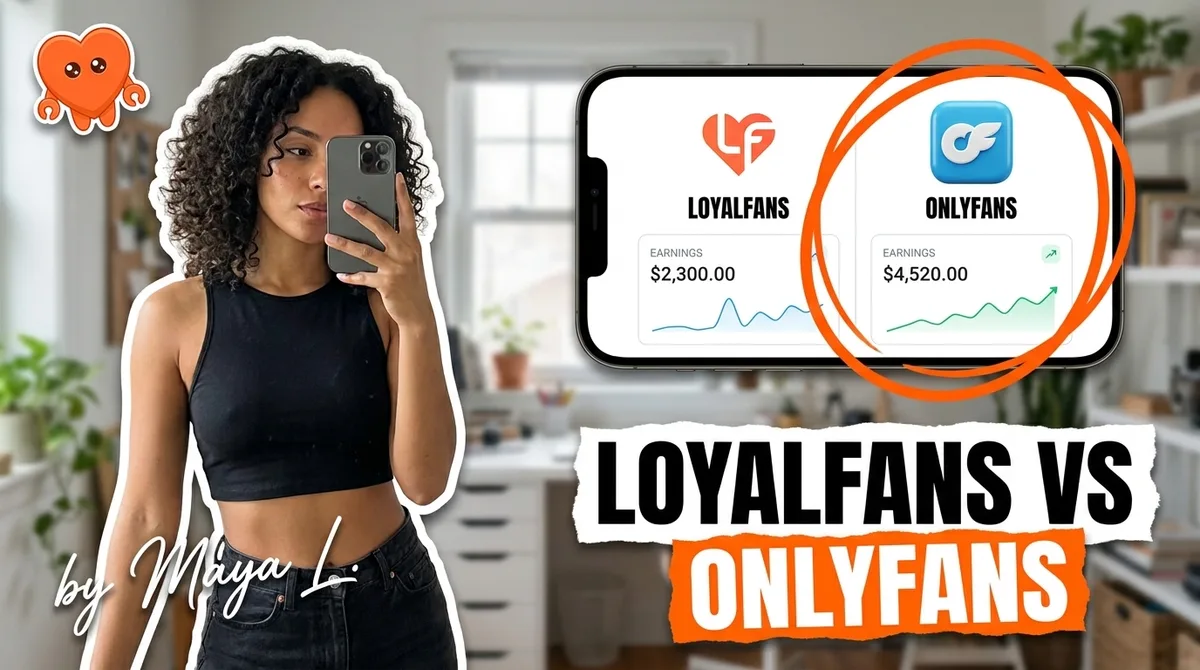
Both platforms take 20 percent and let you build a subscription-based creator business. The real differences are audience size, payout timing, and what you can do creatively. OnlyFans is bigger by a wide margin, which gives you more potential reach from day one. LoyalFans is smaller but ships features, like live-streaming, audio stores, and granular geo-blocking, that OnlyFans has not matched. For most working creators in 2026, the answer is not one or the other. It is both, managed deliberately.
Here is a clear-eyed breakdown of where each platform wins, where neither does, and how to run them without doubling your workload.
Fees and payouts: where the money actually goes
The platform cut is identical. LoyalFans keeps 20 percent. OnlyFans keeps 20 percent. You take home 80 cents on every dollar on both. The 20 percent OnlyFans commission applies flat across subscriptions, tips, and pay-per-view, with no tiers or volume discounts to chase.
Where they diverge is in how and when that 80 percent reaches you.
OnlyFans pays daily. The minimum withdrawal is $20. If you are managing cash flow closely, or if you have spikes in revenue around a new post or campaign, daily access to your earnings is a real operational advantage.
LoyalFans pays twice per month, within seven business days of each payment period closing. The minimum is $50. Payment methods include ACH, wire transfer, SEPA, and Paxum. For creators who treat their account as a business and reconcile monthly, the bi-monthly schedule is fine. For creators living close to their income, waiting two weeks matters.
Neither platform carries hidden charges beyond the 20 percent. Both support standard payment processors for subscriber billing. The fee comparison is, in practice, a draw. Focus on payout timing and minimum thresholds when comparing the two.
A practical note on the $50 LoyalFans minimum versus the $20 OnlyFans minimum: it only bites when you are starting out. On a brand-new LoyalFans account doing $30 in a pay period, your money sits until you clear $50, which can mean a full month before your first withdrawal clears. On OnlyFans, that same $30 is withdrawable the next day. If you are bootstrapping and every dollar counts, this is a real reason to lead with OnlyFans and treat LoyalFans as the channel you grow into. Once either account is doing meaningful volume, the minimums stop mattering, and the daily-versus-twice-monthly cadence becomes the only practical difference. My rule of thumb: if you reconcile your business monthly and keep a buffer, LoyalFans' schedule is a non-issue. If you live close to your income and need cash to flow as it comes in, OnlyFans' daily payout is worth real money to you.
Audience size and discovery: the honest picture
This is where OnlyFans wins clearly and it is worth being direct about it.
OnlyFans is the dominant platform in the subscription content space by a wide margin. Its parent company's fiscal 2024 results put fan accounts at 377.5 million and creator accounts at 4.6 million, with $5.8 billion paid out to creators that year. That scale means a larger pool of subscribers who already know how the platform works, already have a payment method saved, and are actively looking for new creators to follow.
LoyalFans is meaningfully smaller. It has a dedicated user base and a referral program that rewards creators for bringing others onto the platform, but it does not have the same density of potential fans browsing and subscribing without being sent there directly.
One thing worth knowing: neither platform is a discovery engine in the way that TikTok or Instagram is. On both OnlyFans and LoyalFans, the overwhelming majority of your subscribers come from external traffic you generate yourself. Reddit, X, Instagram, and TikTok funnel people to your page. The platform then converts them. So the audience-size gap between OnlyFans and LoyalFans matters most at the conversion step, not the discovery step.
That said, if you have a choice between sending cold traffic to a platform hundreds of millions of people already use versus one significantly smaller, the larger platform converts more of that traffic. OnlyFans has the advantage here.
Features and content options: where LoyalFans pulls ahead
LoyalFans ships creator tools that OnlyFans has not prioritized, and for certain content strategies, that changes the calculus.
Live streaming. LoyalFans supports live video directly in the platform. Fans can tip in real time. For creators who make live interaction a core part of their business, whether it is weekly sessions with regulars or exclusive premium lives for top fans, this is a genuine feature gap. OnlyFans does not offer the same integrated live experience.
Audio stores. LoyalFans lets you sell audio content as a standalone product, separate from your subscription feed. This opens a content category that does not exist natively on OnlyFans without workarounds.
Video stores. Both platforms support pay-per-view content, but LoyalFans has a dedicated video store feature that lets you price and present pre-recorded videos as a catalog rather than individual DM sends. This can work well for creators with deep back catalogs.
Shoutouts and personalized content. LoyalFans has a built-in shoutout product. Fans request personalized videos at a price you set. This maps well to creators who already sell custom content and want a cleaner workflow for it.
Geo-blocking. LoyalFans offers more granular control over which countries can see your profile and content. For creators with specific privacy requirements or audience targeting needs, this matters.
Content policy. LoyalFans is permissive with adult content and has a straightforward verification process. For creators who have faced friction on other platforms, the approval path on LoyalFans is generally reported as smoother.
Side-by-side comparison
| Feature | OnlyFans | LoyalFans |
|---|---|---|
| Platform cut | 20% | 20% |
| Payout frequency | Daily | Twice per month |
| Minimum payout | $20 | $50 |
| Registered users | 377M+ fan accounts | Smaller, growing |
| Live streaming | Limited | Yes, with tipping |
| Audio store | No | Yes |
| Video store | PPV via DMs | Dedicated storefront |
| Geo-blocking granularity | Standard | More granular |
| Shoutouts | Not native | Built-in product |
| Referral program | No | 5% on referred creators |
| Verification ease | Moderate | Generally smoother |
| Discovery (native) | Minimal | Minimal |
| Payment methods | Card processors | ACH, wire, SEPA, Paxum |
Why running both is the 2026 standard
Creators who treat their subscription business seriously increasingly run LoyalFans alongside OnlyFans, not instead of it. The logic is straightforward.
OnlyFans is your primary revenue platform. It has the larger subscriber base, daily payouts, and brand recognition that converts cold traffic at the highest rate. You build your core business there.
LoyalFans serves as a complementary channel. Common patterns include using it as a lower-priced tier to capture fans who balk at your OnlyFans price, running live sessions that you cannot do natively on OnlyFans, or cross-promoting your existing subscriber base to generate a second income stream from fans you already have.
Running both is not double the work, in theory. In practice, it often becomes that, because every platform demands its own inbox, its own posting schedule, its own DM follow-up rhythm. If you are doing it manually across two platforms, you are not running two accounts: you are working two jobs.
How I actually structure the two accounts
The mistake most creators make is treating LoyalFans as a clone of their OnlyFans. Same price, same content, same posting cadence. That just splits your effort in half and gives fans no reason to subscribe to both. Here is the structure that has worked for me, and for most of the creators I compare notes with.
Pick a primary and a wedge. OnlyFans is the primary: it gets your highest-volume posting, your premium pricing, and your most aggressive pay-per-view campaigns, because that is where the conversion rate on cold traffic is highest. LoyalFans becomes the wedge. I price it lower, usually 30 to 40 percent under my OnlyFans subscription, and I position it as the live-and-casual channel. Fans who are not ready to pay full price land there, and a chunk of them upgrade later once they trust the content.
Do not duplicate your feed. Cross-posting the exact same media to both platforms trains fans to pick one and cancel the other. Instead, give each platform a job. On LoyalFans I lean on the live-streaming and audio-store features that OnlyFans cannot match, so the LoyalFans subscription buys something genuinely different. On OnlyFans I keep the deep pay-per-view catalog and the bulk of new drops. The overlap stays under roughly a quarter of total content, which is enough to keep both feeds alive without cannibalizing either.
Reconcile income separately, then together. The payout mechanics are not the same. OnlyFans drips daily into your balance, so it reads like a steady wage. LoyalFans lands twice a month in a lump, so it reads like a bonus. If you track them in one column you will misjudge your real run rate. I keep a simple sheet with both platforms' net (after the identical 20 percent cut on each), tag every withdrawal by source, and only then add them up. That also makes tax season far less painful, because the 1099 or equivalent from each platform lines up with a column you already maintain.
Run one promotion calendar, two destinations. Your external traffic, the Reddit posts, the X teasers, the Instagram story funnels, should point at whichever platform serves that audience best. Free-leaning traffic and live-event hype go to LoyalFans. High-intent buyers and anyone who already follows your paid work go to OnlyFans. The calendar is shared. The landing link changes per campaign. That keeps you from sending the same fan to two checkout pages and confusing them into buying neither.
The version of multi-platform that does not burn you out is one where the routine work, inbox replies, follow-ups, welcome messages, mass messages, is handled automatically, on your machine, in your voice, without handing your login to a cloud service. That is the core problem FanClaw is designed to solve. The agent runs locally on your laptop, handles the repetitive work on OnlyFans, Fansly, Instagram, X, TikTok, Reddit, and Telegram, and brings you the conversations that need a human. It does not run LoyalFans, so your LoyalFans inbox stays yours to answer. Because it runs on your own machine, your fan data and your earnings history never leave it: there is no shared cloud inbox holding your subscriber list. You can download FanClaw and run a first session on your own machine before committing to anything.
The credential risk most creators overlook
Whether you are on OnlyFans, LoyalFans, or both, the biggest operational risk in 2026 is not the platform itself. It is the tools you plug into it.
Most automation and chatting tools in the market are cloud services. They ask for your login credentials and then sign in as you from their own servers. That means a company you may know nothing about holds your account password, reads every fan message, and can see your full earnings history. If their servers are flagged, suspended, or breached, your account inherits the exposure.
The safer setup is one where automation runs on your own machine, not a data center someone else controls. Your login stays on your laptop. No third party can log in as you, read your inbox, or act on your account without your involvement. This distinction matters on every fan platform, and it matters more as your account grows and your subscriber data becomes more valuable.
For creators running LoyalFans and OnlyFans in parallel, the question is not just which tool to use. It is where that tool runs and who holds the keys.
Frequently asked questions
Yes. Both platforms keep 20 percent of every dollar you earn, so you take home 80 cents on the dollar from either. The fee structure is not a deciding factor between the two.
It depends on what you mean by better. LoyalFans has a more permissive approval process for new accounts and offers live-streaming and audio stores from day one. OnlyFans gives you access to a much larger existing audience, which matters more once you have traffic to send. Most creators start on OnlyFans and add LoyalFans after they have a subscriber base to cross-promote.
LoyalFans has a $50 minimum payout, issued twice per month. OnlyFans has a $20 minimum and pays daily, which is a meaningful difference if cash flow matters to your operation.
Yes. Running both is common in 2026. Many creators use OnlyFans as their primary income platform and LoyalFans as a lower-priced second channel or a live-streaming hub. The platforms do not restrict multi-platform activity.
Yes. LoyalFans includes live-streaming as a built-in feature, which OnlyFans does not support in the same way. If live interaction with fans is a core part of your content strategy, LoyalFans is the stronger option for that specific use case.
The same principles apply as on any fan platform. Automation that runs on your own machine, uses your own wording, and does not share your login with a third-party cloud service is low risk. Handing your credentials to an outside tool is the main danger on any platform, including LoyalFans.
LoyalFans has an internal search and a referral program that rewards creators for bringing others to the platform. OnlyFans offers minimal native discovery. On both platforms, the majority of your subscribers will come from external traffic you drive yourself, through social media, Reddit, or direct promotion.
Partly. FanClaw runs locally on your machine and covers OnlyFans, Fansly, Instagram, X, TikTok, Reddit, and Telegram, without requiring you to hand your login to any cloud service. It does not run LoyalFans, so that inbox stays yours to answer while the OnlyFans side and your promotion run in the background.