OnlyFans agency red flags: 10 warning signs
The biggest OnlyFans agency red flag is any agency that wants your password. Here are 10 warning signs of a scam, plus the exact questions to ask first.
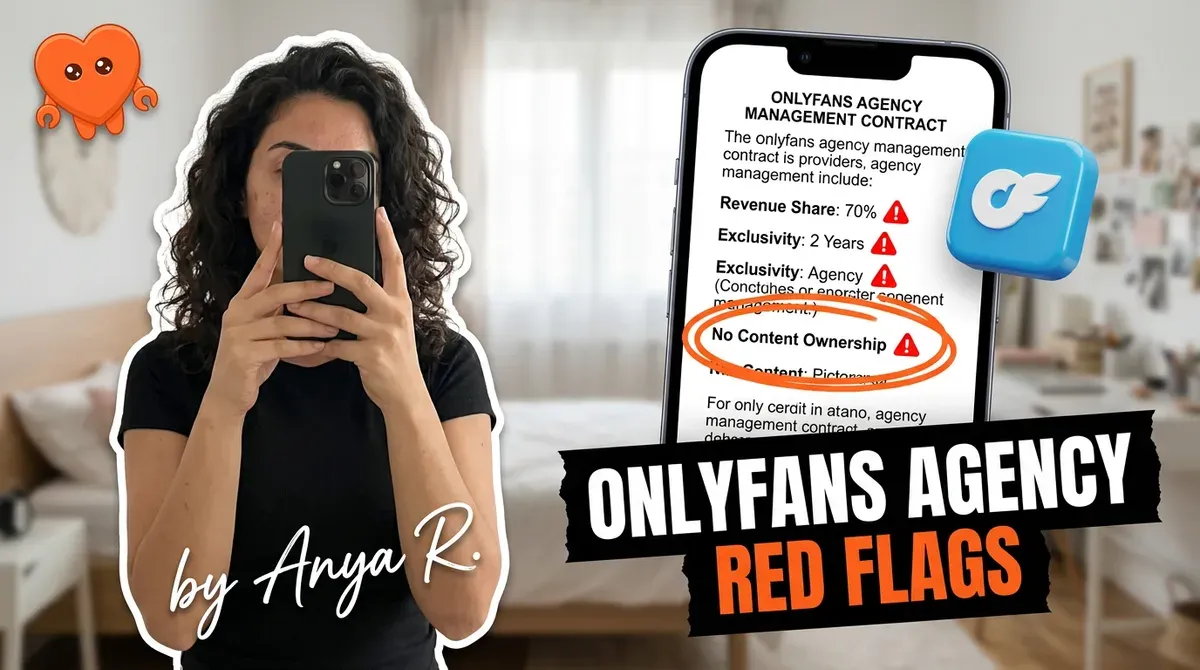
The clearest OnlyFans agency red flag is simple: any agency that wants your password. If a company asks to log in as you, hold your recovery email, or collect your payouts before you see them, stop there. Everything else on this list (the upfront fees, the guaranteed-income pitch, the 50 percent cut, the three-year contract) is a variation on the same theme: an agency trying to own your business instead of grow it. Here are the ten warning signs to catch before you sign, and the exact question to ask for each.
I learned most of these the expensive way. I signed a 40 percent deal in my first year because I was drowning in DMs and someone in my Instagram requests promised to make it all go away. It took eight months and a very patient lawyer to get my account back. You can skip that.
What counts as an OnlyFans agency red flag?
A red flag is any term or behavior that shifts control of your account, your money, or your exit away from you. Good management sells you time and distribution. A bad agency sells you those things too, then quietly takes your login, your subscriber list, and your ability to leave. The tell is always the same: does this make me more in control of my business, or less?
That frame cuts through the polished websites and the friendly onboarding calls. Read every clause and every promise against it. If the answer is "less control for me," it is a flag, no matter how nice the rep sounds on the call.
The 10 OnlyFans agency red flags to watch for
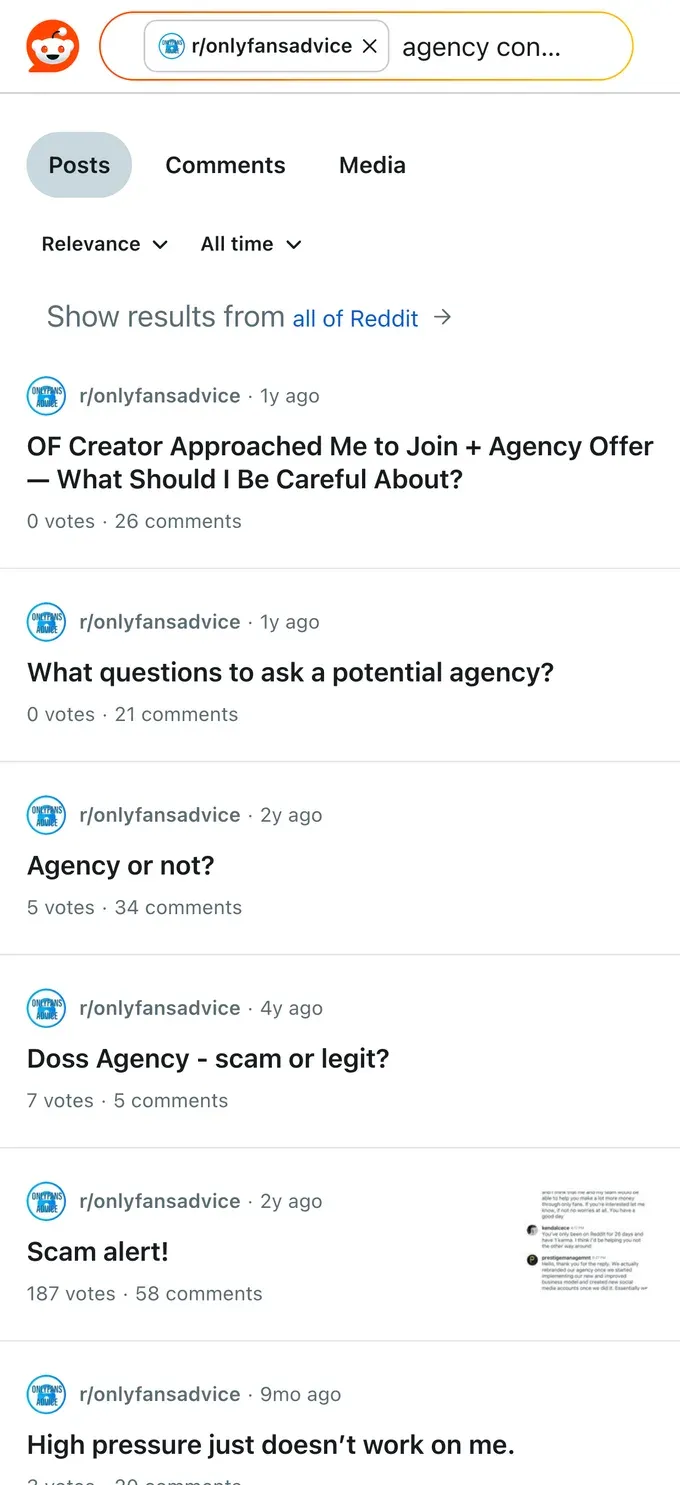
Each of these comes straight from creator threads on r/onlyfansadvice and from contracts I have now read more of than I ever wanted to. For each one: why it matters, and the question that flushes it out.
1. They ask for your OnlyFans password or full account control. Why it matters: a third party signing in as you is the single largest risk to your account. If their systems get flagged, your account inherits the suspicion. Worse, whoever controls the login can change your recovery email and payout details, which is exactly how creators get locked out during a dispute. What to ask: "Will I keep sole control of my login, recovery email, and two-factor, and will OnlyFans pay me directly?" A no, or a "it is easier if we handle that," is the flag.
2. Upfront or "setup" fees. Why it matters: the whole logic of agency management is that they earn when you earn. Setup, onboarding, or training fees of $500 to $5,000 before any work happens are a cash grab, or a test of how much you will hand over before you notice. What to ask: "Is there any charge before I earn? Itemize every fee in writing." Vague bundling is the tell.
3. Guaranteed earnings. Why it matters: no one can promise a number. Income depends on your niche, your content, your consistency, and the platform's own changes. "$10,000 a month guaranteed" is the oldest bait in this business. What to ask: "Will you put that guarantee in the contract with a refund if you miss it?" They will not.
4. A cut above 35 to 40 percent. Why it matters: OnlyFans already takes 20 percent of everything you earn. At a 35 percent agency cut on top, you need your gross to grow by roughly 54 percent just to net what you made alone. At 50 percent you are splitting your business in half; at 60 to 80 percent you are an employee who also takes all the risk. What to ask: "Is your cut on gross or net, and what specifically do I get for it?" "Gross" plus a vague answer is a double flag.
5. Long lock-in contracts with no clean exit. Why it matters: 24 to 36 month terms, automatic renewals, and no performance clause exist to keep you paying whether or not they deliver. The contract should let you leave if the partnership is not working. What to ask: "What is the notice period, and can I exit in 30 days if you miss agreed targets?"
6. Pressure to sign now, and no lawyer allowed. Why it matters: "We only have a few slots," "other creators are waiting," and any pushback on letting a lawyer read the contract are manipulation. A real agency knows the terms hold up to review. What to ask: "I will sign once my lawyer has read it. Send the full contract." If the offer evaporates, it was never an offer worth taking.
7. No verifiable track record. Why it matters: you Google the name and find a website built last month, anonymous testimonials, stock-photo "team members," and no business registration. Scam agencies are designed to be hard to trace, so there is no one to hold accountable later. What to ask: "Connect me with two current creators I can message directly, unprompted." Curated screenshots do not count.
8. Vague service descriptions. Why it matters: "We handle everything" with no specifics means nothing is measurable, so nothing can be held against them. You cannot tell whether they chatted your fans or ignored them. What to ask: "Who exactly chats my fans, on what hours, and how do you report results to me each week?"
9. They collect your money first. Why it matters: if revenue routes through the agency before it reaches you, they control the timing. Watch for "reserve funds" held back for chargebacks (often 10 to 20 percent), "verification periods" of up to 30 days, and administrative-processing delays. That is your cash, sitting in someone else's account. What to ask: "Does OnlyFans pay me directly and I pay you, or do you hold my earnings first?"
10. Unsolicited cold recruitment. Why it matters: legitimate agencies vet creators and rarely cold-call. A stranger sliding into your DMs or email with a too-good pitch is running volume, hoping a few sign without reading. What to ask: "How did you find me, and what is your screening process for creators?" No real process is a flag.
Which contract clauses should I read before I sign?
Three clauses do the most damage, and they are usually buried near the end where people stop reading. Find them first. A reputable agency will explain each one without flinching; an evasive answer is your signal to walk.
Before you sign anything, read these clauses word for word:
- Data retention. Many contracts let the agency keep a copy of your subscriber list and DM history after you leave, forever. Your fan list is your most valuable asset. Make sure you can keep your own copy, and understand what they keep.
- Non-compete. A 6 to 12 month non-compete can bar you from working with another agency, or from running your own account in your niche, after you leave. Enforceability varies by location, which is exactly why a lawyer is worth the call here.
- Tail commission. Some contracts charge a permanent commission on every subscriber acquired while you were under contract, even after the relationship ends. You could pay them for years on fans you now serve entirely yourself.
- Exit, audit, and transition fees. A lump-sum "release" fee, a mandatory financial audit, or a clause requiring you to repay disputed commissions can turn leaving into a months-long ordeal. Know these exist before, not after.
If you are already inside one of these contracts and trying to get out, the step-by-step process is in how to leave an OnlyFans agency, including the order to do things so you do not trigger a dispute.
How do I vet an OnlyFans agency before signing?
Run the same checks you would on any company holding your income. Most scams fall apart the moment you slow down and ask for proof.
- Get a live video call with the actual people, not a chat-only sales rep.
- Ask for two current creators you can contact yourself, unprompted, and actually message them.
- Verify the company exists: registration, reviews, real team profiles, a history older than a month.
- Have a lawyer read the contract. For anything above low four figures, a short consultation costs less than the dispute it prevents.
- Confirm the economics in writing: the cut, whether it is on gross or net, the notice period, and that you keep your login and direct payouts.
The fair deals do exist. They tend to take 20 to 25 percent, give you a genuine distribution advantage (paid acquisition that converts, cross-promotion with bigger accounts), keep you in control of your own login, and let you leave on 30 days notice with your data returned. That is a partner. Everything else on this page is a landlord.
Are all OnlyFans agencies scams?
No. Most of the predatory behavior on this page comes from a loud, fast-moving minority that churns through creators, but real management exists. A legitimate agency is transparent about its cut, lets you keep your login and direct payouts, can show you creators who vouch for it, and earns its keep through distribution you genuinely cannot build alone. Those agencies are the exception, not the pitch in your DMs.
The honest version: an agency makes sense for a small set of creators. If you are scaling faster than you can oversee and someone is bringing real paid acquisition or cross-promotion to the table, a fair 20 to 25 percent deal can pay for itself. The problem is that most creators sign under exhaustion, take a 35 to 50 percent deal without reading the termination clause, and discover later that the only thing the agency reliably solved was the workload. That part you can now solve without giving away a third of your income or your password.
What if I want the help without handing over my account?
Here is the part the agencies do not advertise: the work they sell is now something you can run yourself, without giving anyone your password. Replying to DMs, posting on a schedule, pricing pay-per-view by what each fan actually spends, re-engaging quiet subscribers. That used to justify a 30 to 40 percent cut. It does not anymore.
This is also where the cloud tools fall into the same trap as the agencies. Every chatting tool that ranks in Google today asks for your OnlyFans login and reads your fan messages on its own servers. Whether it is an agency's team or a cloud service's software, the structure is identical: a stranger holds your password and your conversations. The fastest way to lose control of your account is handing your login to anything that signs in as you.
FanClaw is built the opposite way. It is a local-first app that runs your DMs, posting, acquisition, and monetization from your own machine. Your login never leaves your laptop, your fan data never lands on someone else's servers, and you approve anything that matters before it goes out. You get the automation that used to require an agency, in your own voice, while keeping the full margin and the keys. You can download FanClaw and run a first night locally before you decide anything.
The agencies that scared you with the workload were not lying about the workload. They were lying about the price of solving it. You do not owe anyone 40 percent and your password for the privilege of running your own business.
Frequently asked questions
Any agency that asks for your OnlyFans password or wants to control your login, recovery email, and payout settings. You should keep sole access to all three, and payouts should land in your account first. An agency that holds the keys can lock you out, redirect your money, and make leaving a legal fight.
Full-service management sits around 30 to 40 percent of gross in 2026, and the 'fair' deals that genuinely help you tend to be 20 to 25 percent with a real distribution advantage. Management-only arrangements can be 10 to 20 percent of net. Anything at 50 percent or higher is a red flag, and 60 to 80 percent means you are working for them.
No. The entire premise of agency management is that they earn when you earn, so their commission is their pay. Upfront 'setup,' 'onboarding,' or 'training' fees of $500 to $5,000 before any work is done are one of the most reliable scam signals. Small, itemized, clearly-defined costs can be legitimate; a large lump sum up front is not.
No legitimate agency can promise a specific income. Earnings depend on your niche, content, consistency, audience, and the platform itself, none of which an agency fully controls. A guaranteed '$10,000 a month' is bait. If they truly believed it, they would put it in the contract with a refund clause, and they will not.
Short enough to leave if it is not working. Look for a 30 day notice period. Be very wary of 24 to 36 month lock-ins, automatic renewals with no performance clause, and exit fees. A confident agency earns your loyalty month to month instead of trapping you in a multi-year term.
No. Keep sole control of your password, the email tied to the account, and your two-factor method, and make sure OnlyFans pays you directly. When an agency holds your login, they can read every message, change your recovery details, and withhold access during a dispute. A tool or partner that needs your password is a structural risk, not a convenience.
Ask for a live video call, request two current creators you can contact unprompted, and look up the company's registration, reviews, and team online. Refuse to sign without a lawyer's review of the contract. A real agency welcomes the diligence; a scam pressures you to sign before you can do any of it.
You can run the whole business yourself. The work an agency sells, replying to DMs, posting, pricing, and acquisition, now runs as automation on your own machine, in your own voice, with you approving what matters. You keep the full margin and no one else holds your login or your fan data.