Is an OnlyFans agency worth it? an honest 2026 verdict
Is an OnlyFans agency worth it? Usually not. At a 35 percent cut you need roughly 54 percent more revenue just to break even. Here is the honest math.
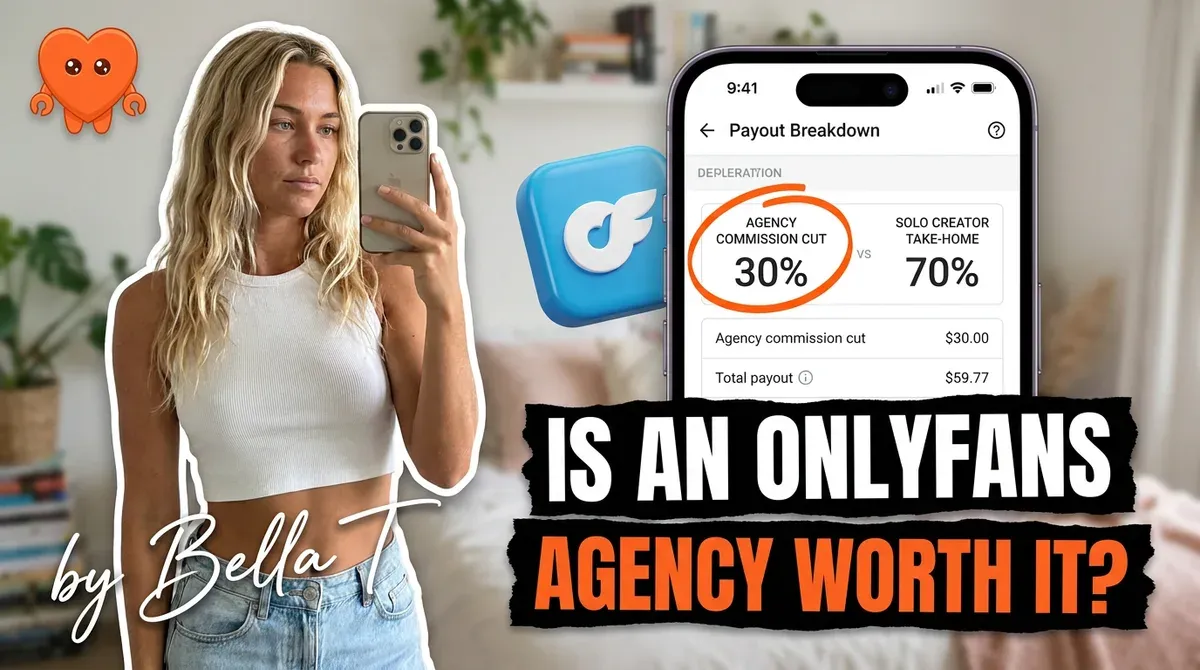
I signed a management deal at 35 percent in my second year. The pitch was clean: they handle the DMs and the posting, I focus on content, everyone wins. Eight months later my gross had barely moved, my chatters were sending messages I would never write, and the exit clause had a non-compete I had not read. Is an OnlyFans agency worth it? For most solo creators, no. A good agency at fair terms can grow an account it genuinely could not grow alone. Most agencies take 30 to 50 percent for work you can now run yourself, on a cut that grows every month you do.
Here is the honest version: the math, what agencies actually do versus promise, the cases where one is worth it, and the alternative that did not exist a couple of years ago.
Is an OnlyFans agency worth it in 2026?
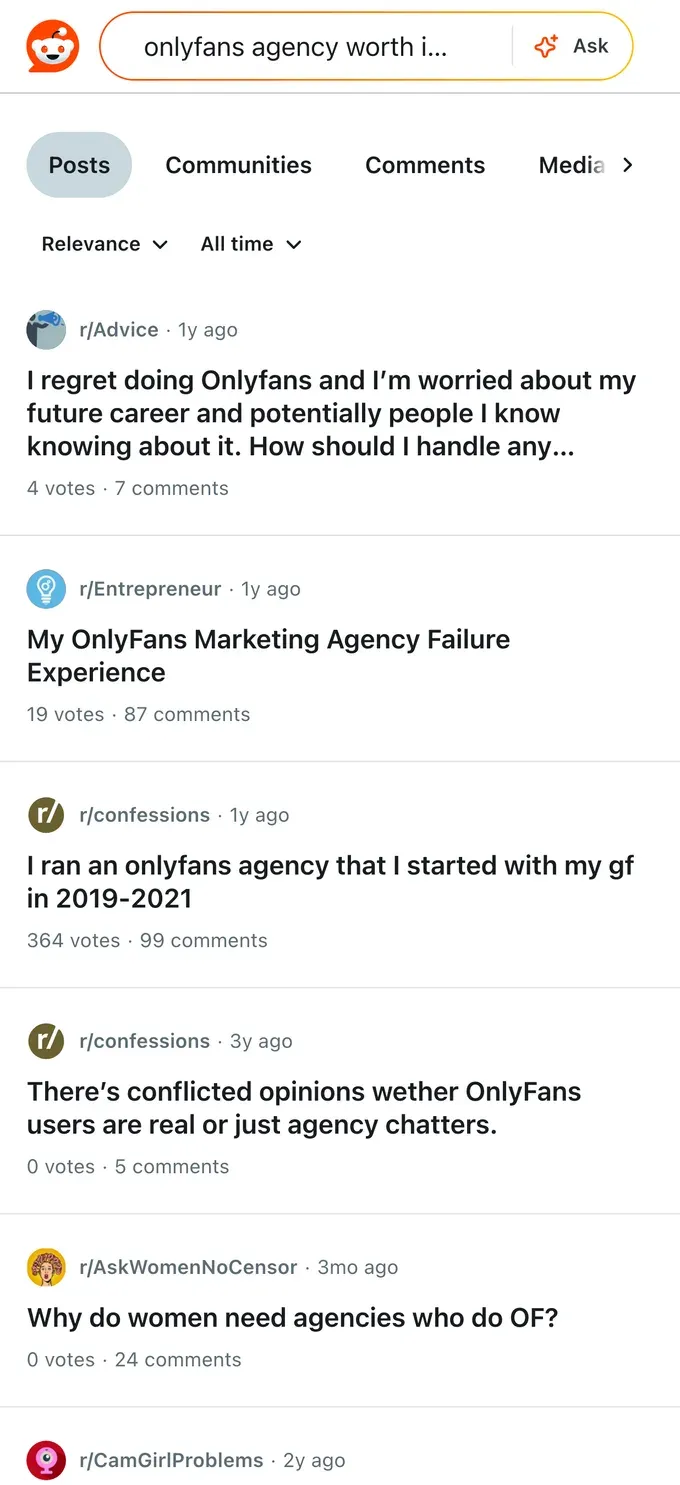
For the average solo creator, an OnlyFans agency is not worth it. The agency's cut scales with your revenue while your cost to run the account yourself stays flat, so the more you grow, the more the deal works against you. An agency is worth it only when it delivers growth you genuinely cannot produce alone, at a fair rate, with a clean exit.
That is the whole decision in one sentence. The cut is not the problem by itself. The problem is paying a percentage forever for a task layer (chatting, posting, scheduling) that is no longer hard to run on your own.
The honest both-sides version: a well-run agency with real chatters and a real paid acquisition channel can take an account from $4,000 a month to $15,000 in a quarter. That happens. It is also the exception, not the median pitch. The median pitch is a 35 percent cut, offshore chatters, a posting calendar you could build in an afternoon, and a contract that is much easier to enter than to leave.
The only number that proves an agency is worth it is your net take-home after the cut, not your gross. If your gross tripled and your net is flat, the agency is the one who got rich.
What does an OnlyFans agency actually do?
An OnlyFans agency bundles four jobs: chatting with fans in your name, scheduling and posting content, running PPV and upsell campaigns, and sometimes paid acquisition across Reddit, Instagram, and TikTok. Those are real tasks with real time cost. The question is whether they justify a permanent slice of everything you earn.
Here is what each piece looks like in practice, and how often the delivery matches the promise.
Chatting and PPV
This is the line item agencies sell hardest, because DMs are where most of the money is. The promise is 24/7 coverage by skilled chatters who build relationships and time PPV sends. The reality ranges widely. Top agencies run trained teams. Plenty run offshore shifts paid per message, working from a script, sending PPVs that read nothing like you. Fans notice. The voice that made your account work is the first thing a cheap chatter loses.
Posting and content strategy
Scheduling, captions, release timing across OnlyFans and Fansly, a content calendar. Genuinely useful when you are drowning. Also the most replaceable piece of the bundle. A posting schedule is a solved problem, and "strategy" from a low-tier agency is often a template applied to every creator they manage.
Acquisition and promotion
The part that actually justifies a cut when it exists. Real paid traffic, real cross-promotion with large accounts, a Reddit and Instagram funnel that converts. This is hard to run solo and worth paying for. It is also the service agencies are most likely to promise and least likely to deliver, because it costs them money. Ask for the specific channels and the numbers before you believe it.
The pattern across creator forums is consistent: the cheaper the agency, the more it leans on AI chatbots and templates while charging for "full management." Some go quiet entirely once the contract is signed.
The break-even math: how much more do you have to earn?
The number no agency leads with is the break-even lift: how much extra gross revenue the agency has to generate just for you to net what you already keep solo. Running solo, you keep 80 cents of every dollar after OnlyFans' own 20 percent cut. Under an agency, you keep far less, so the agency has to grow your gross substantially before you see a single extra dollar.
Here is the math on a $100 fan payment, and the revenue lift each structure needs just to break even against going solo:
| Your setup | What you keep per $100 | Lift needed to match solo |
|---|---|---|
| Solo, no agency | $80 | none |
| 30% cut on gross | $50 | +60% |
| 35% cut on net | $52 | +54% |
| 35% cut on gross | $45 | +78% |
| 50% cut on gross | $30 | +167% |
Read the 35 percent rows together, because the base the cut is applied to changes everything. If the agency takes 35 percent of your gross (before the platform fee), you keep $45 and need a 78 percent revenue lift to break even. If it takes 35 percent of net (after OnlyFans' cut), you keep $52 and need a 54 percent lift. Same headline percentage, a $7 swing on every $100, decided by one clause.
If your contract is ambiguous about gross versus net, assume gross and negotiate from there. On a $10,000 per month account, the gross-versus-net difference is around $700 a month, every month, forever.
So the real question is not "is 35 percent fair." It is "can this specific agency grow my gross by 54 to 78 percent and sustain it." A confident operator will give you a target range in writing. A vague answer means the cut is buying you a task layer, not growth. For a fuller breakdown of how the percentage and the base interact, the how much does an OnlyFans agency take guide runs the tiers in detail.
When an OnlyFans agency is worth it, and when it is not
An agency is worth it when it sells you growth you cannot produce, at a rate that leaves you ahead after the cut, with terms you can exit cleanly. It is not worth it when you are paying a permanent percentage for work that is now automatable on your own machine. Use these two lists honestly.
An agency is worth it if:
- You are scaling faster than you can oversee, and the agency delivers a real distribution advantage: paid acquisition that converts, or cross-promotion with accounts far larger than yours.
- The rate is a fair 20 to 25 percent, the base (gross or net) is in writing, and the cut is justified by a service you genuinely cannot run.
- You can terminate on 30 days notice with your login, subscriber data, and final payment returned, and no non-compete.
- You verified all of the above in writing, and a lawyer read the contract.
An agency is not worth it if:
- It takes 30 percent or more and your growth is coming from your own content, consistency, and audience.
- The "chatters" are generic AI bots or a script, sending messages that do not sound like you.
- The contract has a non-compete, a perpetual commission clause, or vague exit and audit fees.
- You have ever felt uneasy about a company you have never met holding your OnlyFans login.
- The workload is the only real reason you are considering it. That problem now has a cheaper fix.
Most creators who regret their agency signed a 30 to 50 percent deal under exhaustion, did not read the termination clause, and discovered that leaving was harder than canceling a subscription.
What agencies do not tell you about leaving
Leaving an agency is harder than joining one, and the contract is usually built that way. Before you sign, assume the exit will be the hardest part, because for a lot of creators it is.
The common traps, straight from creator contracts and forum reports:
- Data-retention clauses. Many agreements let the agency keep your subscriber records after you leave. Your subscriber list is the single most valuable asset your business has, and you may not cleanly recover it.
- Non-competes. A 6 to 12 month window where you cannot work with another agency or, in some versions, sign directly somewhere else.
- Perpetual commission. Language that claims an ongoing cut on subscribers who joined during the contract, even after you are gone.
- Transition and audit fees. Charges framed as the cost of "account handover" that exist mainly to make leaving expensive.
- Withheld final payments. Slow or disputed final payouts while the agency holds the leverage.
There is a quieter risk underneath all of this: the agency holds your login. They can see your earnings, your fan messages, and your subscriber list, and you are trusting their staff turnover and their security with the keys to your business. One creator's documented experience involved hiring a lawyer over subscriber claims and rebranding to escape the contract, losing momentum in the process. An agency that refuses to let a lawyer review the contract before you sign is telling you exactly what kind of agency it is.
The alternative: keep the work, keep your margin
The reason most creators consider an agency is the workload, not the strategy. And in 2026 the workload is the part that no longer requires giving away a third of your income. The DMs, follow-ups, PPV sends, posting, and acquisition that an agency charges a percentage for can now run automatically, which removes the only reason most creators sign in the first place.
There is a catch worth naming. Most of the tools that rank for creator software take your OnlyFans login into their own systems (servers, proxies, or shared team sessions). Supercreator, Infloww (from $40 per creator profile a month, rising with earnings), and the rest run your account through infrastructure you do not control. That is the same credential risk as an agency, with less accountability. If their infrastructure gets flagged, your account inherits it.
FanClaw is built the other way. It is a local-first app that runs your DMs, posting, acquisition, and pricing from your own machine. Your login and your fan data never leave your laptop. No third party holds your credentials, reads your conversations, or can act as your account. You write the flows in your own voice, you keep a human approval step on anything sensitive, and the mechanical work runs while you sleep or film. The cost is flat: it does not climb every time your revenue does.
The contrast is the whole argument. At $5,000 a month, a 35 percent agency takes $1,750. At $10,000, it takes $3,500. A flat-rate tool on your own machine costs the same whether you earn $3,000 or $30,000, so every dollar past break-even is a dollar you keep. You can download FanClaw and run a full first night locally before you decide anything, and the guide on how to run OnlyFans without an agency walks through the exact solo setup.
None of this means agencies are never worth it. For a high earner who needs production or acquisition she genuinely cannot run herself, the right agency at a fair rate can pay for itself. For everyone else, the agency economy was built around creators who did not have a better option. That option exists now, and it runs on your machine instead of taking a cut of it.
Frequently asked questions
Rarely. A new creator has the least leverage, signs the worst terms, and pays a cut on revenue she is mostly generating herself through her own content and consistency. Beginners are better served learning the basics solo and automating the workload than handing 35 percent to an agency that treats small accounts as a volume business.
Most take 20 to 50 percent of your revenue, with the market settling around 30 to 40 percent. That sits on top of OnlyFans' own 20 percent fee. At a 35 percent agency cut on gross, you keep 45 cents of every dollar a fan pays.
A good one can, through real paid acquisition and chatters that lift conversion. Many do not. A 25 percent agency that does not grow your income is more expensive in practice than a 40 percent agency that triples it. The only number that matters is whether your net take-home went up after the cut, not your gross.
Often, yes. Many contracts include data-retention clauses that let the agency keep your subscriber records, plus a 6 to 12 month non-compete and transition or audit fees on exit. Some claim perpetual commission on subscribers who joined during the contract. Read the termination clause before you sign anything.
Only if the agency delivers something you cannot: 24/7 chatters that measurably raise conversion, a paid acquisition channel that converts, or cross-promotion with large accounts. If you are producing your own content and the chatter is a generic bot, 30 percent is still too much.
Most are legitimate businesses, but the category attracts predatory contracts. The common traps are perpetual commission, non-competes, unilateral rate increases, and agencies that go quiet after you sign. An agency that refuses to let a lawyer review the contract is telling you something.
The math favors going solo at almost every level, because the cut scales with your revenue while your costs to run it yourself stay flat. Agencies make the most sense for high earners (roughly $20,000 a month and up) who need genuine production or acquisition help they cannot run alone, on fair terms.
Run the account yourself with the workload automated. DMs, follow-ups, PPV sends, posting, and acquisition can now run on your own machine at a flat monthly cost. You keep your full margin, your login, and your subscriber list, and you stay in control of the conversations that matter.