How to monetize an AI influencer (2026 playbook)
How to monetize an AI influencer in 2026: the revenue streams that work, the platforms that allow AI, and how to run the account without burning hours.
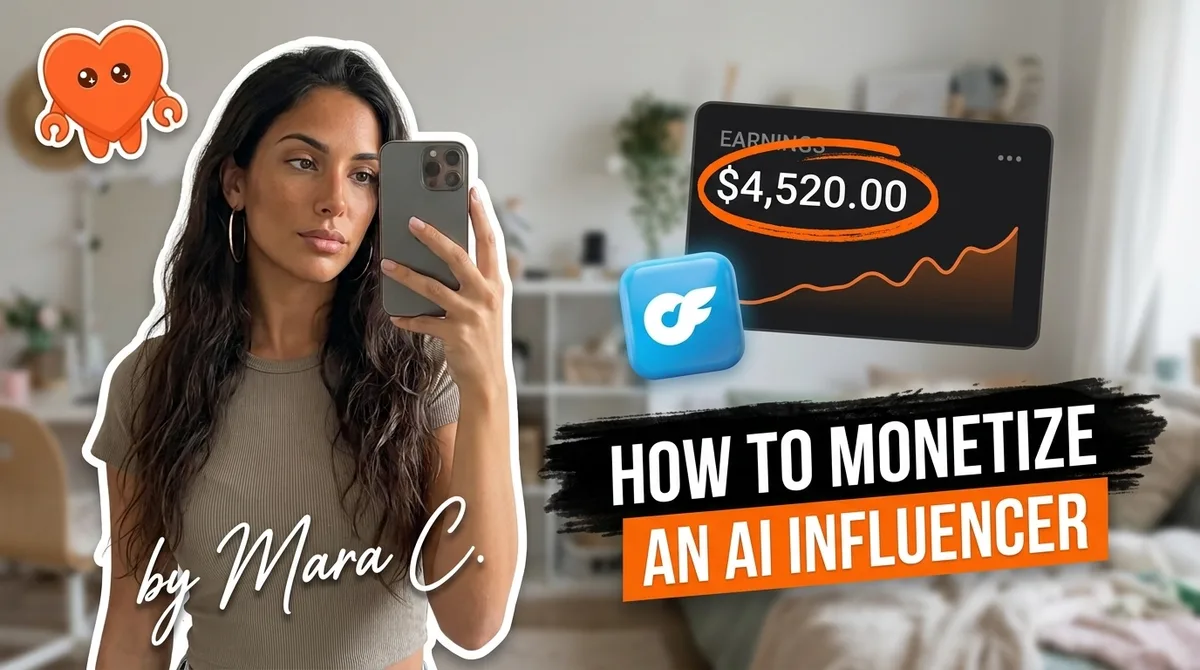
Monetizing an AI influencer in 2026 is a real business operation. The revenue model is identical to any subscription creator account: subscriptions, pay-per-view content, direct messages, tips, and brand or affiliate deals. The difference is that the creative production is handled by AI image and video tools, which removes the content bottleneck without removing the need for disciplined account operations. This guide covers each revenue stream, which platforms allow it, and how to run the account without being online around the clock.
For the build side, including persona creation and platform setup, see create an AI influencer.
The revenue streams that actually work for AI influencers
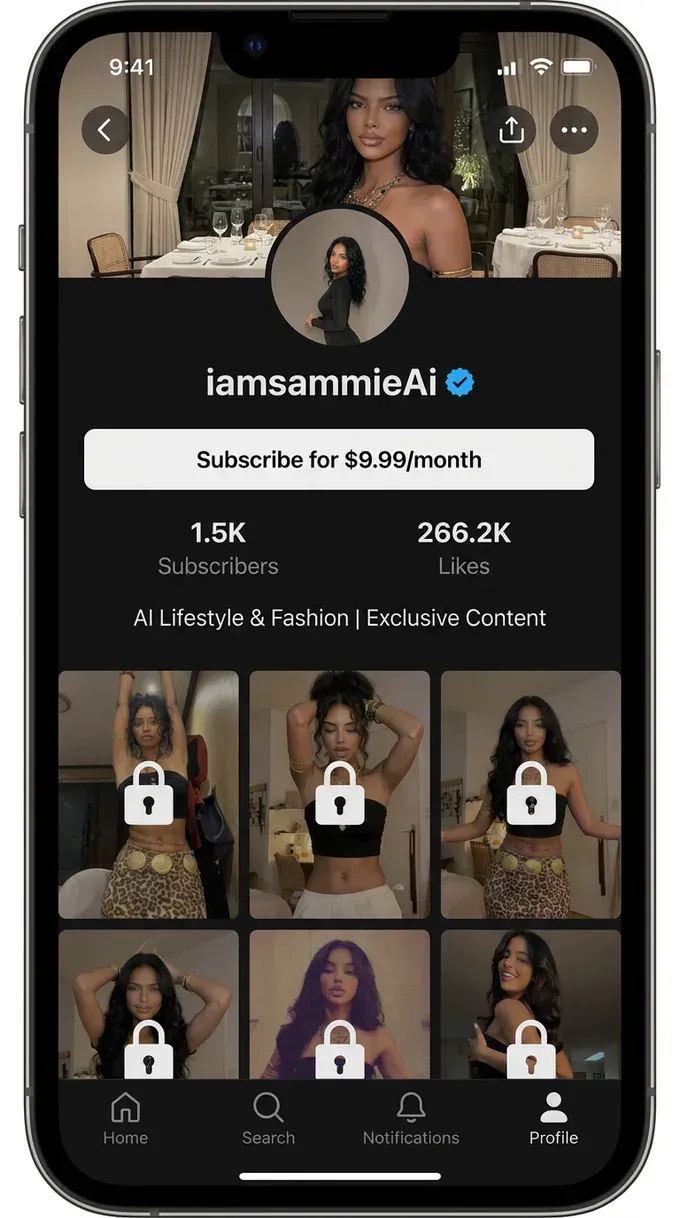
An AI influencer account generates income from five primary sources: monthly subscriptions (the recurring base), pay-per-view content (individual premium purchases), direct messages (the highest-converting revenue channel), tips, and brand or affiliate deals. Operators who combine all five streams consistently outperform those who rely only on subscriptions.
The goal is not to pick one stream. Each one reinforces the others.
Subscriptions: the recurring base
A monthly subscription price is what every fan pays to access the account's primary content feed. It provides predictable recurring revenue and it funds the platform's discovery algorithm, since subscription count is the primary signal platforms use to surface creators.
Set the subscription price based on your posting volume and niche, not based on what you assume competitors charge. New accounts often start at a lower price point to grow the subscriber base quickly, then raise it as the library deepens and social proof builds. Always account for the platform's 20 percent fee when setting prices.
Pay-per-view content: the premium layer
Pay-per-view (PPV) content is where individual pieces of premium media are sold on top of the subscription at a one-time price. This is where the content library produced by AI tools earns its value.
A tiered PPV value ladder converts better than flat pricing. A practical structure: $15, $25, $45, $70, $120. Photo sets typically range from $10 to $30; video content from $20 to $50, roughly $3 to $5 per minute as a benchmark. Attaching one or two preview images to a PPV message lifts the unlock rate by 40 to 60 percent. Pricing too high too early collapses unlock rates before trust is established.
Direct messages: the single biggest revenue lever
The DM inbox is where the most revenue is generated on most high-performing subscription accounts. Fans who receive contextual, personal messages buy more PPV, tip more frequently, and renew at higher rates than fans who only see posts. A subscriber who never receives a direct message will churn at the first billing cycle.
Custom content requests, fan-specific PPV pricing, re-engagement sequences for lapsed subscribers, and tip prompts all live in the inbox. The inbox is the sales floor.
This is also the most time-intensive part of running the account. More on how to handle it at scale below.
Tips and custom requests
Tips are incremental income that compounds significantly across an active fanbase. Fans tip in response to messages, posts, and custom content delivered to them directly. Custom content requests (specific scenarios, backgrounds, outfits) generate premium pricing because the fan perceives direct involvement in the production.
For an AI influencer account, custom content requests are a strong monetization path: the production is AI-generated, so the marginal cost of producing a custom piece is low, while the perceived value to the fan is high.
Brand deals and affiliate income
Brand and affiliate revenue is the stream with the most upside for accounts that have built a real audience. Brands in categories adjacent to your persona's niche, such as beauty, fitness, gaming, or fashion, pay for sponsored posts or product integrations. Affiliate programs pay a percentage of referred sales.
The threshold to attract meaningful brand deals varies by niche and audience quality, but accounts with an engaged, well-defined following can negotiate deals independently or through creator marketplaces. This stream grows with audience size and cannot be rushed, but it requires no additional production cost once the audience is there.
Which platforms allow AI monetization in 2026
Platform policy is the first constraint for any AI influencer operator. The landscape shifted significantly through 2025 and 2026. Not every platform that allows creators also allows synthetic ones.
| Platform | AI content policy (2026) | Disclosure required | Fully synthetic persona allowed |
|---|---|---|---|
| Fanvue | Explicitly permitted | Yes, on all AI content | Yes |
| OnlyFans | Restricted: must feature verified creator's own likeness | Yes, required as of 2026 | No (fully synthetic risks termination) |
| Fansly | AI-generated content banned | N/A | No |
Fanvue is the primary platform for AI influencer monetization in 2026. It explicitly permits fully AI-generated images, videos, and personas, offers a dedicated AI Creator designation at signup, and charges only 15 percent for the first 12 months. Fanvue crossed a $100 million run rate in January 2026 alongside a $22 million Series A round, and AI-created accounts have become a significant share of that growth. Disclosure of AI content is required: a watermark, caption, or bio statement that makes the synthetic nature of the content clear and prominent.
OnlyFans is not viable for a fully synthetic AI persona in 2026. Its current policy requires AI-assisted content to feature the verified creator's own likeness. Accounts built around entirely synthetic personas risk termination. If you have a verified OnlyFans account and want to incorporate AI image tools into your content workflow, that is a separate operational question. But building an AI influencer account from scratch on OnlyFans is the wrong starting point.
Fansly has banned AI-generated content outright as of 2026. Operators who previously ran dual Fanvue and Fansly accounts have moved their AI-generated content exclusively to Fanvue.
The correct posture: build your primary AI influencer account on Fanvue, review both its and any secondary platform's terms every few months (policy in this space continues to move), and never post AI-generated content on a platform that has not explicitly permitted it.
The disclosure requirement is not optional
Every platform that allows AI content requires disclosure, and the requirement is not buried in footnotes. It is a visible, persistent label that fans see before they subscribe or purchase. Fanvue requires it on every piece of AI-generated content, through a bio statement, caption, or watermark. OnlyFans requires it as of 2026.
Beyond platform rules, undisclosed AI content drives chargebacks and fan reports. A fan who discovers after paying that the content is AI-generated and was never told will dispute the charge. Chargebacks damage your account standing on the platform and your standing with payment processors.
Disclosure is both the ethical and the practical choice. Fans who subscribe to an AI-labeled account know exactly what they are paying for and are far less likely to dispute charges or report the account. Disclosure does not reduce revenue; it protects it.
The accounts that have built durable AI influencer businesses in 2026 are the ones that treated disclosure as a non-negotiable part of the brand, not an obstacle.
How DMs drive the majority of revenue (and why it requires a system)
On most high-performing subscription accounts, more than half of total revenue comes from the DM inbox. That is where fans become buyers, not just subscribers.
The DM workflow for an AI influencer account follows the same logic as for any subscription creator:
- Welcome message sent to every new subscriber within the first few hours. This sets the tone, introduces the persona's voice, and converts the subscription into an active relationship.
- PPV send targeted to individual fans based on their spend history and engagement level. Whale-spenders receive a different offer than first-week subscribers.
- Re-engagement sequence triggered when a subscriber goes quiet or approaches their renewal date. A contextual message with a relevant PPV offer recovers a significant share of subscribers who would otherwise lapse.
- Custom content response when a fan makes a request. Acknowledge it promptly, confirm the price, and deliver within the expected window.
- Tip acknowledgment after every tip. A short, personal-sounding thank-you message signals to the fan that the tip was noticed and valued, which increases the probability of the next one.
Running this workflow manually is unsustainable at any real volume. An inbox with 200 unread messages, fans in multiple time zones active at 3 a.m., and a PPV send campaign to run simultaneously is a full-time job. At scale, it becomes several.
The operators running AI influencer accounts profitably are not doing this manually. They use automation tools to handle the high-frequency, repeatable parts of the inbox workflow while maintaining on-voice, contextually appropriate messaging. The automation has to match the persona's written voice exactly. Robotic, off-voice replies drive unsubscribes and reports.
How to run the account at scale without being online 24/7
The operational challenge for an AI influencer account is the same as for any creator account: the revenue opportunity exists around the clock, across time zones, but no single person can be online and responsive continuously.
The solution is software that runs the operations layer from your own machine, without requiring you to be present in the inbox at every moment.
FanClaw is a local-first app that runs a creator's business entirely on the operator's own machine: posting, DM automation, PPV sends, fan re-engagement, and account operations across OnlyFans, Fansly, Instagram, X, TikTok, Reddit, and Telegram. It does not run Fanvue. FanClaw handles the operations layer. You produce the visuals with AI image and video tools. FanClaw runs the business side from your machine, with your fan data staying local and your credentials never leaving the machine.
The critical distinction from cloud-based chatting services is that those services sign in as you from their own servers. That means a company you have never met holds your login credentials, reads your fan conversations, and can take actions on your account. If their infrastructure is compromised, your account is exposed. The fastest way to create serious platform and security risk is handing your login to a third party.
Software that runs locally on your machine never creates that exposure. Your credentials stay on your machine. Your fan data stays on your machine. download FanClaw and run a session on your own accounts before committing.
FanClaw does not generate images or video. It is not a production tool. It is the system that handles what happens after the content exists: scheduling posts, managing the inbox, sending PPV campaigns, and surfacing what is converting so you can produce more of it.
The realistic economics of an AI influencer account
There is no guaranteed income figure. Any article that gives you a specific monthly number without context is not being honest with you.
What is honest: earnings depend on four variables.
Niche and demand. Some niches convert better than others. A well-defined niche with an underserved audience outperforms a generic one every time.
Consistency. Subscription platforms reward regular posting. Accounts that post irregularly lose subscribers between billing cycles. AI tools make it easier to maintain production volume, but you still need to produce and schedule content consistently.
Promotion and acquisition. An account with no external traffic earns nothing. Reddit drives 35 to 45 percent of new subscribers for many operators running subscription accounts. Instagram, X, and TikTok run teaser content and build profile awareness. Acquisition is not optional.
DM engagement quality. This is the variable with the highest leverage. Two accounts with identical subscriber counts and identical posting schedules can generate vastly different revenue based purely on inbox engagement rate. The account whose DMs feel personal and on-voice will outperform the one sending generic mass messages by a wide margin.
The accounts that are building real businesses from AI influencer operations in 2026 are treating them exactly that way: as businesses, not as passive income. That means running the inbox with discipline, investing in content quality, staying compliant with platform terms, and iterating on what converts.
That is a systems problem. And systems that run locally on your machine, with your data private and your credentials secure, are the only ones that scale without introducing account risk you cannot control.
Frequently asked questions
AI influencers generate revenue through five primary streams: monthly subscriptions, pay-per-view (PPV) content, direct messages, tips, and brand or affiliate deals. On subscription platforms, the DM inbox is typically the single largest revenue lever because fans who are engaged in conversation buy more PPV and renew at higher rates than passive subscribers.
Fanvue is the platform most openly committed to AI creators in 2026, explicitly permitting fully synthetic personas and charging only 15 percent for the first year. OnlyFans allows AI-assisted content but requires the content to feature the verified creator's own likeness and requires disclosure; fully synthetic personas risk account termination. Fansly has banned AI-generated content as of 2026.
Earnings depend entirely on niche, consistency, DM engagement quality, and promotion effort. Accounts operated with discipline and active DM management can generate meaningful recurring income. There is no guaranteed number. The operators running at high volume combine subscriptions, a tiered PPV ladder, and active fan engagement across social acquisition channels.
Yes, and this is non-negotiable. Fanvue requires a clear and prominent AI disclosure on all synthetic content. OnlyFans requires disclosure as of 2026. Beyond platform rules, undisclosed AI content drives chargebacks, reports, and account terminations. Disclosure is both the ethical and the practical choice.
The DM inbox. Fans who receive personal, contextual messages buy more pay-per-view content, tip more, and renew subscriptions longer than fans who only see posts. A subscriber who never receives a DM will churn at the first renewal. The accounts that generate the most revenue treat the inbox as their primary sales channel, not an afterthought.
Yes. Automation of welcome messages, follow-up sequences, PPV sends, and mass messages is widely used and permitted. The risk is in how you automate: cloud services that sign in as you from their own servers hand your credentials to a third party and create platform risk. Software that runs entirely on your own machine avoids both of those problems.
A PPV value ladder is a tiered pricing structure for pay-per-view content designed to convert fans at every spending level rather than filtering for only high spenders. A practical ladder might run $15, $25, $45, $70, and $120. Starting too high collapses unlock rates; starting too low leaves money on the table. Attaching one or two preview images to a PPV message can lift the unlock rate by 40 to 60 percent.
FanClaw is a local-first app that runs the operations layer of a creator business entirely on the operator's own machine: DMs, posting, PPV campaigns, and fan re-engagement across OnlyFans, Fansly, Instagram, X, TikTok, Reddit, and Telegram. It does not run Fanvue. It does not generate images or video. Credentials never leave the machine and fan data is never sent to an outside server. Operators use AI image and video tools to produce the content; FanClaw runs the business side.