

Are AI influencers allowed on OnlyFans? (2026)
Are AI influencers allowed on OnlyFans? Yes, with disclosure rules. What OnlyFans and Fanvue allow for AI content in 2026, and how to run an AI account safely.
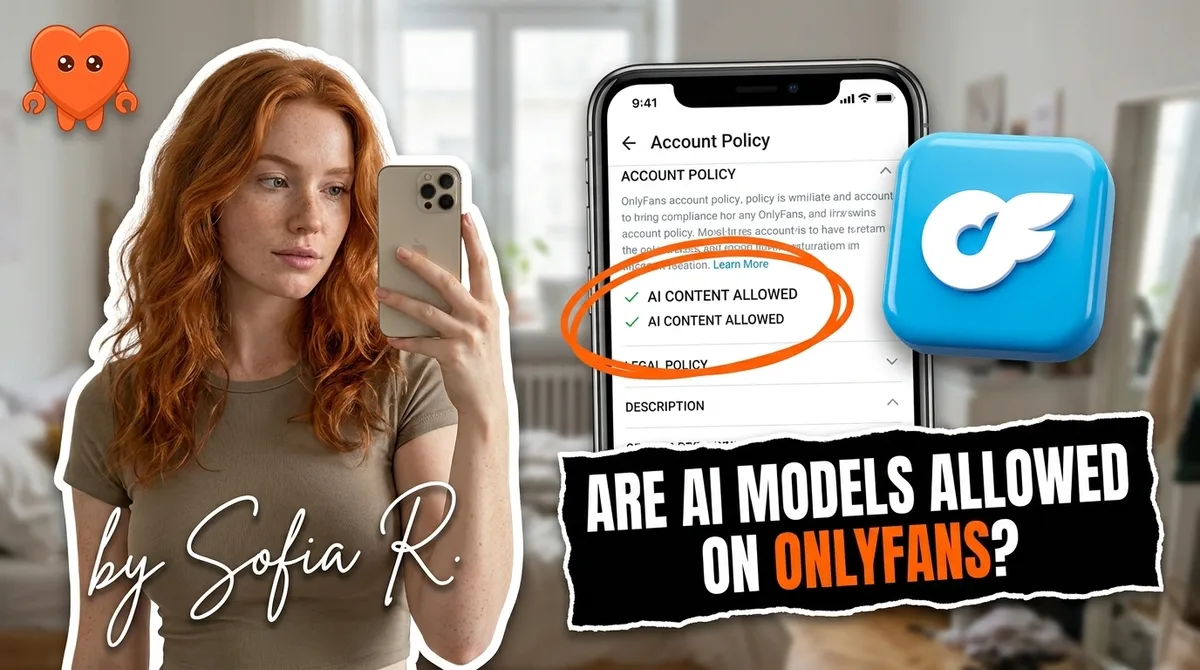
AI influencers are allowed on OnlyFans in 2026, with clear conditions. A real, verified human must be behind every account. AI-assisted content, labeled AI images, and AI-drafted messages are all permitted when properly disclosed. What is banned, with no exceptions, is AI used to generate deepfakes of real people without their consent, and fully synthetic personas presented as human with no real creator attached. Fanvue takes a more permissive route: it actively supports fully AI-generated accounts and anonymous creator teams, provided the content is disclosed and no real individual is impersonated.
Here is exactly where each platform draws the line, why consent and disclosure are the two non-negotiable rules regardless of which platform you use, and how to run an AI-assisted account safely without putting your income at risk.
What OnlyFans actually allows for AI content in 2026
OnlyFans permits AI-assisted content under a specific framework. The platform requires a real, verified human identity behind every creator account. That person's identity is tied to the account through OnlyFans' standard verification process, the same process any creator goes through. The AI content must be associated with that real creator.
Within that framework, the following are allowed:
- AI-assisted photo editing and enhancement. Touch-ups, upscaling, color grading, and post-production work using AI tools are standard and unproblematic.
- AI-assisted captions and messaging. Using an AI tool to draft replies, captions, or mass messages is permitted, provided the creator reviews the output and the AI assistance is disclosed where required.
- AI-generated images and video. Synthetic imagery tied to the creator's account is allowed when labeled. The platform expects visible disclosure, typically #AI or #AIGenerated tags on the content itself.
- AI personas that resemble the real creator. An AI-generated version of yourself, trained on your own likeness with your consent, falls within the permitted zone as long as disclosure is in place.
What OnlyFans does not allow is an account built around a fully synthetic character with no real human attached, or a creator using AI to present an entirely fabricated persona as a real person. Every account, no matter how AI-assisted the content is, requires a human holding the verification documents.
The clearest summary: OnlyFans is AI-friendly when disclosure is present and a real person owns the account. It is not designed to host AI-native virtual influencers with no human behind them.
Fanvue's position: the platform built for AI creators
Fanvue has explicitly positioned itself as the destination for AI-generated creators, including fully virtual influencers with no real human operator who ever needs to be disclosed. As of 2026, Fanvue permits:
- Fully AI-generated images and videos, including explicit content in regions where such content is permitted.
- Synthetic personas that are not tied to any real individual. You can build and monetize a character that exists only as a digital construct.
- Anonymous creator teams. A studio or team can run an AI account without disclosing a real identity behind it.
- AI-generated personalities with their own backstories and aesthetics, as long as the page is disclosed as AI-generated content.
The disclosure requirement still applies on Fanvue. Creators must make clear to subscribers that a page or its content is AI-generated. And the hard line holds: impersonating a real, identifiable person without their consent is prohibited on Fanvue as well.
If your goal is to build a virtual creator brand without anchoring it to your real identity, Fanvue is architecturally built for that. For more context on what the platform offers and how it compares to OnlyFans, see our guide on what is Fanvue.
The hard line that applies everywhere: consent and no impersonation of real people
Both platforms, every legal jurisdiction, and basic professional ethics draw the same boundary. Using AI to generate realistic content that places a real, identifiable person in scenarios they did not consent to is not a grey area.
On OnlyFans, this is an immediate permanent ban with no appeal path. On Fanvue, it is equally prohibited. Beyond platform enforcement, it exposes the operator to civil and criminal liability under laws that have tightened considerably since 2024. Several jurisdictions now have specific statutes covering non-consensual synthetic media, including the US federal TAKE IT DOWN Act signed into law in May 2025, which criminalizes the nonconsensual publication of intimate images both real and AI-generated. The trend is toward stricter enforcement, not looser.
The practical rules are simple:
- Your own likeness, your own consent. Using AI to generate content featuring your own face and body, with your own consent, is the clearly permitted zone on both platforms.
- Entirely original synthetic personas. Characters with no ties to a real person are permitted with proper disclosure, and Fanvue is the better-suited platform for this use case.
- Real people without consent. Zero tolerance, zero exceptions. No platform rule, no creative framing, and no claim of fictional intent changes this.
The fastest way to end your creator business permanently is to generate non-consensual synthetic content featuring a real person. This is the one category where every platform, every payment processor, and most legal systems agree.
How to stay compliant when using AI in your content workflow
Compliance on both platforms reduces to three practices. Applied consistently, they remove the meaningful account risk that comes with AI-assisted workflows.
Disclose visibly and early. On OnlyFans, use #AI or #AIGenerated on any post where AI tools generated or substantially altered the content. Do not bury the disclosure in a profile footer that subscribers rarely read. Put it where fans see it before they pay. Fanvue requires the same at the page level for AI creator accounts. Visible disclosure is the difference between a permitted workflow and a policy violation.
Keep a real human in the loop for messaging. On OnlyFans especially, the platform's permitted AI chatting model requires a human reviewing and approving what gets sent. An AI drafts, a human sends. This is not just a compliance point: conversations that have a real person in the loop tend to convert better, because the replies can actually respond to what the fan said rather than generating a plausible-sounding non-answer.
Own the content you post. Whether the image was taken by a photographer, generated by an AI tool, or produced by a studio, you need the rights to post and monetize it. AI-generated content where you hold no license to the output, or where the generation was done on a platform that retains ownership of generated assets, creates a gap you do not want in your content library.
A fourth practice worth adding: review each platform's terms every couple of months. Both OnlyFans and Fanvue update their AI policies as the technology and the regulatory environment evolve. A rule that was permissive in early 2026 may be tightened by late 2026. Ten minutes of reading is cheaper than an account suspension.
AI chatting tools and the account safety question they rarely answer
There is a second dimension to AI on OnlyFans that disclosure rules do not cover: where the AI runs, and what it does with your credentials and your fan data.
Most AI chatting tools available today are cloud services. You give them your OnlyFans login, they sign into your account from their own servers, and they send messages on your behalf. The AI assistance is real. The account risk is also real, and it is structural rather than behavioral.
When a cloud tool logs in as you from shared servers, your account inherits the flag profile of those servers. If any other account on those servers has been flagged for spam, fraud, or policy violations, that flag can travel to yours. This is one of the mechanisms behind unexplained account restrictions that creators often attribute to mysterious platform behavior. The actual trigger is frequently a compromised server IP shared with a flagged account.
The data risk is equally direct. A cloud tool reading your DMs has access to your fan list, your subscriber payment behavior, your highest-spending fans, and your complete message history. That data lives on their servers under their terms, not yours. You have no audit trail if something goes wrong.
The alternative architecture is an agent that runs on your own machine. Your login never leaves your laptop. No server you do not control ever touches your fan messages. This is the model FanClaw uses: a local agent that handles DMs, posting, and acquisition on your machine, with your approval on anything that matters. For the full picture of what puts accounts at risk and how to protect yours, the why OnlyFans accounts get banned guide covers every category in detail.
The disclosure requirement and the account-safety question are separate issues. You can be fully compliant on disclosure and still be running a structural risk by handing your credentials to a cloud service. Getting both right is the standard worth holding.
OnlyFans vs Fanvue for AI content: a quick comparison
| OnlyFans | Fanvue | |
|---|---|---|
| Real human required behind account | Yes, verified | No (anonymous teams allowed) |
| Fully AI-generated personas | Not permitted | Permitted with disclosure |
| AI-assisted content tied to real creator | Permitted with disclosure | Permitted with disclosure |
| AI deepfakes of real people | Permanent ban | Permanent ban |
| Disclosure required | Yes (#AI / #AIGenerated) | Yes (page-level disclosure) |
| AI-generated explicit content | Allowed when disclosed and tied to verified creator | Allowed in permitted regions |
| Best fit for | Real creators using AI tools | Virtual/AI-native creator brands |
The platforms are not in direct competition for this use case. They serve different operator profiles. If you are a real creator using AI to extend your output, OnlyFans is fine. If you are building a virtual brand with no real human identity attached, Fanvue is designed for you. Running both is common among operators who want reach on the larger platform and flexibility on the more permissive one.
Running both is also the 2026 standard for maximizing subscriber reach. OnlyFans had 377.5 million fan accounts by the end of fiscal 2024 and the strongest discovery surface. Fanvue brings algorithmic recommendation, better creator tools, and full support for AI-native accounts. There is no reason to treat them as an either-or choice.
Frequently asked questions
Yes, with conditions. OnlyFans requires a real verified human behind every account. AI-assisted content is allowed when it is disclosed and tied to that real creator. Fully synthetic personas with no real human attached are not permitted. AI deepfakes of real people are an immediate permanent ban.
Yes. As of 2026, OnlyFans requires creators to label AI-generated or AI-assisted content using visible tags such as #AI or #AIGenerated. Undisclosed AI content is a stated policy violation that can lead to suspension. The disclosure requirement applies to images, videos, and AI-assisted messages.
No. OnlyFans requires a real, verified human identity behind every creator account. An account built entirely around a synthetic persona, with no real person attached, violates the platform's terms. If you want to run a fully AI character without disclosing a real identity, Fanvue is the platform designed for that use case.
Fanvue actively supports AI-generated creators. Fully synthetic personas, AI-generated images and videos, and anonymous teams running AI accounts are all permitted, provided the content is clearly disclosed as AI-generated and the persona does not impersonate a real individual. Fanvue has positioned itself as the primary destination for AI influencer accounts.
No. Generating realistic images or videos that place a real person's face on content they did not consent to is an immediate permanent ban with no appeal. This is the zero-tolerance category on both OnlyFans and Fanvue. It also carries legal exposure under multiple jurisdictions independent of what any platform permits.
Yes, with disclosure. OnlyFans allows AI-assisted messaging with a human in the loop and a real creator behind the account. The AI drafts or assists; the creator reviews and sends. As of 2026, disclosed AI chatting is explicitly permitted. The key word is disclosed: using undisclosed AI to impersonate a real creator is a policy violation.
There is an account-risk dimension beyond the disclosure question. Cloud chatting tools log into your account from their own servers, and your credentials travel outside your machine. If those servers are shared with flagged accounts, your account can absorb that risk. The safest setup is automation that runs locally, so your login never leaves your own device.
Undisclosed AI content is explicitly on OnlyFans' list of policy violations that can result in account suspension. The platform expects visible labeling, such as #AI or #AIGenerated tags. Disclosure is also the ethical baseline: fans paying for content have a reasonable expectation of knowing whether what they are seeing is AI-generated.