

What is Fanvue? the complete creator guide (2026)
What is Fanvue? A subscription platform for creators, known for AI-friendly policies and lower fees. How it works, what it costs, and how it compares to OnlyFans.
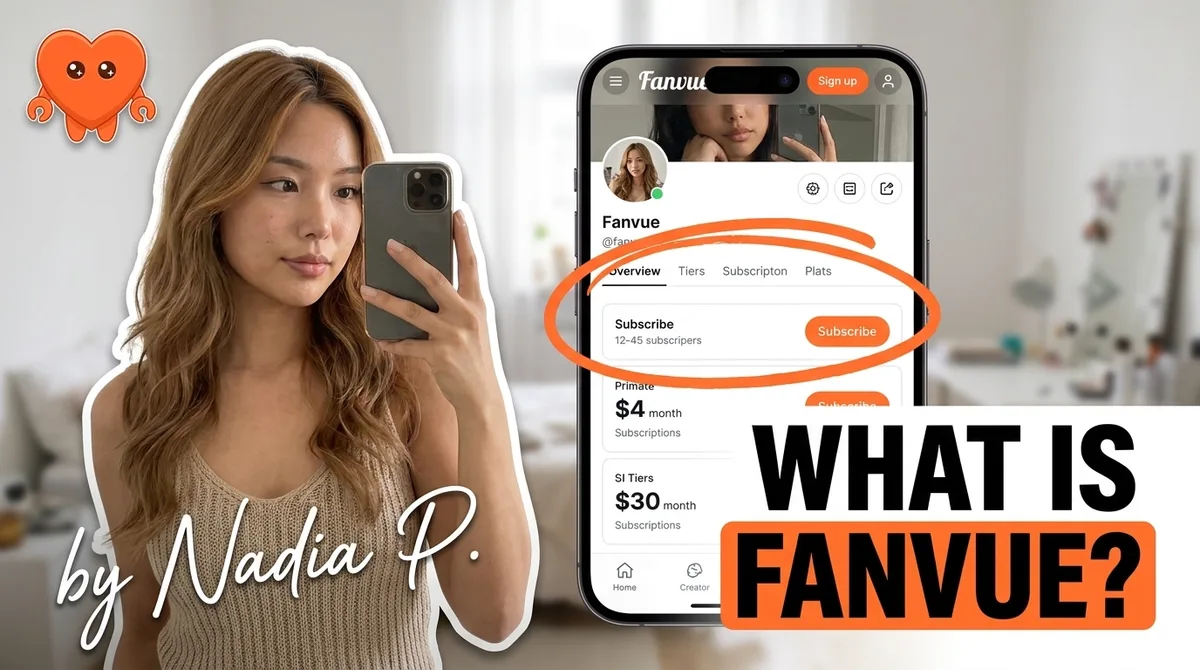
Fanvue is a subscription platform for creators that lets fans pay a recurring fee to access exclusive photos, videos, and direct messages. It launched as a direct competitor to OnlyFans, and its defining features are a lower fee for the first year of operation and an explicitly AI-friendly content policy that sets it apart from every other major subscription platform in 2026.
If you are trying to understand whether Fanvue is worth adding to your platform mix, this guide covers everything: how the platform works, what it costs, who it is built for, how it compares to OnlyFans, and what running it alongside other platforms actually looks like in practice.
How Fanvue works
Fanvue follows the same core model as OnlyFans. Fans pay a monthly subscription fee you set to unlock your profile. Inside that paywall, you post content and communicate with subscribers directly.
Beyond the subscription, you have three additional revenue levers:
- Pay-per-view (PPV). Lock individual photos or videos behind a one-time purchase price. Fans who are subscribed still need to pay separately to unlock PPV content.
- Direct messaging. Charge fans to message you, or send them paid content directly in the chat. The DM inbox is where the biggest earners on subscription platforms generate the most revenue.
- Tips. Fans can send tips on any post or message without any minimum, which works well for reactive appreciation from engaged fans.
Getting set up requires identity and age verification before Fanvue activates your payout capability. The process takes one to three days and is a standard requirement across all legitimate subscription platforms.
What Fanvue costs creators (fees and payouts)
Fanvue charges 15 percent for your first 12 months, then 20 percent from year two onward. You keep 85 percent of everything you earn in year one. That drops to 80 percent after the promotional period ends, which matches Fanvue's own creator earnings policy: the standard rate is 80 percent of gross revenue to the creator, with promotional earning rates published separately.
Payouts go out via bank transfer, e-wallet, or cryptocurrency. The minimum payout threshold sits in the $50 to $100 range, and Fanvue targets a 10-business-day processing window from when you request a withdrawal.
The comparison to OnlyFans is straightforward:
| Fanvue (year 1) | Fanvue (year 2+) | OnlyFans | |
|---|---|---|---|
| Platform fee | 15% | 20% | 20% |
| Creator keeps | 85% | 80% | 80% |
| Payout frequency | Weekly | Weekly | Daily |
| Minimum payout | ~$50-$100 | ~$50-$100 | $20 |
| Payout methods | Bank, e-wallet, crypto | Bank, e-wallet, crypto | Bank |
| AI content | Permitted (labeled) | Permitted (labeled) | Restricted |
The first-year fee advantage is real. On $5,000 per month in revenue, the five-percentage-point difference is $250 a month you keep instead of paying to the platform. Over 12 months, that is $3,000. After year one, the gap closes entirely.
For a full side-by-side breakdown of the two platforms including content rules, verification, and audience size, see Fanvue vs OnlyFans.
Fanvue's AI-content policy: the real differentiator
Fanvue's most significant strategic bet is its permissive stance on AI-generated content. The platform explicitly allows AI-created images, videos, and written content as long as creators label it clearly so fans know what they are buying.
This is not a passive policy. Fanvue has integrated AI tools directly into its creator dashboard, including content generation utilities that help creators produce posts faster. As of 2026, the platform reports that a large majority of its creators use at least one of its built-in AI tools, and AI-assisted content accounts for a meaningful share of total platform revenue.
OnlyFans has moved in the opposite direction, tightening restrictions on synthetic and AI-generated content and requiring more transparency around what is real versus produced by a model. That divergence makes the two platforms increasingly complementary rather than purely competing: creators who want to experiment with AI-generated work have a natural home on Fanvue, while their established audience on OnlyFans continues to expect real content.
One key rule applies to both platforms: label AI content honestly. Fans who feel deceived about what they paid for drive chargebacks and complaints, both of which carry real consequences for your account standing.
Who Fanvue is actually built for
Fanvue fits a specific type of creator situation better than OnlyFans does. It is worth considering if:
You are in your first year of monetizing. The 15 percent fee is a genuine advantage when you are building revenue from a lower base and every dollar of margin matters. The difference adds up before you have the scale to absorb platform cuts easily.
You want to work with AI-generated content. Whether that is using AI tools to produce content faster, publishing AI-created personas alongside your real profile, or experimenting with synthetic posts, Fanvue is the platform that explicitly supports it and provides tooling for it.
You want a secondary platform with no exclusivity friction. Fanvue has no contract that prevents you from running OnlyFans, Fansly, or any other platform at the same time. Adding it as a secondary channel is low-commitment.
You prefer crypto payouts. Fanvue's cryptocurrency payout option is the only one of its kind among the major subscription platforms.
Fanvue is a weaker fit if your primary goal is raw audience reach. OnlyFans is a vastly larger marketplace, with hundreds of millions of registered users against Fanvue's far smaller base. Neither platform provides serious built-in discovery, but OnlyFans's brand name is more widely recognized among fans who are searching for new creators to subscribe to.
Is Fanvue legit?
Yes. Fanvue is a legitimate, operating business that has processed real payouts to creators since 2021. It has public legal documentation including terms of service, creator earnings policies, and payout terms. It requires age and identity verification before activating monetization, which is the same standard every serious subscription platform maintains.
The clearest signal that Fanvue is a real platform: creators use it alongside OnlyFans without treating it as a risk. It is not a "instead of" decision for most people. It is an "also" decision. Thousands of creators earn meaningful secondary income on Fanvue while keeping their primary operation on OnlyFans.
The caution that applies to every subscription platform still applies here. Read the payout terms before you accumulate a large balance. Understand the verification requirements so you are not surprised during onboarding. Keep a copy of your content independently. These are table stakes, not Fanvue-specific concerns.
Running Fanvue alongside other platforms
The practical challenge with operating on multiple subscription platforms is not signing up. It is the daily workload of managing each platform's inbox, scheduling posts across all of them, and keeping your messaging consistent.
Most creators who run OnlyFans and Fanvue simultaneously default to treating one platform as primary and the other as a lower-maintenance mirror. The DMs on the secondary platform get slower responses because there are only so many hours to spend in chat.
The tools that claim to solve this are almost all cloud services: they ask for your login to both platforms, sign in as you from their own servers, and read your fan messages to generate replies. That means a company you have never met holds the credentials to your income, reads your most private fan conversations, and can access your earnings data. If their infrastructure is compromised, your accounts are exposed.
The safer approach is software that runs on your own machine. When the tool operates locally, your login never leaves your laptop, your fan messages are never sent to a third party's servers, and no outside company can take action on your account. FanClaw is built on that principle: one agent running on your machine that handles DMs, posting, acquisition, and monetization across OnlyFans, Fansly, Instagram, X, TikTok, Reddit, and Telegram. It does not run Fanvue, so if you pair the two, FanClaw takes the OnlyFans side and your promotion while you manage Fanvue yourself. You keep full control. You can download FanClaw and run a real session on your own accounts before you commit to anything.
The platforms you run do not change the underlying principle. Whether you are on Fanvue, OnlyFans, Fansly, or all three, the work is the same: conversations to answer, content to post, fans to re-engage. The question is whether you handle all of it manually, hand it to a cloud service that holds your passwords, or run it from your own machine where you stay in control.
What the typical Fanvue creator setup looks like in 2026
Creators who get real value from Fanvue tend to follow a recognizable pattern. They signed up during their first year of monetizing, took advantage of the lower fee while building their subscriber base, and kept the account running after year two because the audience they built on it keeps renewing.
A typical dual-platform setup looks like this:
- OnlyFans as the primary platform, where most subscribers are and where the bulk of DM revenue comes from.
- Fanvue as a secondary platform, sometimes with different or AI-assisted content that does not appear on OnlyFans.
- Instagram, X, Reddit, and TikTok driving traffic to both subscription pages, with acquisition posts timed to each platform's peak hours.
- The DM workload split between both inboxes, either manually or with an automation layer that runs locally and keeps credentials private.
Fanvue is not a replacement for OnlyFans and does not pretend to be. It is a complement, and for creators who want to explore AI-assisted content or keep their options diversified across multiple platforms, it is the most sensible place to do it.
Frequently asked questions
Fanvue is a subscription platform for creators that lets fans pay a monthly fee to access exclusive content. Creators can also earn through pay-per-view messages, direct messaging, and tips. It launched as a direct alternative to OnlyFans and distinguishes itself with a lower first-year fee and a permissive stance on AI-generated content.
Fanvue charges 15 percent for a creator's first 12 months on the platform, then 20 percent after that. This means you keep 85 percent of earnings in year one and 80 percent from year two onward. OnlyFans takes 20 percent from day one with no introductory discount.
Yes, Fanvue is a legitimate platform that has been operating since 2021 and processes real payouts. It requires age and identity verification before you can monetize, and it has its own terms of service and legal documentation. Thousands of creators earn on it every month alongside OnlyFans and Fansly.
Yes. Fanvue explicitly permits AI-generated content and actively integrates AI tools into its creator dashboard. This is the platform's main differentiator from OnlyFans, which has tightened restrictions on AI and synthetic content. Fanvue requires creators to label AI content clearly so fans know what they are purchasing.
Fanvue processes payouts via bank transfer, e-wallet, and cryptocurrency. The minimum payout threshold is in the $50 to $100 range and Fanvue aims to initiate payment within 10 business days of a payout request. This is less frequent than OnlyFans, which offers daily withdrawals with a $20 minimum.
Yes, and running both is the standard approach for serious creators in 2026. There is no exclusivity clause between the two platforms. Many creators treat OnlyFans as their primary income channel and use Fanvue as a secondary platform to capture the audience that prefers it, or to experiment with AI-generated content.
OnlyFans has no built-in discovery feature; all traffic comes from off-platform promotion. Fanvue offers a small onsite discovery component, but it is not a major traffic source for most creators. Both platforms require you to build your own audience through social media, Reddit, and other channels.
The challenge with running multiple platforms is that each one becomes a separate inbox to manage. Tools that run on your own machine, rather than cloud services that hold your login, let you handle DMs, scheduling, and fan outreach across platforms without handing credentials to third parties.