

How to manage multiple creator platforms (2026)
How to manage multiple creator platforms in 2026: the role of each platform, a weekly cadence, one inbox, tracking what pays, and a setup plan that holds.
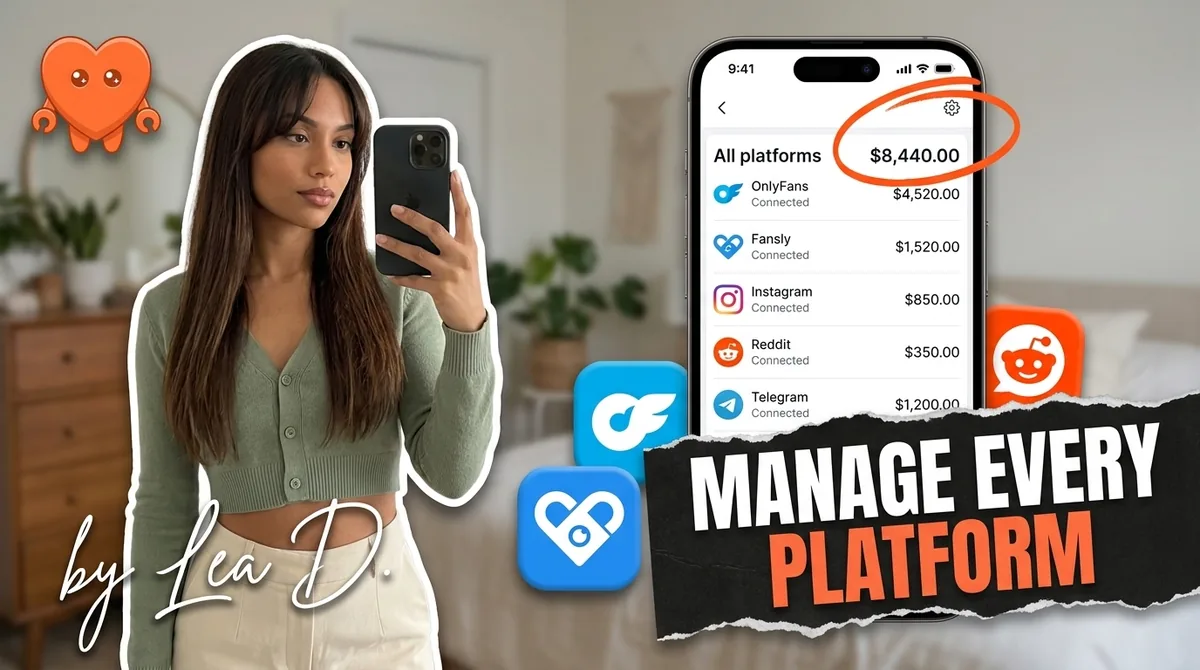
To manage multiple creator platforms, give each one a single job, run them all from one weekly cadence, and stop treating every inbox as a separate shift. In practice that means one or two subscription platforms that earn (usually OnlyFans and Fansly), a few traffic platforms that feed them (Reddit, X, Instagram, TikTok), one batch of content adapted per platform, and a simple way to see where the money actually comes from.
The creators who burn out on multi-platform are rarely on too many platforms. They are on platforms with no defined role, logging into five dashboards a day and answering fans in whichever app buzzed last. This guide is the operating system I use instead: the role of each platform, the weekly rhythm, the inbox problem, tracking, the tool stack, and a setup plan you can copy this week.
Why do creators run several platforms in 2026?
Creators run several platforms because no single platform does both jobs a creator business needs: earning and finding fans. Subscription platforms convert and pay but bring little discovery. Social platforms bring reach but ban or limit adult content. Running both kinds, plus a backup, is how you grow and protect income at the same time.
Subscription platforms earn. OnlyFans is still the largest. In its fiscal 2025 report it counted roughly 5 million creator accounts and 437 million registered fan accounts, and it takes 20 percent of what fans pay. Fansly takes the same 20 percent, adds multi-tier subscriptions and an algorithmic For You feed, and is more permissive on some niches. That is why most adult creators now run both. If you are still weighing them, the full Fansly vs OnlyFans comparison covers fees, payouts and discovery side by side.
Traffic platforms feed. OnlyFans has weak internal discovery, so most new subscribers arrive from outside. Reddit drives 35 to 45 percent of new subscribers for many creators. X allows labeled adult content under its adult content policy. Instagram and TikTok do not allow nudity, but they build the audience that later looks for your link.
A second platform is insurance. Policy changes, payment processor pressure and account reviews happen. A creator with one platform starts from zero after a suspension. A creator with a live second platform and an owned channel (a Telegram list, for example) keeps earning while she sorts it out.
A multi-platform creator business is not more platforms. It is fewer decisions per platform.
What role should each platform play?
Each platform should have one primary job: earn, discover, convert, or keep. When a platform has a clear role, you know what to post there, how often, and how to judge it. When it does not, it quietly eats hours. Here is the map most solo creators can start from.
| Platform | Role | What you post there | How it makes money | Main risk |
|---|---|---|---|---|
| OnlyFans | Earn (main paid base) | Full feed, PPV, customs, mass messages | Subscriptions, PPV, tips | Credential sharing, off-platform payment links |
| Fansly | Earn plus discover | Same content, split into tiers | Tiered subs, PPV, tips, For You reach | Doubling your inbox work |
| Discover (highest volume) | SFW-to-explicit teasers per subreddit rules | Sends subscribers | Shadowbans from identical posts | |
| X | Discover plus convert | Labeled teasers, personality posts, replies | Sends subscribers, direct link allowed | Unlabeled adult media, spam patterns |
| Discover (top of funnel) | SFW lifestyle, reels, Stories | Builds demand for your link | Nudity removals, link suppression | |
| TikTok | Discover (reach at scale) | SFW short video around a broad niche | Builds audience, indirect | Account removal for adult signals |
| Telegram | Keep (owned list) | Announcements, previews, VIP drops | Retention, paid channel option | Leaks if you post full content |
Two rules make this table work. First, only the earn platforms hold paid content. Everything else is a trailer. Second, every discover platform points to one link hub, so you are not maintaining seven different funnels. For the wider landscape of paid platforms beyond these two, see our roundup of sites like OnlyFans and pick at most one extra earn platform per year.
The platform-map mistakes that cost the most hours:
- Two platforms with the same job. Running Instagram and TikTok as identical reach channels, with the same clips and no difference in audience, doubles the work for one result. Give one of them a different angle or park it.
- A traffic platform with no path to money. If a channel has no link hub, no pinned post and no clear next step, its views never become subscribers.
- Paid content leaking into free channels. A full set on a free Telegram group or a public subreddit teaches fans they never need to subscribe.
- Adding a platform because it is new. A new platform deserves a place on the map only when it does a job the others do not, such as reaching an audience you cannot reach today.
How to run multiple platforms on one weekly cadence
Run every platform from the same weekly rhythm: one production block, one adaptation and scheduling block, short daily promotion and inbox windows, and one weekly review. The platforms change what each post looks like. They should never change when you work. A shared cadence is what keeps five platforms at roughly the effort of two.
Batch once, adapt per platform
Shoot once for the week, or for two. Then work in this order: plan the full set for the paid platforms, cut the SFW versions for Instagram and TikTok, pick teasers for X and Reddit, and write short previews for Telegram. Adapting from the full set down is fast. Going the other way means reshooting.
Keep one media library with a simple log: file, shoot date, and a column per platform for where it went. It sounds basic. It is the difference between a 20 minute scheduling session and an hour of scrolling feeds to check what already went out.
A weekly rhythm that holds
- Monday: plan the week's posts and PPV, queue OnlyFans and Fansly for the whole week.
- Tuesday to Friday: 30 to 45 minutes of promotion a day (one Reddit post, X replies and a teaser, one Instagram or TikTok piece), plus two short inbox review windows.
- One day a week: production. Filming, then editing and captioning in one pass.
- Sunday: a 30 minute review of what each channel sent and what it earned.
Your exact days matter less than keeping them fixed. The algorithm on each platform rewards consistency, and so does your nervous system.
The one-inbox problem
Content scales with batching. The inbox does not. Every earn platform has its own DMs, and the traffic platforms add comments and message requests on top. DMs are also the single biggest revenue lever: a new subscriber is warmest in the first minutes, and a $50 custom that sits for eight hours often goes cold. A solo creator can wake to 200 or more unread messages on one platform. On two, she cannot give both inboxes real attention by hand.
The fix is to treat all inboxes as one queue with one set of rules. Welcome flows, same-day follow-ups and re-engagement nudges run on every earn platform in your own wording. Money conversations (customs, PPV follow-ups, top spenders) come to you for approval, wherever they started. That turns two or three inbox shifts into one review window.
How do you track which platform actually makes money?
Track two numbers per channel: how many new subscribers it sends, and what those fans spend in their first 30 days. Follower counts and views tell you almost nothing about revenue. A channel that sends 40 subscribers who each spend $60 beats one that sends 150 who leave after a week.
Here is a tracking setup that takes about 15 minutes a week:
- One link per source. Use a distinct trial or tracking link per traffic platform where your earn platform supports it, or a tagged link through your link hub.
- Ask in the welcome message. "How did you find me?" is a natural opener, and fans answer it. It also catches the traffic links miss.
- Log weekly, not daily. New subscribers by source, first 30 day spend by source, and hours you spent on that source. Daily numbers are noise.
- Judge after eight to twelve weeks. A new traffic platform needs time to warm up. After that window, a channel with zero paying fans gets cut or rebuilt.
The third column, hours per source, is the one creators skip and the one that matters most. Revenue per hour of promotion is how you decide whether TikTok deserves another quarter or whether that time belongs to Reddit.
Here is what that looks like in a real review. Say Reddit took five hours last week and sent 12 subscribers who spent $40 each in their first month: that is $480, or roughly $96 per promotion hour. TikTok took six hours and sent three subscribers at $25: $75, or about $12 per hour. The takeaway is not to quit TikTok after one week. It is to watch the gap for two months, and if it holds, move hours to the channel that earns them. Account for the 20 percent platform fee when you compare against costs, since you keep 80 cents of each dollar either way.
Five cloud tools, five logins: the tool stack problem
Most multi-platform creators end up with a patchwork: a chatting tool for OnlyFans, something else for Fansly, a scheduler for social, a link hub, a spreadsheet, and sometimes a chatter team. Each one wants its own subscription and, usually, your login. The result is more dashboards, more monthly fees, and your credentials spread across companies you have never audited.
That last part is the real cost. The chatting and CRM tools that rank today (Supercreator, Infloww, and the rest) take your login into their own systems (servers, proxies, or shared team sessions). You hand over your platform login, and the service acts as you and reads your fan messages through its system. Several now cover Fansly too, but each connected account is billed separately. Infloww, for example, starts at $40 per creator profile per month and rises with each account's earnings.
| Patchwork of cloud tools | One agent on your own machine | |
|---|---|---|
| Logins handed over | One per tool, per platform | None, sessions stay on your laptop |
| Where fan messages are read | On each vendor's servers | Only on your machine |
| Platforms covered | Usually OnlyFans first, others patchy | All connected platforms, one place |
| Inbox rules | Different per tool | One set of flows, one approval queue |
| Where your fan data compounds | Split across vendors | In one local history you own |
| Monthly cost | Stacks per tool and per account | One subscription |
This is the gap FanClaw is built to close. FanClaw is a local-first app that runs a creator's DMs, posting, acquisition and monetization from her own machine, across OnlyFans, Fansly, Instagram, X, TikTok, Reddit and Telegram. It is text-only, it drafts in your editorial style, and you approve anything that involves money or a sensitive conversation. Your logins and your fan data never leave your laptop. If you want to see how one agent handles several platforms before deciding anything, you can download FanClaw and run the 7-day free trial locally.
The fastest way to lose several accounts at once is handing all of their logins to cloud tools that sign in as you.
A step-by-step setup plan for managing multiple platforms
Set up in this order: define roles, secure accounts, build one content pipeline, set up tracking, cover the inbox, then add platforms one at a time. Each step makes the next one cheaper. Skipping ahead, usually by opening three new accounts in one weekend, is how creators end up with platforms they abandon within a month.
- Write your platform map. List every platform you are on or plan to join, give each one role from the table above, and delete or park any platform that has no role.
- Secure every account first. Unique passwords, two-factor authentication, a creator email separate from your personal one, and the same handle everywhere so fans can find you. Do not share logins with anyone, tool or person.
- Verify and set up your earn platforms in one sitting. Have your ID ready, set subscription prices and tiers, write your welcome message and bio on both platforms the same day. This is the only part that is truly double work, and it happens once.
- Build one content pipeline. One shot list, one production day, one media library with a per-platform log, and a rule for how each asset gets adapted (full, SFW cut, teaser, preview).
- Create one link hub and one tracking sheet. One link in every bio. Distinct links or tags per source. A weekly log of subscribers, 30 day spend and hours per channel.
- Cover the inbox with shared rules. Write your welcome, follow-up and re-engagement flows once in your own words, apply them to every earn platform, and route money conversations to a single approval queue.
- Lock the weekly cadence. Put the production block, daily promotion windows, inbox reviews and the Sunday review on a calendar and protect them.
- Add one platform at a time. Run the current setup for at least a month. Only when it runs without daily firefighting do you add the next platform, and you give it a clear role and an eight to twelve week test window.
Run this for a quarter and the question changes. It stops being "how do I keep up with all of these" and becomes "which of these deserves more of my week." That is the moment a set of accounts becomes a creator business.
Frequently asked questions
They give each platform one job, batch content in one session and adapt it per platform, and run everything on a fixed weekly cadence. The subscription platforms (OnlyFans, Fansly) earn the money, and the traffic platforms (Reddit, X, Instagram, TikTok) feed them. The inbox is covered by flows in the creator's own wording so it does not depend on her being online.
Yes, and running both is the 2026 standard for adult creators. Both platforms take 20 percent, and nothing in either platform's standard terms makes your content exclusive. The work only doubles if you manage both by hand, so plan content once, queue it on both, and use one inbox workflow for both sets of fans.
Most solo creators do well with one or two subscription platforms and two or three traffic platforms. Five platforms you run well beat eight you neglect. Add a new platform only when the existing ones run on a routine, and drop any traffic platform that sends no paying fans after a fair test of eight to twelve weeks.
Look for one tool that covers the platforms you actually use, handles DMs as well as posting, and does not need your password on its servers. Most creator tools are cloud services built around OnlyFans alone, so a multi-platform creator ends up with several subscriptions and several logins. FanClaw covers OnlyFans, Fansly, Instagram, X, TikTok, Reddit and Telegram from one agent on your own machine.
It depends on where the app runs. A cloud app that stores your logins and signs in from its own servers concentrates every account in one place you do not control, so one breach exposes all of them. An app that runs on your own machine keeps each session on your laptop, and no third party ever holds the keys.
Use a distinct link or a short tag per traffic source, ask new subscribers how they found you in your welcome message, and log it weekly. Then compare two numbers per channel: new subscribers it sent and their spend in the first 30 days. A channel that sends fewer but higher-spending fans is worth more than a big one that churns.
You can reuse the same shoot everywhere, but not the same post. Paid platforms get the full content, while Instagram and TikTok need SFW cuts, X needs adult media labeled, and each subreddit has its own rules. Adapting the crop, caption and explicitness per platform is what keeps your accounts safe.
No. An agency sells hours, and it charges 30 to 50 percent of your revenue on top of the platform's 20 percent for them. A creator with a clear platform map, a batched content routine and inbox coverage on her own machine can run several platforms solo and keep the margin.