Does TikTok allow AI influencers? (2026)
Does TikTok allow AI influencers? Yes, with AI-content labeling rules. What TikTok requires in 2026, what gets flagged, and how to use TikTok to funnel fans.
TikTok allows AI influencers in 2026, and it is one of the strongest discovery surfaces an AI creator brand can use. The platform requires AI-generated content to carry a visible disclosure label, prohibits deepfakes of real people, and bans synthetic media depicting private individuals without consent. Within those rules, fully AI-generated personas, synthetic video content, and virtual character accounts are all permitted. The label is the price of entry, and for most AI creator operations it is a non-issue.
Here is what the rules actually say, what gets removed, and how to structure a TikTok presence that builds your audience without putting the account at risk.
What TikTok's AI labeling rules require in 2026
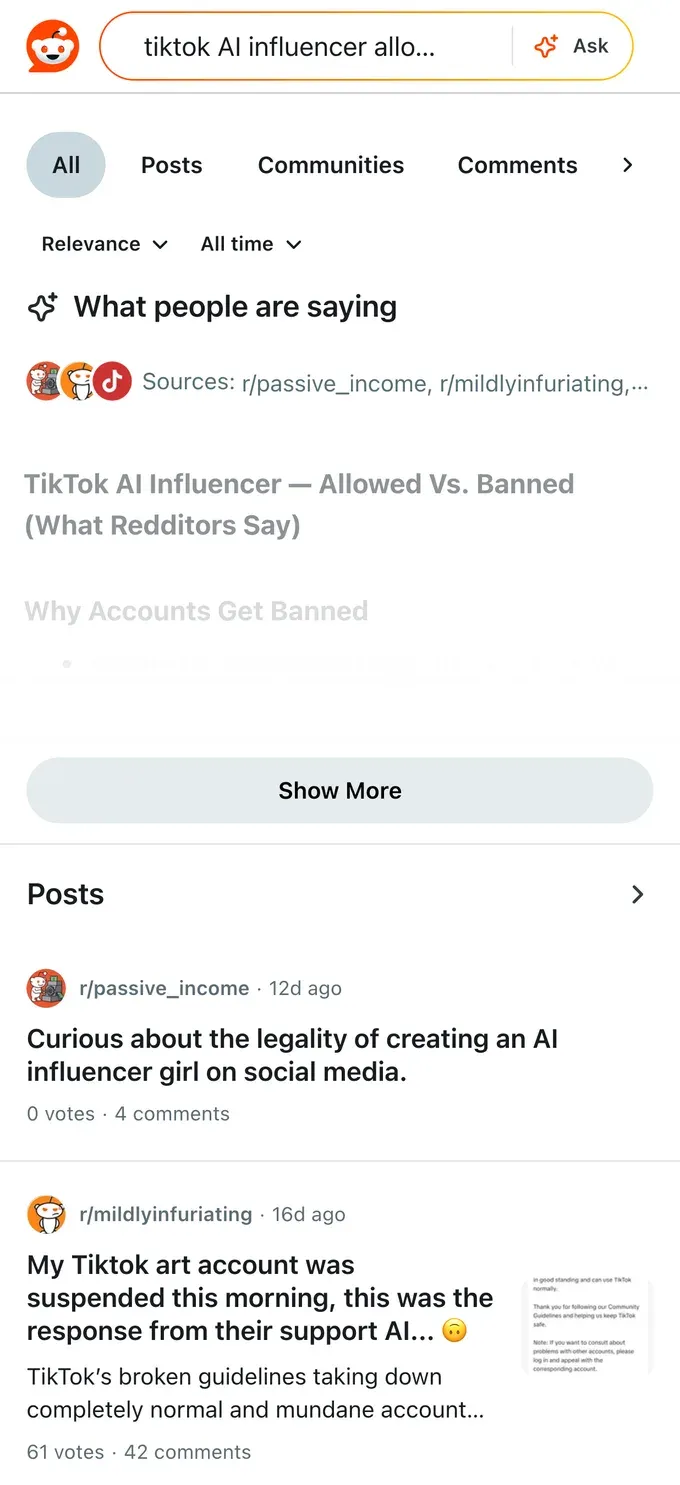
TikTok's synthetic media policy requires a visible AI-generated content label on any video where AI substantially produced the visuals or audio depicting realistic people, faces, or environments. TikTok's own help center states that it requires creators to label all AI-generated content that contains realistic images, audio, and video. The disclosure must be applied using TikTok's built-in label, not a caption note that fans can scroll past.
TikTok enforces this two ways. Creators must self-disclose at upload. The platform also uses C2PA Content Credentials to detect synthetic media automatically, including content where no label was applied. TikTok was the first major social platform to support the open C2PA standard, the same provenance technology now being adopted across the industry. In the first quarter of 2026, TikTok removed over 2.3 million videos globally under its synthetic media policies, a 180 percent increase versus the same period in 2025. The enforcement is active and growing, not theoretical.
What the label requirement covers:
- AI-generated video that depicts a realistic human face or body, including virtual influencer characters
- AI-generated voice-over or synthetic audio paired with realistic human visuals
- Face-swaps, digital avatars based on real individuals, and synthetic talking-head videos
- AI-generated scenes depicting realistic real-world environments presented as documentary
What falls outside the labeling requirement:
- AI-assisted text workflows: script writing, caption generation, hashtag suggestions
- Clearly stylized animation or illustrated content that no reasonable viewer would mistake for reality
- AI tools used for color grading, audio cleanup, or production finishing on real footage
The practical standard is whether a viewer could reasonably mistake the content for a real person doing or saying something. If yes, the label is required.
What TikTok prohibits for AI content, with no exceptions
Labeling unlocks the permitted zone. Some content stays prohibited regardless of what label is attached.
Deepfakes impersonating real people. Generating a realistic video of a real, identifiable person saying or doing something they did not say or do is prohibited. A label does not make this content compliant. The prohibition applies whether the person is a celebrity, a public figure, or a private individual.
Synthetic media of private individuals. Any AI-generated content that realistically depicts a private person, without their explicit consent, is banned. This category has no carve-out for satire or creative framing.
Election-adjacent synthetic media. TikTok prohibits AI-generated content depicting real political candidates, elected officials, or government figures making statements they did not make, within a 90-day window around any national or regional election. This applies globally, not only in the US.
Non-consensual intimate imagery. Synthetic media of real people in intimate or sexual contexts they did not consent to is an immediate permanent ban. This is the zero-tolerance category across every major platform, and TikTok's enforcement here is consistent with its peers.
The useful frame: TikTok is permissive toward AI personas that are clearly synthetic, constructed characters. It is strict toward AI used to put words or actions into real people's mouths or bodies without their consent. The line is not about whether content is AI-generated. It is about whether it misrepresents real individuals.
What AI influencer accounts look like in practice on TikTok
A TikTok AI influencer account, run compliantly, typically looks like this. A synthetic character, with its own aesthetic, name, and content niche, posts short-form videos labeled as AI-generated. The character does not claim to be a real person. The account is registered to a real operator who manages it, but the published persona is entirely virtual.
This format is common in 2026. AI fashion influencers, AI lifestyle characters, and AI personalities built around specific niches (fitness, beauty, travel aesthetics) are all operating publicly on the platform with their AI-generated labels in place.
The operator behind such an account does not need to be the face of the content, and TikTok does not require a real human identity to be disclosed on the public profile. What it requires is that synthetic content be labeled and that no real person is misrepresented.
Where TikTok differs from platforms like OnlyFans is that it is a discovery surface, not a monetization endpoint. TikTok has no subscription infrastructure, no pay-per-view system, and no direct fan payment mechanism. Its value is reach: the algorithm surfaces content to audiences who have no prior relationship with the account, at a scale that is difficult to match on other platforms. For the question of which platforms actually monetize an AI influencer audience, see our guide on are AI influencers allowed on OnlyFans, which covers both the policy and the revenue mechanics in detail.
How to use TikTok as a discovery funnel for an AI creator brand
TikTok's role in an AI creator operation is acquisition. The content is SFW by necessity (TikTok does not permit explicit material), which means the TikTok presence is always the top of the funnel, not the destination. The funnel looks like this:
- Build the AI persona on TikTok. Post consistently. The algorithm rewards frequency and completion rate over follower count. A new account with a clear aesthetic and consistent posting can reach a meaningful audience faster on TikTok than on almost any other platform.
- Label every AI-generated video at upload. Use TikTok's built-in disclosure tool. This takes ten seconds and removes any enforcement risk. Do not skip it because the content feels clearly stylized: the rule applies to any realistic synthetic depiction, and TikTok's automated detection will flag it regardless of your intent.
- Direct traffic to your monetization platform. The bio link, pinned comments, and call-to-action within videos point followers toward your subscription platform, whether that is OnlyFans, Fansly, Fanvue, or another destination. TikTok allows this as long as the linked destination is within its permitted content guidelines for external links.
- Keep TikTok content clean and standalone. The TikTok audience and the paying subscriber audience are separate segments at different stages. TikTok content teases the persona and builds familiarity. It does not need to preview or reference the monetized content explicitly.
- Post on a consistent schedule. TikTok's algorithm deprioritizes accounts with irregular posting patterns. For an AI creator operation where content production is not rate-limited by a human creator's availability, consistency is a competitive advantage worth using.
The accounts that convert TikTok followers to paying subscribers most efficiently are those where the TikTok persona and the subscription platform persona are recognizably the same character. Continuity across platforms increases conversion because the follower already has an established sense of what the persona is.
Staying compliant as TikTok's AI policies continue to evolve
TikTok's AI content rules are not static. The platform updates its synthetic media policy as regulatory environments shift and as enforcement technology improves. The C2PA detection system it uses is the same standard being adopted by other major platforms, which means the compliance habits you build for TikTok transfer directly to how other platforms handle synthetic media going forward.
The practices that keep an AI creator account compliant long-term are straightforward:
- Apply the AI-generated content label to every qualifying video at upload, without exception. It costs nothing and removes the primary enforcement risk.
- Do not attempt to use AI to represent real people in misleading ways, even if the intent is creative or satirical. The platform's rules do not make an exception for intent.
- Check TikTok's Community Guidelines and synthetic media policy every few months. Changes in the 90-day election window, the definition of realistic synthetic media, or the scope of prohibited content types can affect a live account without any warning if the operator has not been reading updates.
- Keep a real person registered behind the account. TikTok's account registration requires a real identity, even for accounts publishing entirely AI-generated content under a virtual persona. The operator identity is separate from the published persona.
One thing worth noting for operators running multiple platforms: compliance discipline on TikTok correlates with account safety elsewhere. Operators who are careless about synthetic media labeling on one platform tend to create risk across their whole portfolio, because the habits are the same. Build the disclosure reflex once and apply it everywhere.
Running the TikTok acquisition funnel on your own machine
For an AI creator operation that uses TikTok as a discovery channel and a subscription platform as the monetization layer, the operational complexity compounds quickly. TikTok requires consistent posting, engagement with comments, and audience tracking. The subscription platform requires DM management, PPV campaigns, and fan retention. Doing this manually across both simultaneously is how creators reach burnout without ever seeing the revenue scale they were building toward.
FanClaw is a local agent that runs a creator's full operation from her own machine: posting, DM management, acquisition workflows, and monetization across OnlyFans, Fansly, Instagram, X, TikTok, Reddit, and Telegram. The fan data stays on the machine. No cloud service handles the login. The operator approves what matters and the agent handles the volume.
For AI creator operations specifically, the TikTok side (discovery, consistent posting, comment engagement) and the OnlyFans or Fansly side (fan DMs, PPV sends, retention) can both run through a single local system rather than a patchwork of cloud tools each asking for a different set of credentials. To see how it works, download FanClaw and run the 7-day trial against your own accounts.
The disclosure rule on TikTok is simple. The operational discipline to run a high-volume AI creator brand across multiple platforms is where the real work is.
Frequently asked questions
Yes. TikTok allows AI-generated and AI-assisted content, including virtual influencer accounts, as long as the content is labeled as AI-generated using TikTok's built-in disclosure tool. Unlabeled synthetic media that depicts realistic people or scenes can be removed without warning.
Yes. As of 2026, TikTok requires creators to apply an AI-generated content label to any video where AI substantially produced the visuals or audio depicting realistic people or environments. TikTok also uses C2PA Content Credentials to detect synthetic media automatically, even when creators do not self-disclose.
Yes, with conditions. AI-generated content that is properly labeled can be monetized through the TikTok Creator Fund and brand deals. The platform does not exclude AI accounts from monetization programs, but unlabeled or misleading synthetic media risks suppression or removal from those programs.
TikTok prohibits deepfakes that impersonate real people without labeling, any synthetic media depicting private individuals without their consent, and synthetic content showing real candidates or elected officials making statements they did not make within 90 days of an election. Harmful non-consensual deepfakes are banned outright regardless of labeling.
Yes. Many AI creator operators use TikTok as a discovery channel, posting SFW content to build an audience and then directing followers to a monetization platform like OnlyFans or Fansly. TikTok does not allow explicit content, so the TikTok presence stays clean and acts as the top of the funnel.
TikTok requires a real person to register and own the account, but the published content itself can be entirely AI-generated and feature a synthetic persona. Unlike OnlyFans, TikTok does not require the creator's verified identity to be the face of the content.
Unlabeled synthetic media that depicts realistic people or scenes can be removed. TikTok's C2PA-based detection can flag content automatically even without a creator disclosure. Repeated violations risk account suppression or removal from creator monetization programs.
TikTok is the strongest discovery surface for AI influencer brands in 2026, with its algorithm surfacing content to audiences with no prior follower relationship required. The platform is not a monetization endpoint (no subscriptions or direct fan payments), so operators use it as an acquisition channel that funnels audiences to OnlyFans, Fansly, or similar platforms.