Best platforms to monetize an AI influencer (2026)
The best platforms to monetize an AI influencer in 2026, compared by AI-content policy, fees, and discovery, so you publish where AI creators are welcome.
The best platform to monetize an AI influencer in 2026 is Fanvue. It is the only major subscription platform that explicitly permits fully synthetic personas, builds AI tools directly into its creator dashboard, and requires labeling rather than prohibition. OnlyFans allows AI content with a verified human behind the account and mandatory disclosure. Fansly banned photorealistic AI content in 2025 and is not a viable primary option for realistic AI personas. Social platforms like Instagram and TikTok are discovery channels for building an audience, not monetization destinations. The practical stack for most AI creator operators is Fanvue for paid content, Instagram or TikTok for reach, and a local-first operations layer to run the account without handing logins to cloud services.
Which platforms actually allow AI influencer content?
The answer to this question changed significantly between 2025 and 2026. The three platforms most relevant to adult or semi-adult AI creator accounts have diverged sharply on policy.
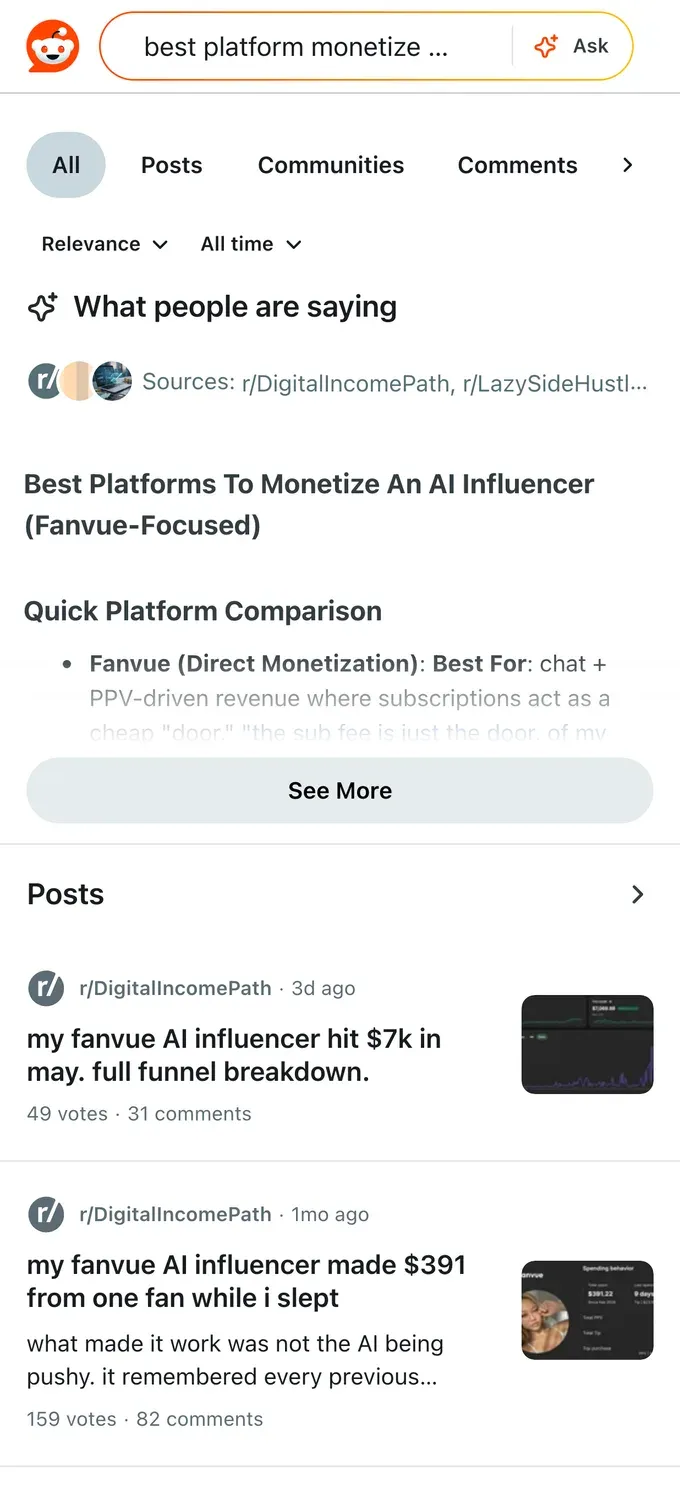
Fanvue is the most permissive. As of 2026, the platform explicitly allows AI-generated images, videos, and fully synthetic personas, including adult content in permitted regions. Creators must label AI content clearly, own the rights to what they publish, and avoid impersonating real individuals. Fanvue's own help center spells this out: when content is AI-generated, the disclosure that it is not real "must be clear and prominent." Fanvue has gone further than any competitor by integrating AI generation tools into its creator dashboard and publicly reporting that a large share of its creators use at least one of those built-in tools. For an indie hacker building an AI persona from scratch, Fanvue is the platform that has structurally decided to support that use case.
OnlyFans permits AI-assisted content under a specific set of conditions: a real, verified human must own and be accountable for the account, all AI-generated or manipulated content must be labeled (tags like #AI or #AIGenerated), and there can be no fully autonomous chatbot impersonating a nonexistent creator. AI-assisted editing, caption drafting, and human-supervised automated chat are allowed. A pure AI persona with no human behind it is not. For operators who want access to OnlyFans' larger audience (more than 370 million registered users as of 2024), the viable path is a hybrid account: a verified human operator responsible for the account, with AI tools doing much of the production work under disclosure.
Fansly banned photorealistic AI-generated content in June 2025. The platform limits AI use to clearly non-realistic content and has tightened its broader synthetic media policies. For a realistic AI persona, Fansly is not a workable primary platform under current rules. It remains a strong option for human creators but should be removed from consideration for AI creator stacks unless your content is explicitly stylized or non-photorealistic.
For a deeper breakdown of Fanvue's AI tools and fee structure, see what is Fanvue, and for a head-to-head on the two platforms most AI creators weigh first, see Fanvue vs OnlyFans.
Platform comparison table for AI influencer monetization
| Platform | AI content policy | Fee | Best for |
|---|---|---|---|
| Fanvue | Fully permitted, label required | 15% year 1, then 20% | Primary monetization for AI personas |
| OnlyFans | Permitted with verified human operator + disclosure | 20% | Secondary platform, hybrid accounts |
| Fansly | Photorealistic AI banned (2025) | 20% | Human creators only |
| Permitted, disclosure required | Free (no monetization for adult) | Audience building, top-of-funnel | |
| TikTok | Permitted, disclosure required | Free (no monetization for adult) | Short-form discovery, viral reach |
| X (Twitter) | Permitted on adult tier with disclosure | Revenue share (Blue subscribers) | Community building, direct audience |
| Patreon | Permitted for SFW, explicit not allowed | ~10% | Mainstream AI personas only |
The table reflects policies as of mid-2026. Platform policies on synthetic content are an active area of regulatory and commercial change; check the current terms before launching any new account.
The social discovery layer: build on Instagram and TikTok, monetize on Fanvue
Fanvue and OnlyFans do not provide meaningful built-in discovery for new accounts. Fanvue has some onsite discovery components, but most new subscriber growth comes from off-platform promotion. That means the social layer is not optional for any AI creator account: it is where you build the audience that then converts on the paid platform.
Instagram and TikTok are the two highest-leverage social platforms for driving subscription signups. Instagram's visual format suits AI-generated image-based personas naturally. TikTok's algorithm is more volatile but can produce rapid top-of-funnel reach for the right content format. Both platforms updated their AI content disclosure requirements in 2025 and 2026: synthetic media must be labeled, and accounts that build followings on undisclosed AI content carry real platform-removal risk that would collapse the whole funnel.
X is the third option for community building. Its adult content policies are more permissive than Instagram or TikTok, which makes it useful for personas in the adult creator space that cannot build freely on the mainstream platforms. Revenue sharing through X's creator program is available for Blue subscribers but is not a primary monetization vehicle at scale.
The structural point is consistent across all three: social platforms are top-of-funnel. The goal is to convert social followers to paid Fanvue (or OnlyFans) subscribers. Direct monetization of an AI persona on Instagram or TikTok is not currently viable for adult content categories.
Building a funnel that converts
A working AI creator funnel in 2026 typically looks like this:
- Post regular content on Instagram or TikTok with clear AI disclosure in the bio and applicable posts.
- Include a link-in-bio pointing to your Fanvue page (or a landing page that bridges to it).
- Use X for community engagement and direct promotional posts when the persona's content category allows it.
- Keep the Fanvue page active with regular posts, PPV messages, and DM engagement to retain subscribers who convert.
The conversion rate from social follower to paid subscriber depends heavily on how often you publish, how consistent the persona's voice is, and how quickly you respond to fan interest. An AI persona that takes three days to reply to a DM from a hot lead loses that conversion.
Consistency compounds over time. A persona that posts three times a week and replies to every DM within a few hours will outperform a higher-production account that goes quiet for stretches. The mechanical work of maintaining that cadence, not the content production itself, is where most AI creator operations break down. Building the operations layer before you scale the audience is the order that works.
The disclosure imperative: label early, label clearly
Every platform that permits AI content at all requires disclosure. This is not a technicality. It is the single most important compliance decision for an AI creator operation.
Fanvue requires that fans can tell what they are purchasing. OnlyFans requires explicit labeling of AI-generated or AI-manipulated content. Instagram and TikTok mandate disclosure for synthetic media under updated 2025-2026 policies. Undisclosed AI content that fans later discover tends to produce chargebacks, complaints, and account-standing damage that is harder to recover from than simply labeling it properly from the start.
A useful standard: disclose in your profile bio, in the caption of every AI-generated post, and in any sales messages that include AI-produced media. Fans who know they are buying AI content and choose to do so are not going to dispute the charge. Fans who feel deceived are. Disclosure is not a conversion killer for AI personas in 2026. There is an active and growing audience that specifically seeks AI-creator content, and that audience tends to be more engaged and less likely to churn than fans who only subscribe when they believe the creator is human.
One further boundary applies everywhere: do not generate photorealistic content using the likeness of a real, identifiable person without explicit consent. This violates the terms of every platform listed in this article and carries legal exposure beyond platform removal. The personas that scale cleanly are original characters, not synthetic versions of existing public figures.
The operations problem: running an AI account without handing over your logins
Choosing the right platform is the first decision. Running the account at scale is the harder one.
An active AI creator account on Fanvue requires daily content posts, regular PPV drops, responses to DMs from new and returning fans, re-engagement messages to subscribers who have gone quiet, and a consistent persona voice across every interaction. This is a full operational load regardless of how much of the content production is automated.
The standard solution many operators reach for is a cloud chatting or management service: you provide your login, and the service sends messages from its own servers on your behalf. This trades operational overhead for something more valuable than it might seem: every cloud service that holds your login has read access to your fan conversations, your earnings data, and your account settings. If that service is compromised, your accounts are exposed. If the service decides to change its terms or raise its prices, you have limited leverage because they hold the credentials.
A local-first approach keeps every piece of that on your own machine. FanClaw is a local agent that runs a creator's DMs, posting, fan engagement, and monetization from her own machine across OnlyFans, Fansly, Instagram, X, TikTok, Reddit, and Telegram. It does not run Fanvue, so a Fanvue account stays yours to manage while FanClaw takes the OnlyFans side and your social channels. Your login never leaves your laptop. Your fan messages are never sent to a third-party server. The agent handles the operational workload and you approve what matters. You can download FanClaw and run a real session on your own accounts without committing to anything.
For AI creator accounts specifically, local-first operations has an additional advantage: your persona's voice, fan data, and interaction history stay on your machine. A cloud service that reads those conversations is a third party that can, intentionally or not, use your persona's training data in ways you did not authorize.
What the standard AI creator stack looks like in 2026
For an indie hacker launching or scaling an AI influencer account, the working stack in 2026 is:
Primary monetization: Fanvue. Set up with full AI disclosure in the bio and on every AI-generated post. Use Fanvue's built-in AI tools for production acceleration. Price subscriptions to match the persona's niche and content frequency.
Secondary monetization: OnlyFans (if you have a verified human operator). An OnlyFans account with a real person accountable for it gives you access to a larger audience. The content can be AI-produced under disclosure, but the account needs a human owner.
Social discovery: Instagram and TikTok. Build the top-of-funnel audience with regular posts. Include clear AI disclosure. Link out to Fanvue. Treat social as traffic generation, not the monetization destination.
Community and adult promotion: X. Use for community engagement and direct promotional content where the persona's content category allows it.
Operations layer: a local agent. Handle DMs, scheduling, and fan engagement from your own machine. Do not hand your logins to a cloud service.
This is not a theoretically ideal setup. It is the setup that fits within the actual 2026 policies of each platform, keeps your credentials and data private, and gives an AI creator account the best realistic shot at sustainable revenue.
The platform landscape for AI influencers is consolidating around Fanvue as the permissive home, OnlyFans as the hybrid option, and social platforms as the discovery layer. The biggest operational risk is not platform policy: it is handing your logins to a tool that runs your account from its own servers and holds everything you have built.
Frequently asked questions
Fanvue is the most AI-friendly major subscription platform in 2026. It explicitly permits AI-generated images, videos, and fully synthetic personas, requires labeling rather than banning, and has built AI creator tools directly into its dashboard. It is the first platform most indie hackers launching an AI persona should evaluate.
OnlyFans allows AI-assisted content as long as a real, verified human owns the account and all AI-generated or manipulated content is clearly labeled, for example with #AI or #AIGenerated. Fully AI-owned accounts, autonomous chatbots impersonating nonexistent creators, and deepfakes of real people without consent are not permitted. A real person must be accountable for the account.
No. As of June 2025, Fansly banned photorealistic AI-generated content. The platform limits AI to clearly non-realistic content and enforces strict policies on synthetic material. For any AI persona that produces photorealistic output, Fansly is not a viable primary platform in 2026.
Yes, with caveats. Instagram and TikTok are discovery channels, not monetization platforms. Both require disclosure of AI-generated content under their updated policies. They are most useful for building a following and funneling that audience to a paid subscription platform like Fanvue. They should not be treated as the destination for monetization.
Fanvue charges 15 percent for a creator's first 12 months on the platform, then 20 percent from year two onward. OnlyFans charges a flat 20 percent with no introductory discount. For an AI-creator account generating $3,000 per month, Fanvue's first-year advantage saves $150 per month compared to OnlyFans.
Yes, on every platform that permits AI content at all. Fanvue requires labeling AI content so fans know what they are purchasing. OnlyFans requires disclosure of AI-generated or manipulated content. Instagram and TikTok also mandate AI disclosure for synthetic media. Undisclosed AI content that leads to chargebacks can damage your account standing across all platforms regardless of the specific rule.
The standard stack is: Instagram and TikTok for audience discovery and top-of-funnel reach, Fanvue as the primary monetization platform because it explicitly supports AI content, and OnlyFans as a secondary option when the account has a verified human operator behind it. X is useful for community building if your persona fits that environment.
Use a local-first operations layer. Tools that run on your own machine keep your credentials and fan data private, unlike cloud chatting services that sign in as you from their own servers. FanClaw is a local agent that handles DMs, posting, and fan management from your machine on OnlyFans, Fansly, Instagram, X, TikTok, Reddit, and Telegram, so no third party ever holds your login or reads your fan messages. It does not run Fanvue.