Financial planning for content creators (2026 guide)
Irregular creator income does not have to mean financial chaos. Here is how to pay yourself a steady salary, set aside taxes, and build a creator-sized safety net.
Irregular creator income does not have to mean financial chaos. The fix is a simple system: route your earnings into a business account, pay yourself a steady monthly salary, set aside 20 to 30 percent for taxes, and build a bigger emergency fund than a salaried worker would. Do that and your personal budget stays calm even when your income swings by half from month to month. This guide lays out the whole system, the same one creators use to end the feast-or-famine cycle, in plain steps.
Why creators need a financial plan
The defining feature of creator income is that it is unpredictable. A great month and a quiet month can be double or half each other, platforms change rules, and seasons swing. Salaried workers get a smoothed, withheld, predictable paycheck. Creators get the raw, lumpy version, with taxes and benefits entirely on them. Without a system, that volatility turns into overspending in good months and panic in slow ones.
A financial plan is what converts lumpy income into a steady life. It does three jobs: it smooths the swings so your personal budget is stable, it sets aside what is not really yours (taxes), and it builds protection for the inevitable slow stretch. None of it requires being good with money in some natural way. It requires a few accounts and a couple of automatic rules, set up once. The rest of this guide is those rules.
Separate your business and personal money
The foundation is two sets of accounts. Open a dedicated business checking account and route all of your platform income into it. Nothing personal touches it. Then, once a month, transfer a fixed amount to your personal account. That transfer is your salary.
The trick is setting the salary below your average income, not at it. If you average $5,000 a month, pay yourself maybe $3,500. The gap stays in the business account and becomes a buffer, so a one-to-three-month cushion builds up that covers the slow months automatically. Your business absorbs the volatility; your personal life sees a steady, boring paycheck. This one move, paying yourself a salary instead of spending whatever lands, is the single biggest upgrade most creators can make to their finances.
Set aside taxes: the 20 to 30 percent rule
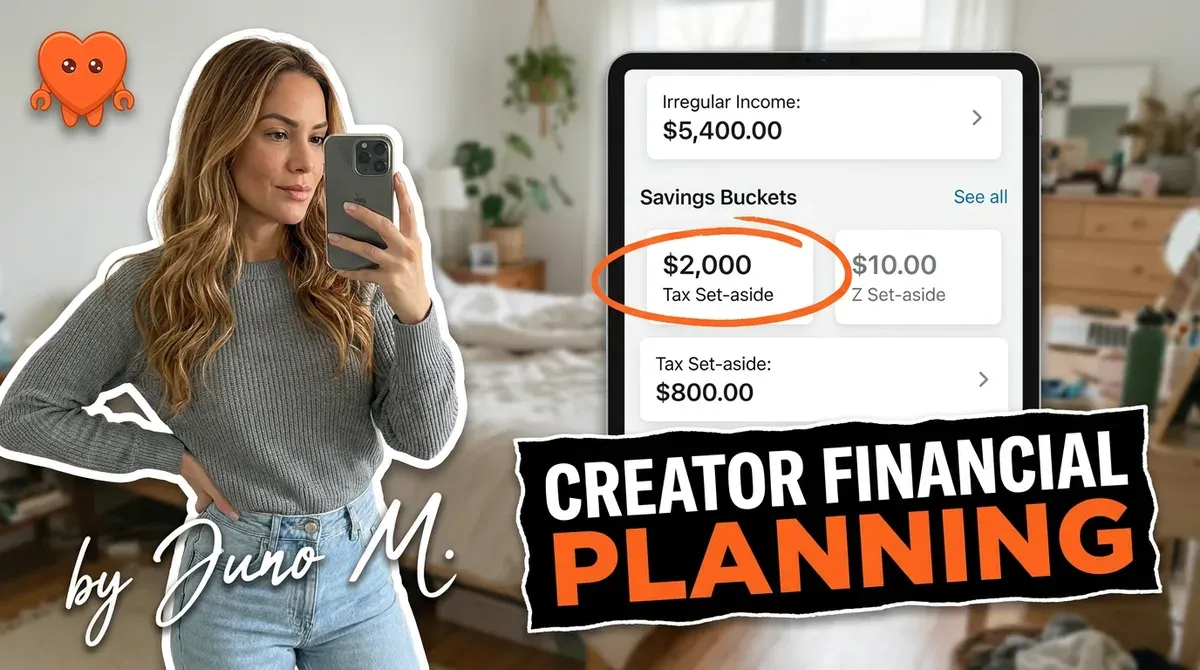
Creator income arrives with no tax withheld, so a chunk of every payout belongs to the tax authority and is just waiting to be moved. The rule: the moment a payout lands in your business account, send 20 to 30 percent of it to a separate tax savings account. Treat that account as untouchable.
Then pay quarterly. Self-employed earners owe estimated taxes four times a year, around April, June, September, and January, and paying as you go keeps you clear of penalties and surprises. When you have set the money aside automatically, quarterly tax is just a transfer from an account that was already full. This is also where the OnlyFans-specific tax detail lives, the 1099, the self-employment tax, the deductions, covered in depth in our guide to OnlyFans taxes. The set-aside habit is what makes all of it painless.
Build a creator-sized emergency fund
Everyone needs an emergency fund, but creators need a bigger one. The standard advice for salaried workers is three to six months of expenses. For creators, aim for 6 to 12 months of essential living costs, held in a high-yield savings account, separate from both your business buffer and your tax account.
The reason for the larger cushion is exactly the reason creators need a plan at all: your income is less predictable and less protected than a job. A platform can change its rules, an account can get suspended, a niche can cool off, a season can be slow. A salaried worker has notice and severance; you have your emergency fund. Six to twelve months of runway is what lets you treat a bad stretch as a problem to solve rather than an emergency that forces bad decisions.
Plan for retirement and keep clean books
Two things finish the system. First, retirement: as a self-employed earner you get access to some of the most generous tax-advantaged accounts there are, like a solo 401(k) or a SEP-IRA, which allow far higher contributions than a standard workplace plan and lower your tax bill in the same move. Automate a monthly contribution and your future self is funded while your tax bill shrinks. You do not need to max it out to start; you need to start.
Second, clean books. Every part of this system, the salary, the tax set-aside, the deductions, depends on knowing your numbers, and that depends on records. Keep your income and expenses tracked in one place, not scattered across platform dashboards and a personal bank app. This is where running your business from one place helps: FanClaw is a local-first app that runs a creator's DMs, posting, and sales from her own machine and keeps that activity on it, so your numbers live in one place you control instead of scattered across platform dashboards. It will not budget for you, but a plan is only as good as the numbers under it, and download FanClaw keeps those on your side.
Frequently asked questions
Build a buffer and pay yourself a salary. Route all platform income into a business account, then transfer a fixed amount to your personal account each month, set lower than your average so it holds in slow months. A one-to-three-month buffer in the business account smooths the swings, so your personal budget stays steady even when earnings do not.
Set aside 20 to 30 percent of your net income in a separate tax savings account, moving the money the moment a payout lands. Creator income has no withholding, so this is on you. Pay quarterly estimated taxes in April, June, September, and January, and the bill is covered before it ever arrives. Knowing your numbers turns tax season into a transfer, not a crisis.
Aim for 6 to 12 months of essential living expenses in a high-yield savings account. That is larger than the standard 3-to-6-month advice for salaried workers, and deliberately so: creator income is less predictable, platforms change rules, and seasons swing. The bigger cushion is what lets you ride out a slow stretch or a platform problem without panic.
Yes, it is the single best habit for irregular income. Instead of spending whatever lands, you pay yourself a consistent monthly amount from your business account, even when earnings swing by 40 percent. Your business absorbs the volatility; your personal life gets a steady paycheck. It ends the feast-or-famine cycle that burns creators out financially.
As self-employed earners, creators have access to some of the most generous options available, like a solo 401(k) or a SEP-IRA. They allow much higher contributions than a standard workplace plan and reduce your taxable income at the same time, so you save for the future and cut this year's tax bill. Automating monthly contributions makes it painless.
Strongly recommended. A dedicated business checking account keeps your income, taxes, and expenses cleanly separated from personal spending, which makes paying yourself, setting aside taxes, and filing dramatically easier. It also gives you a clean record if you are ever audited. You do not need an LLC to open one as a sole proprietor, though many creators add one as they grow.
Not necessarily at the start, but the system matters more than the advisor. Most of the wins, a business account, a salary, a tax set-aside, an emergency fund, a retirement account, you can set up yourself. As income grows or gets complex, a tax professional or advisor who understands creator income can save you more than they cost. Start with the system; add help when the numbers justify it.