

Do you pay taxes on OnlyFans? (2026 guide)
Yes, OnlyFans income is taxable from the first dollar. Here is the 1099-NEC, the self-employment tax, quarterly payments, and the write-offs that cut your bill.
Yes, you pay taxes on OnlyFans income, from the very first dollar. It is self-employment income in the eyes of the IRS, which means you owe regular income tax plus a 15.3 percent self-employment tax on your net profit, and OnlyFans withholds none of it for you. The smart move is to set aside 25 to 30 percent of every payout, learn the handful of deductions that legally shrink the bill, and pay quarterly so nothing piles up. This is a plain-English guide, not formal tax advice, so treat anything high-stakes as a reason to call a professional.
Below: whether you owe, the form OnlyFans sends, how much to expect, the quarterly schedule, and the write-offs that matter most.
Do you have to pay taxes on OnlyFans?
Yes. Money you earn on OnlyFans is taxable self-employment income, full-time or side hustle, form or no form. The platform does not act like an employer: it withholds nothing, sends you 80 percent of your gross, and leaves the tax entirely to you. That is the part that catches new creators out. The payout feels like take-home pay. It is not. A chunk of it belongs to the tax authority and is simply waiting to be set aside.
Treating it as a business from day one solves most of the pain. Open a separate account, move 25 to 30 percent of every payout into it the moment it lands, and keep a simple record of what you earn and what you spend on the business. Do that and tax season is a filing task, not a crisis. Skip it and you spend money that was never really yours, then scramble in April.
The blunt version: not declaring OnlyFans income is tax evasion, not a loophole. The platform reports, so the income is visible. The only question is whether you handle it calmly in advance or painfully after.
What tax form does OnlyFans send? (the 1099-NEC)
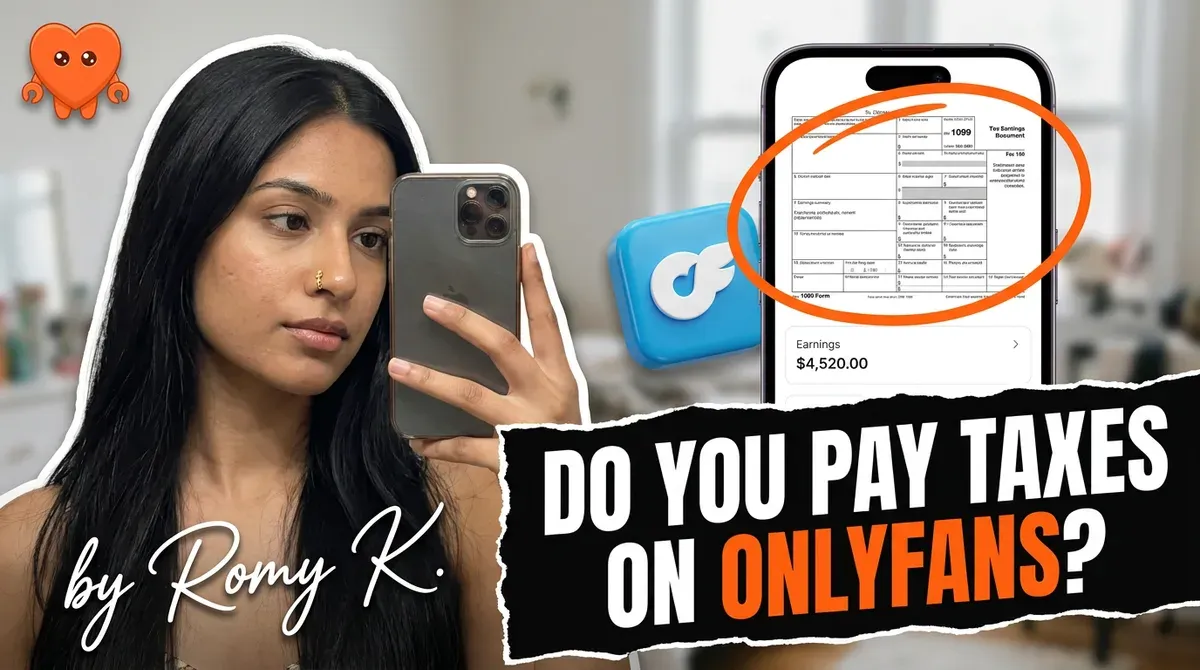
US creators receive a 1099-NEC, the form for non-employee compensation. It is issued under OnlyFans' billing entity, Fenix Internet LLC, which is the name you will see on the paperwork rather than "OnlyFans". For 2026 the reporting threshold was raised to $2,000, up from the old $600, so creators who earned less than that may not receive a form at all.
Here is the trap in that change: no form does not mean no tax. The threshold only governs when the platform is required to file paperwork. Your obligation to report begins at the first dollar regardless. So if you earned $1,500 and never got a 1099, you still report that $1,500. Pull your earnings total from your own records, reconcile it against any form you do receive, and report the real number. A missing form is not a free pass; it is just less help with the math.
How much tax will you owe?
Plan for two layers stacked on top of each other. The first is self-employment tax: a flat 15.3 percent on your net profit, made up of 12.4 percent for Social Security and 2.9 percent for Medicare. According to the IRS, self-employment tax covers the contributions an employer would normally split with you, which is why the rate feels high: you are paying both halves. The second layer is regular income tax at your federal bracket, plus state income tax if your state has one.
You owe both on your net profit, which is your earnings after deductions, not your gross. That is why the deductions section below matters so much. As a working rule, set aside 25 to 30 percent of every payout. Lower earners may end up owing a bit less, higher earners a bit more, but 25 to 30 percent in a separate account keeps you covered without having to predict the exact figure mid-year. The goal is simple: when the bill arrives, the money is already sitting there.
Do you have to pay quarterly taxes?
If you expect to owe more than $1,000 for the year, yes, the IRS expects estimated quarterly payments rather than one lump sum in April. The deadlines fall around April 15, June 15, September 15, and the following January 15. You estimate each payment with Form 1040-ES and pay online through IRS Direct Pay or your IRS account.
Quarterly payments sound like extra admin, but they are mostly a discipline that protects you. They spread the bill across the year so you never face one giant number, and they keep you clear of underpayment penalties, which the IRS charges when you wait until April with nothing prepaid. The mechanics are easy once you have the set-aside habit: the money is already in your tax account, so paying quarterly is just moving it to the IRS four times a year instead of once. Missing all four on a real income is how creators turn a tax bill into a tax bill plus penalties.
What can you deduct? (the write-offs that cut your bill)
Deductions are where you legally lower what you owe, because you are taxed on net profit, not gross earnings. Every ordinary, necessary business expense comes off the top first. The single biggest one most creators miss is the platform fee itself.
The deductions that matter most:
- The 20 percent OnlyFans keeps. It is a platform fee and a deductible business expense. On $100,000 gross, that is a $20,000 deduction.
- Equipment and tech. Camera, phone, lighting, computer, ring light, anything you bought to make content.
- The business share of internet and phone. Deduct the percentage you actually use for the business, not the whole bill.
- Home office. A space used regularly and only for your work can qualify; the rules are specific, so document it.
- Props, wardrobe, and sets used only for content, plus software, subscriptions, and tools.
- Health insurance and retirement. Self-employed health premiums and contributions to a plan like a SEP-IRA are high-value and often overlooked.
Keep receipts and a clean log, because deductions are only as good as your records. This is where running your business from one place helps. FanClaw is a local-first app that runs a creator's DMs, posting, and sales from her own machine and keeps that activity on it, so your earnings and what drove them sit in one place you control instead of scattered across five cloud dashboards. It does not file your taxes for you, but keeping your own numbers organized is the cheapest tax move you can make, and download FanClaw keeps them on your side. And once you know how the money arrives, onlyfans payment methods covers the payout side that feeds straight into all of this.
Frequently asked questions
Yes. Every dollar you earn on OnlyFans is taxable self-employment income, whether it is your full-time job or a side hustle, and whether or not you receive a tax form. OnlyFans does not withhold anything, so the responsibility to report and pay is entirely yours. Not reporting it is tax evasion, not a gray area.
US creators receive a 1099-NEC, issued under OnlyFans' billing entity Fenix Internet LLC. For 2026 the reporting threshold was raised to $2,000, up from $600, so smaller earners may not get a form. That does not change your obligation: you still owe tax on all of it, form or no form, from the first dollar.
You owe two layers: 15.3 percent self-employment tax (12.4 percent Social Security plus 2.9 percent Medicare) on your net profit, and regular federal income tax at your bracket, plus any state tax. A safe rule of thumb is to set aside 25 to 30 percent of every payout in a separate account so the bill never surprises you.
Usually yes. If you expect to owe more than $1,000 for the year, the IRS expects estimated payments four times a year, around April 15, June 15, September 15, and January 15. You calculate them with Form 1040-ES and pay online through IRS Direct Pay. Skipping all four can trigger underpayment penalties on top of the tax.
Ordinary, necessary business expenses. The 20 percent OnlyFans keeps is deductible, as are equipment (camera, phone, lighting), the business-use share of your internet and phone, a home office, props and wardrobe used only for content, subscriptions and software, and professional fees. Self-employed health insurance and retirement contributions are among the highest-value deductions. Keep receipts and a clean record.
No, you do not need an LLC to earn or to file. By default you are a sole proprietor and report on Schedule C. An LLC or S-corp can offer liability or tax advantages at higher income, but it adds paperwork and cost, so it is a decision to make with a tax professional once your profit is consistent, not on day one.
It is tax evasion, and the platform reports payments to tax authorities, so the income is visible. Unreported income can bring back taxes, interest, and penalties, and in serious cases worse. The fix is simple and far cheaper than the risk: track your earnings, set money aside, and file. If you are behind, a tax professional can help you get current.
Yes, the principle is the same everywhere: OnlyFans income is taxable, and you declare it under your country's self-employment rules. In the UK that means Self Assessment, and other countries have their own equivalent. The forms differ, the obligation does not. Check your local rules or ask a local accountant, because thresholds and rates vary.