

Who makes the most money on OnlyFans? (2026)
Who makes the most money on OnlyFans in 2026? The reported top earners, why the numbers are unverified, the real income distribution, and what the top 1% share.
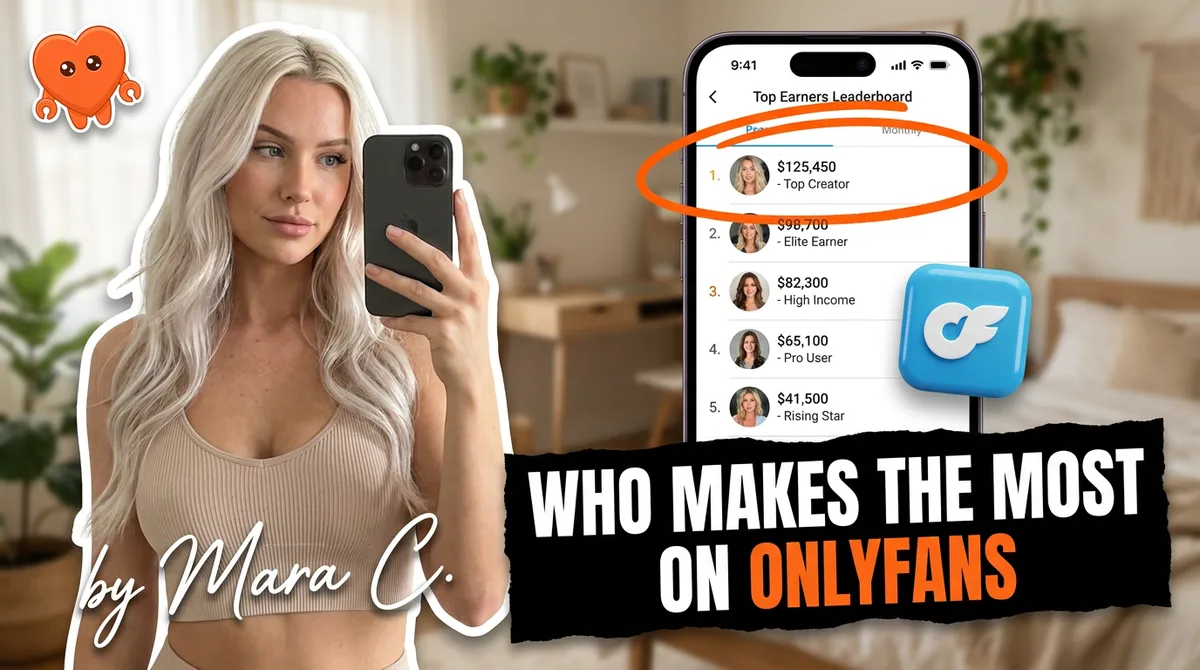
The creators who make the most money on OnlyFans are almost all celebrity-crossover names. Figures like Blac Chyna, Bhad Bhabie, Bella Thorne, Iggy Azalea, and Sophie Rain are reported to earn anywhere from several million to tens of millions of dollars a year. The crucial caveat: every one of those numbers is reported, not audited. OnlyFans does not confirm individual earnings, so the leaderboards you see are built from interviews, social posts, and press coverage, and many of the biggest figures are peak-month or launch-day spikes rather than steady income. The more useful story is the one underneath: how top-heavy the platform really is, and which of the top earners' habits an ordinary creator can actually copy.
This is a data piece, so it is careful with its numbers. Here is who reportedly earns the most, why the figures deserve skepticism, the real income distribution, and the patterns worth learning from.
Who makes the most money on OnlyFans?
The top of OnlyFans is dominated by creators who brought an existing audience with them. Below are the names most frequently cited across 2026 earnings write-ups, with their reported figures and where each number comes from. Read every total as an estimate from press and creator claims, not a confirmed audit.
| Creator | Reported earnings | Basis (read as estimate) |
|---|---|---|
| Blac Chyna | Up to ~$20M/month at peak (around 2021) | Press estimates; a peak-month figure, activity later scaled back |
| Sophie Rain | ~$43M first year (2024); claims ~$95M total since 2023 | Her own posted analytics, self-reported; no explicit content |
| Bhad Bhabie | Claims tens of millions total; record launch (2021) | Self-reported screenshots and interviews |
| Bella Thorne | ~$11M reported in her first week (2020) | Widely reported; her launch triggered platform policy changes |
| Iggy Azalea | Reported multi-million annual run rate | Music-celebrity crossover; press estimates |
| Bonnie Blue | ~$815K/month reported (2025), before a platform ban | Press estimates; banned from OnlyFans in mid-2025 |
The common thread is obvious: these are not people who built an audience from zero on the platform. They converted pre-existing fame, or a deliberate viral spectacle, into subscribers. That is the single biggest reason their numbers dwarf everyone else's, and it is the most important thing to understand before you compare yourself to them.
It is also worth noting how fragile a spot at the top can be. Bonnie Blue reportedly cleared close to $10 million a year before OnlyFans banned her in mid-2025 for content that broke its terms. A top-earner ranking is a snapshot, not a guarantee.
How reliable are these numbers?
Treat them as directional, not factual. This is the most important section in the article, because the entire top-earner genre rests on figures no one can independently verify.
OnlyFans, through its parent company, does not publish or confirm individual creator earnings. Every figure on every leaderboard comes from one of a few sources: a creator's own interview or social media post, press coverage repeating that claim, or occasionally an estate or legal filing. None of it has been independently audited. Creators also have a clear incentive to inflate, because a big number is itself marketing. Sophie Rain spelled this out when she posted what she said were her own platform analytics showing about $95 million in total revenue. The screenshot is persuasive, but it is still self-reported.
The bigger trap is timeframe. When you read "Creator X makes $1 million a day," that figure almost always conflates a record launch day with a sustained monthly run rate, and those are wildly different things. Piper Rockelle's reported $2.9 million in her first 24 hours in January 2026 is a real claim, but a launch spike of that size typically falls 70 to 90 percent within months as the initial subscriber rush lapses. The rankings are probably right about who sits near the top. The exact dollars should carry a mental asterisk every time.
The single most honest statement about OnlyFans top-earner data: it is reported, not audited, and often a peak number rather than a steady one. Use it to understand the shape of the platform, not to benchmark your own page against a figure nobody can confirm.
What does the real income distribution look like?
Here is the context the headlines bury. OnlyFans income is extraordinarily top-heavy, and the median creator lives in a completely different world from the leaderboard.
- The top 1 percent of creators are estimated to earn around a third of all the money on the platform, and the very top, the top 0.1 percent, are outliers even within that group.
- Roughly 75 percent of creators reportedly earn under $1,000 a year, and a large share of accounts are effectively inactive and earn close to nothing.
- The average creator earns roughly $130 to $180 a month with a small handful of subscribers, a figure dragged down by all those dormant accounts.
For scale at the platform level: OnlyFans reported paying out around $5.8 billion to creators in its 2024 fiscal year across roughly 4.6 million creator accounts. Divide it out and the average works out to about $100 a month per account before expenses, which tells you just how thinly that money spreads once you leave the top.
Translated into monthly take, the tiers look roughly like this. Read the ranges as widely cited industry estimates for 2026, not audited figures:
| Creator tier | Estimated monthly earnings |
|---|---|
| Top 0.1% (a few thousand accounts) | $100,000 to $500,000+ |
| Top 1% | $10,000 to $50,000 |
| Top 10% | $1,000 to $5,000 |
| Median creator | ~$130 to $180 |
Niche moves the ceiling, too. What you earn is partly a function of what you make content about. Industry estimates for 2026 put couples accounts at the top, then solo adult, with the non-explicit lanes earning less per fan but often retaining subscribers longer. These are ceilings for creators already running a tight operation, not starting points:
| Niche | Estimated top-creator range (monthly) |
|---|---|
| Couples | $15,000 to $40,000 |
| Solo adult | $12,000 to $25,000 |
| Fitness | $8,000 to $15,000 |
| Lifestyle | $6,000 to $12,000 |
Put those numbers together and the picture is clear. A handful of creators capture an outsized share of the revenue, while the typical account earns a modest side income at best. This is why "the average OnlyFans creator makes X" is such a misleading frame: the distribution is so skewed that the average is pulled far above what a normal creator actually experiences. For the fuller breakdown of those numbers, see our data on OnlyFans average income.
None of this means a non-celebrity cannot do well. It means the top of the chart is not a realistic target, and the middle of the chart is where the achievable goals live.
What do the top earners actually have in common?
Strip away the fame and the same operational patterns show up again and again. These are the replicable parts, and they matter more than any single creator's headline number.
- A promotion machine. Top earners are everywhere their audience is, constantly. Celebrities start with that reach for free. Non-celebrity high earners build it the hard way, through relentless cross-platform promotion on Reddit, X, TikTok, and Instagram, which for many creators drives the large majority of new subscribers.
- A parasocial bond. The best earners make fans feel a genuine personal connection. Sophie Rain is the clearest example: reportedly a top earner without explicit content, built on viral visibility and a strong parasocial strategy that turns attention into paid relationships.
- Heavy DM and pay-per-view monetization. The subscription is the doormat, not the house. Subscriptions reportedly make up only about 4 percent of creator revenue platform-wide, while chatting and pay-per-view, the unlocks, customs, sexting sessions, and tips that happen inside the inbox, drive an estimated 70 to 90 percent of what top creators earn. Look again at Piper Rockelle's reported launch day, where direct messages brought in $819,000, nearly as much as the $1.4 million in subscriptions. The pattern is consistent: average creators obsess over their subscription price, and big earners obsess over the conversation.
- Consistency at scale. They post and engage constantly, not in bursts. Volume and reliability compound, and every gap in activity is a reason for a fan to cancel.
- A clear identity. Even at the top, the strongest creators are known for something specific, not for being generically appealing. A sharp niche retains subscribers far longer than a vague one.
The most repeated piece of advice in creator communities like r/onlyfansadvice is blunt: stop selling subscriptions and start selling conversations. That is where the top of the leaderboard actually lives.
The fame is not copyable. The promotion discipline, the parasocial skill, and the DM monetization are. That distinction is the entire point of studying the leaderboard.
Can a non-celebrity reach the top?
Reaching the absolute summit almost always takes a celebrity-scale audience, or a viral moment that hands you one. That is the honest ceiling, and pretending otherwise is how creators end up disappointed. But "the top" is not the only goal worth having, and the methods that put creators there scale down cleanly.
Bella Thorne's 2020 entrance is the cautionary tale worth remembering here. She reportedly earned around $1 million in her first 24 hours and $11 million in her first week, but the rush of high-priced pay-per-view messages and refund complaints coincided with OnlyFans capping pay-per-view messages at $50 and stretching payout timing for everyone. The lesson is not "charge less." It is that the platform itself sets the guardrails, and a strategy built on a one-time spectacle is brittle.
Sophie Rain is the more instructive case for a normal creator, because her reported success is credited less to explicit content and more to method: viral reach plus a parasocial connection that converts. A non-celebrity cannot manufacture viral fame on command, but they can build the same engine at smaller scale. A sharp niche, aggressive but smart promotion on Reddit and X, and an inbox run like a business is how creators move from the inactive majority into the earning minority, and from a hobby income into a real one.
The realistic target is not to out-earn Bhad Bhabie. It is to apply the top earners' replicable habits to your own audience and capture far more than the $130-a-month median. If you want a sense of where AI-built personas now sit on that curve, our breakdown of how much AI influencers make covers the next wave of creators climbing it.
What do the top earners teach the rest of us?
The biggest lesson from the leaderboard is also the most practical: the money is made in the relationship, and the relationship is made in the DMs. Celebrities monetize attention at massive scale, but the mechanism, a conversation that converts into pay-per-view and tips, is identical for a creator with 500 fans. The constraint for everyone below the top is the same too. The inbox does not scale by hand. A solo creator can promote and post all day, but she can only answer so many messages before the most profitable task on the platform becomes her bottleneck, and fans who wait hours for a reply stop converting. Creators in the busiest niches report fielding 100 or more DMs a day, and sitting in the inbox eight-plus hours on top of filming is exactly how burnout arrives in two to three months. That is the real reason most accounts never climb: not weak content, an inbox that outgrows one person.
This is where the achievable version of "earning like the top creators" runs into reality. Agencies will run your DMs for 30 to 50 percent of revenue on top of the platform's 20 percent cut, which at a 35 percent agency rate leaves you keeping barely half of what each fan spends. Cloud chat tools do the same work while signing in as you from their own servers and reading every message your fans send. Both take something you should keep: your margin, or control of your account.
The alternative is to run the top earners' playbook yourself, from your own machine. FanClaw is a local-first app that handles your DMs, posting, and promotion from your own computer, in your own writing style, with your fan data never leaving your device. It runs the welcomes, follow-ups, and pay-per-view offers that high earners rely on, while you keep the full margin and your login stays yours. You can download FanClaw and build the engine without giving away a cut of it.
So, who makes the most money on OnlyFans? Reportedly, a small group of celebrity-crossover creators, on numbers no one can verify and many of which are peak spikes. The more useful answer is that the top 1 percent earn most of the money by doing a few replicable things extremely well. You will not become Blac Chyna. You can absolutely borrow the habits that put her there.
Frequently asked questions
The most-reported top earners are celebrity-crossover creators. Names frequently cited in 2026 include Blac Chyna, Bhad Bhabie, Bella Thorne, Iggy Azalea, and Sophie Rain, with reported earnings ranging from several million to tens of millions of dollars a year. These figures come from creator interviews, social posts, and press, not from audited platform data, so treat them as estimates rather than confirmed totals.
The top 1 percent of creators are estimated to earn roughly a third of all the money generated on OnlyFans. Individual top earners reportedly make millions per year, while the median creator earns around $130 to $180 a month. About 75 percent of accounts reportedly earn under $1,000 a year. The platform's income is extremely top-heavy, which is why averages mislead.
Not reliably. OnlyFans does not publish or confirm individual creator earnings. Every leaderboard figure comes from creator interviews, social posts, press coverage, or estate filings, and none has been independently audited. The rankings are directionally useful, but exact dollar amounts should be read as reported, not verified, and many are peak-month or launch-day figures rather than sustained income.
Sophie Rain is widely cited among the very top earners. She went viral in late 2024 claiming roughly $43 million in her first year, and in late 2025 posted analytics she said showed about $95 million in total revenue from June 2023, notably without posting explicit content. Like every figure here, it is self-reported, not audited. Her reported success is credited to viral visibility and a parasocial strategy that converts attention into subscriptions and paid messages.
Launch-day records are a genre of their own. In January 2026, Piper Rockelle claimed about $2.9 million in her first 24 hours, reportedly split as $1.4 million in subscriptions, $819,000 in direct messages, and $118,000 in tips. Years earlier, Bella Thorne reportedly made around $1 million in her first 24 hours in 2020. These are self-reported launch spikes, not sustained monthly income, and they typically decay sharply after the first rush.
Celebrities arrive with a built-in audience of millions, so they skip the hardest part: acquisition. They convert existing fame into subscribers instantly, then monetize through subscriptions, pay-per-view, and tips at massive scale. Their advantage is the audience, not a secret method. The mechanics they use are the same ones available to any creator with a smaller following.
Reaching the absolute top usually requires a celebrity-level audience or a viral moment. But the patterns top earners use, a relentless promotion machine, a genuine parasocial connection, and heavy DM and pay-per-view monetization, are replicable at smaller scale. Most non-celebrity creators who do well build a strong niche and run their inbox like a business rather than chasing the leaderboard.
A large share of accounts are effectively inactive and earn near zero, and roughly 75 percent of creators reportedly earn under $1,000 a year. The platform's earnings concentrate heavily at the top, with the top 1 percent taking an estimated third of all revenue. The median creator earns a modest monthly amount, far below the headline figures, which is the most important context for anyone deciding to start.