How much do AI influencers make? (2026)
How much do AI influencers make? An honest 2026 look at AI creator earnings, what drives them, and why most income still comes from the same levers.
AI influencers make anywhere from under $200 per month to over $10,000 per month, with income distributed along the same steep power curve that governs human creator earnings. A small number of breakout accounts generate most of the visible revenue; the majority of new accounts earn modestly, at least to start. The difference between the two groups is almost never the image quality. It is the business operations behind the persona.
This article covers what the data actually shows about AI influencer income in 2026, what drives the spread, and why the same monetization levers that apply to human creators apply here too.
TL;DR: what AI influencers actually earn
- Newcomer accounts typically earn $200 to $500 per month in their first few months, assuming consistent posting and basic promotion.
- Mid-tier accounts can reach $2,000 to $5,000 per month within 6 to 12 months of focused operation.
- High-profile breakout examples: Aitana Lopez, a synthetic Spanish fitness and gaming character created by a Barcelona agency, reportedly earns up to around $11,000 per month, largely via Fanvue (as reported by multiple outlets in 2024).
- Fanvue reported in 2024 that AI creators generate approximately 15% of platform revenue, suggesting a meaningful and growing share even if total numbers are not disclosed.
- Income is highly skewed. Most AI influencer accounts earn little. The accounts that break through run multiple revenue streams and treat the DM inbox as a primary revenue channel.
- Hard data is thin. Anyone quoting a precise "average" AI influencer income is extrapolating from a small sample. Treat headline figures as illustrative, not representative.
The realistic earnings range: skewed, not average
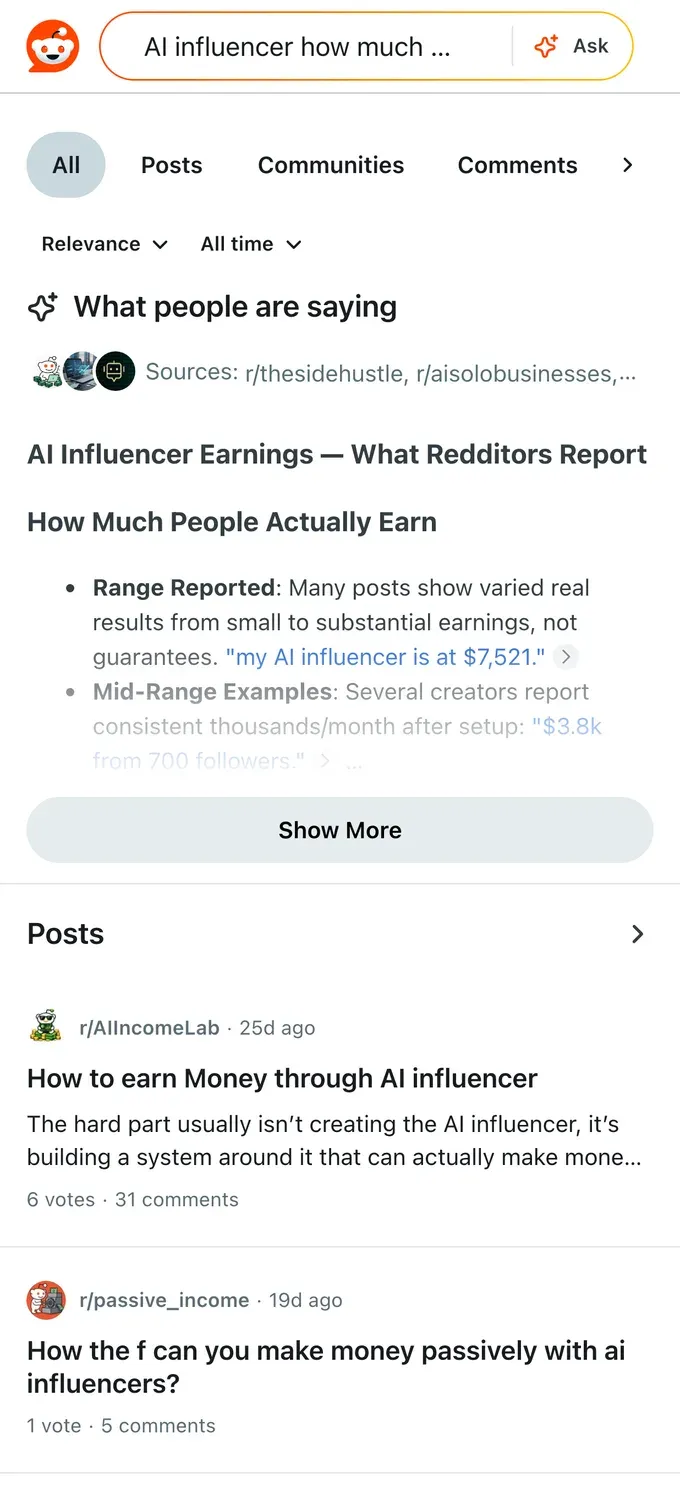
There is no authoritative platform-wide data on AI influencer earnings the way there is for, say, OnlyFans creator payouts overall. What exists is a mix of operator reports, platform disclosures (mostly Fanvue), and case studies from agencies and solo creators who have built AI personas.
The honest picture, based on available data as of 2026:
| Account stage | Monthly income range | Typical conditions |
|---|---|---|
| New account (0-3 months) | $0 to $500 | No existing audience, basic promotion |
| Growing account (3-12 months) | $500 to $5,000 | Consistent posting, 1-2 traffic channels active |
| Established account (12+ months) | $3,000 to $10,000+ | Multiple revenue streams, DM conversion active |
| Breakout (top end) | $10,000 to $50,000+ | Strong brand, audience, and operations |
Aitana Lopez sits at or above the breakout tier. She is not representative. The vast majority of AI influencer accounts that launch today are in the first two rows of that table, and many never leave them.
The income distribution for AI influencers mirrors what we see in human creator platforms: a small percentage of accounts generate a disproportionate share of total revenue. Fanvue's figure that AI creators accounted for roughly 15% of platform revenue is notable not because AI accounts earn more per account, but because the absolute number of AI accounts is still small relative to human creators. A 15% revenue share from a fraction of the creator base implies above-average per-account earnings for the subset that is actively monetizing.
That said: most AI influencer accounts that launch do not reach active monetization. The ones that do are run as businesses, not experiments.
Notable examples and what they reveal
Aitana Lopez is the most cited example. Created by The Clueless agency in Barcelona, she is presented as a 25-year-old Spanish fitness and gaming enthusiast. As of 2024 reporting, she earns up to around $11,000 a month in brand deals, with income split between subscription revenue and brand partnerships with companies who pay her to feature their products in posts. The key detail: a full agency team manages her content, persona, and partnerships. She is not a passive asset; she is an operated character.
The Clueless agency's broader portfolio illustrates a second model: agencies building multiple AI characters simultaneously, treating each as a separate revenue unit. Individual characters may earn less than Aitana, but the portfolio aggregates.
Solo operators running a single AI character on Fanvue, OnlyFans, or Fansly typically report more modest numbers: $500 to $3,000 per month for accounts with a few hundred paying subscribers, rising toward $5,000 to $10,000 for accounts that have built a genuine following over 6 to 12 months and diversified beyond subscriptions.
The honest conclusion from these examples: high AI influencer earnings are real, but they require the same operational investment as a human creator business. The synthetic image removes one cost (the creator's time in front of a camera), but it does not remove the need for content strategy, audience building, or fan relationship management.
The revenue-stream count correlation
Accounts earning over $1,000 per month almost universally run more than one revenue stream. Accounts earning under $1,000 per month almost always rely on a single stream, typically the subscription fee alone.
The pattern holds for AI influencers just as it does for human creators:
One stream (subscription only): Income is capped by subscriber count times monthly price. With a $15/month subscription and 50 paying subscribers, you earn $750 gross before the platform's 20% cut, netting $600. Growth is linear with subscriber acquisition only.
Four or more streams (subscription, PPV, custom content, brand deals): The same 50 subscribers generate more revenue. A PPV message offering a new photo set at $20 nets 80% of however many subscribers unlock it. A custom content request from a single engaged fan can generate $50 to $200 in a single transaction. A brand deal pays regardless of subscriber count. The math compounds differently.
The four revenue streams that high earners consistently combine:
- Subscription fee (recurring baseline, typically $9.99 to $19.99 per month for a new account)
- PPV content unlocks (photo sets $10 to $30, video clips $20 to $50)
- Custom content requests (fan-directed, priced per request)
- Brand partnerships or UGC deals (one-off or recurring, common for fitness, lifestyle, and gaming niches)
An AI influencer account that only has a subscription page is leaving most of its potential revenue untouched.
The factors that drive AI influencer earnings
Niche and character coherence
A clearly defined niche retains subscribers longer and converts brand deals more easily. Fitness, gaming, lifestyle, and cosplay are the most common AI influencer niches in 2026. Characters with a consistent aesthetic, backstory, and posting cadence build stronger parasocial attachment than accounts that post inconsistently across unrelated themes.
Niche also affects PPV pricing tolerance. Some niches support higher per-piece content pricing. Whatever the niche, coherence beats novelty: an audience stays because they know what to expect.
Posting consistency and content cadence
Subscription platforms surface active creators more prominently than dormant ones. Accounts that post four to five times per week retain subscribers at higher rates than those posting once or twice. Every gap in posting is a reason for a subscriber to reconsider renewal.
Image generation tools have reduced the marginal cost of content production for AI creators, but the scheduling and cadence work remains. Consistency is an operational discipline, not a creative one.
DM engagement and conversion
This is where most AI influencer accounts leave significant money on the table. The subscription fee is the entry point; the DM inbox is where revenue compounds.
Among top-earning human creators on OnlyFans, direct messages and PPV messages sent through DMs account for roughly 70% of total income. The same dynamic applies to AI influencer accounts. A subscriber who receives a personalized PPV offer referencing something they mentioned in a previous message converts at a higher rate than one who sees the same mass offer.
The challenge: maintaining conversational consistency across dozens or hundreds of simultaneous subscriber threads, in the voice of a fictional character, 24 hours a day, across multiple time zones. This is where AI creator operations become genuinely complex. Generating the images is the easy part. Managing the relationship layer at scale is not.
Platform fit and disclosure
As of 2026, Fanvue, OnlyFans, and Fansly all permit AI-generated content with disclosure requirements. Fanvue has leaned furthest into supporting AI creators, with dedicated categories and published data on AI creator performance. OnlyFans and Fansly require disclosure but do not promote AI accounts specifically.
Proactive disclosure, framed as part of the character's identity rather than a warning label, tends to retain subscribers better than ambiguity. Accounts that are perceived as deceptive face trust damage and potential bans that are difficult to recover from. The ethical and business cases for transparency align here.
Why the same levers decide it
The income gap between a $300/month AI influencer account and a $5,000/month one is not usually image quality. Mid-tier image generators produce compelling output at low cost. The gap is operational.
The accounts that break through do the same things top human creators do: they post on a schedule, they promote on at least two off-platform channels, they treat the DM inbox as a sales channel, and they run multiple revenue streams in parallel. The synthetic character reduces certain costs and removes some friction, but it does not automate the business.
That is the clearest thing the data shows: AI influencer income is real, it can be significant, and it follows the same rules as creator income generally. High-frequency posting. Active promotion. DM-first monetization. Revenue diversification. Consistency over time.
For a practical breakdown of how to build those revenue streams, see the full guide on how to monetize an AI influencer.
How FanClaw fits into AI creator operations
FanClaw is a local-first app that runs a creator's DMs, posting, acquisition, and monetization from her own machine, on OnlyFans, Fansly, Instagram, X, TikTok, Reddit, and Telegram (not Fanvue). It is the operations layer, not the image generator. It does not produce or store images. What it handles is the part of the AI creator workflow that scales hardest: maintaining consistent, on-voice conversations with hundreds of subscribers simultaneously, sending PPV offers at the right moment, and keeping the inbox responsive around the clock.
Your fan data never leaves your machine. The persona's conversation style is configured locally. You approve what matters. No cloud tool holds your login or reads your subscriber messages on a third-party server.
For operators running AI influencer accounts who are finding that content production is the easy part and subscriber engagement is the bottleneck, download FanClaw and run a session on your accounts before committing to anything.
AI influencer income is real and growing. The ceiling is higher than most people assume. The floor is also lower than the headlines suggest. The accounts that reach meaningful income are operated, not just launched.
Frequently asked questions
There is no reliable platform-wide average for AI influencer income, and anyone who quotes one is likely extrapolating from a small sample. Verified examples show a wide range: newcomer accounts typically earn $200 to $500 per month in their first few months, mid-tier accounts with a small but loyal following can reach $2,000 to $5,000 per month within 6 to 12 months, and breakout accounts like Aitana Lopez reportedly earn up to around $11,000 per month. Income is highly skewed, just like human creator earnings.
Yes, several AI influencers earn meaningful income. Aitana Lopez, a synthetic Spanish fitness and gaming character, reportedly earns up to around $11,000 per month through subscription and brand deal revenue, largely via Fanvue. Fanvue reported in 2024 that AI creators generate approximately 15% of platform revenue. The income is real; what varies widely is whether a given account reaches the scale to make it significant.
Fanvue, OnlyFans, and Fansly are the three most common subscription platforms for AI creator monetization as of 2026. Fanvue has leaned into AI creator support explicitly and has published data on AI creator revenue share. OnlyFans and Fansly require disclosure of AI-generated content but allow it. Some AI influencers also earn through brand partnerships, UGC deals, and Instagram or TikTok sponsorships without a subscription layer at all.
High earners in the AI creator space typically run four or more concurrent revenue streams: a subscription, PPV (pay-per-view) content unlocks, custom content requests, and brand or UGC deals. Accounts earning under $1,000 per month almost always rely on a single stream, usually just the subscription fee. The revenue-stream count is one of the clearest separators between accounts that plateau and those that grow.
Not necessarily. AI influencers face the same platform-concentration risk, algorithm changes, and audience churn as human creators. They also face additional risks: platform disclosure requirements, audience trust issues if the AI nature of the account is perceived as deceptive, and dependency on whoever manages the underlying image and content generation. Operational consistency, the same thing that drives human creator income, is the primary stabilizer.
Scaling fan engagement. Generating images and posting content is the easy part once a workflow is established. The hard part is handling the DM inbox at scale: replying to subscribers, converting fans via personalized PPV offers, and maintaining the persona's voice consistently across hundreds of conversations. This is why AI creator operators increasingly use automation tools to manage the conversation layer, while keeping the character's image and identity under their own control.
As of 2026, OnlyFans and Fansly both require creators to disclose AI-generated content. Fanvue has explicit AI creator categories. Beyond platform rules, the ethical and reputational case for disclosure is strong: audiences are increasingly savvy, and accounts that are later outed as undisclosed AI face significant trust damage and potential bans. Proactive disclosure, framed as part of the character's identity, tends to retain subscribers better than concealment.
Most operators report that a new AI influencer account requires 3 to 6 months of consistent posting and promotion before generating reliable income above the cost of tools and image generation. Accounts that reach $1,000 per month within the first 90 days almost always launched with an existing audience or significant paid promotion. Starting from zero and reaching $3,000 to $5,000 per month within 6 to 12 months is achievable but requires treating the account as a full-time operation, not a passive income experiment.