Teacher on OnlyFans: risks and staying anonymous
Can a teacher have an OnlyFans? It is legal, but school district policies and codes of conduct create real risk. How to protect your job and stay anonymous.
A teacher can have an OnlyFans. It is legal in the United States, and teachers in every state do it. But teaching is one of the professions where the risk profile is genuinely distinct from most: contracts often contain morality clauses, state licensing boards hold authority over professional conduct, and the community-recognition risk is higher than in almost any other field. Students, parents, and administrators are not abstract colleagues. They are people who see your face regularly, search your name, and exist in the same local community. This guide breaks down the real risks and the identity-protection steps that actually reduce them. It is not legal advice. For anything involving your specific contract, district, or state licensing rules, speak to an attorney.
Can a teacher have an OnlyFans? The legal and employment reality
The short answer is yes, it is legal, but "legal" and "consequence-free" are not the same thing. For teachers specifically, two distinct risk categories exist, and understanding both before you launch is the difference between a sustainable anonymous account and one that ends your career.
The first category is your employment contract. Most US public school teachers work under a contract that includes a conduct clause, a morality clause, or a community-standards provision. Private and religious school teachers often work under even broader conduct terms. These clauses vary significantly in their language, but the general principle is the same: your employer can take action if it determines your off-duty conduct is incompatible with your role in the school community. Courts in multiple states have upheld teacher terminations rooted in these clauses when a district could show a direct workplace connection, which in practice usually means a student, parent, or community member recognized the account.
The second category is your teaching license. Every US state licenses teachers through a state education agency or professional standards board. Most of those licensing frameworks include language about moral character, fitness to teach, or conduct unbecoming an educator. Whether running an adult content account meets that standard is not settled across all jurisdictions and varies significantly by state. A formal complaint to the state board is a serious process regardless of outcome. The pathway to that complaint almost always runs through recognition: someone identifies you, informs the district or the board, and a process begins.
These two risks are separate. A district can terminate you without a licensing action being filed. A licensing complaint can be filed without your district initiating anything. A fully anonymous account, maintained with real operational discipline, reduces the surface area for both.
School district codes of conduct and morality clauses
Teacher employment in the United States sits at an unusual intersection: public school teachers work for a government employer, which creates certain constitutional considerations, but most conduct clauses have been consistently upheld where districts can demonstrate a legitimate workplace connection.
How morality clauses are written
Morality clauses in teacher contracts typically use language such as "conduct unbecoming a teacher," "behavior inconsistent with the moral standards of the community," or "conduct that brings the district into disrepute." This language is intentionally broad. It does not enumerate specific off-duty behaviors as automatically prohibited. Instead, it gives districts discretionary authority to make case-by-case determinations, which means the risk to you depends heavily on local administrative culture, community context, and whether your professional identity is discoverable.
Private and religious schools operate under even broader authority. First Amendment protections that constrain public employer overreach do not apply equally to private institutions, and religious schools in particular routinely enforce lifestyle and conduct standards as a condition of employment.
The at-will and tenure distinction
Tenure does not eliminate conduct-based termination risk. It changes the procedural threshold: a tenured teacher generally cannot be dismissed without a formal process that meets due-process standards, which means a hearing, written notice of charges, and an opportunity to respond. For an anonymous account that is never connected to you, none of this process is triggered. For a discovered account, tenure means the process is slower and more reviewable, not that termination is unavailable.
Non-tenured teachers, and teachers in states with weak tenure protections, face simpler contract non-renewal without any formal hearing requirement in many districts. Recognition before tenure is established is a materially higher-stakes event.
State education agency authority over licenses
Beyond your employment contract, most states give their education agency or professional standards board authority to suspend or revoke a teaching license based on moral character findings. A handful of states have issued explicit guidance clarifying that consensual adult content creation, by itself, does not constitute grounds for license action. Most states have not addressed it explicitly, leaving the question to case-by-case adjudication. States with more conservative regulatory environments tend to have broader character-fitness standards and less favorable precedent.
A one-hour consultation with an attorney who handles teacher license defense in your state is money well spent before you launch, not after an incident.
Employment and tenure risk: what the cases show
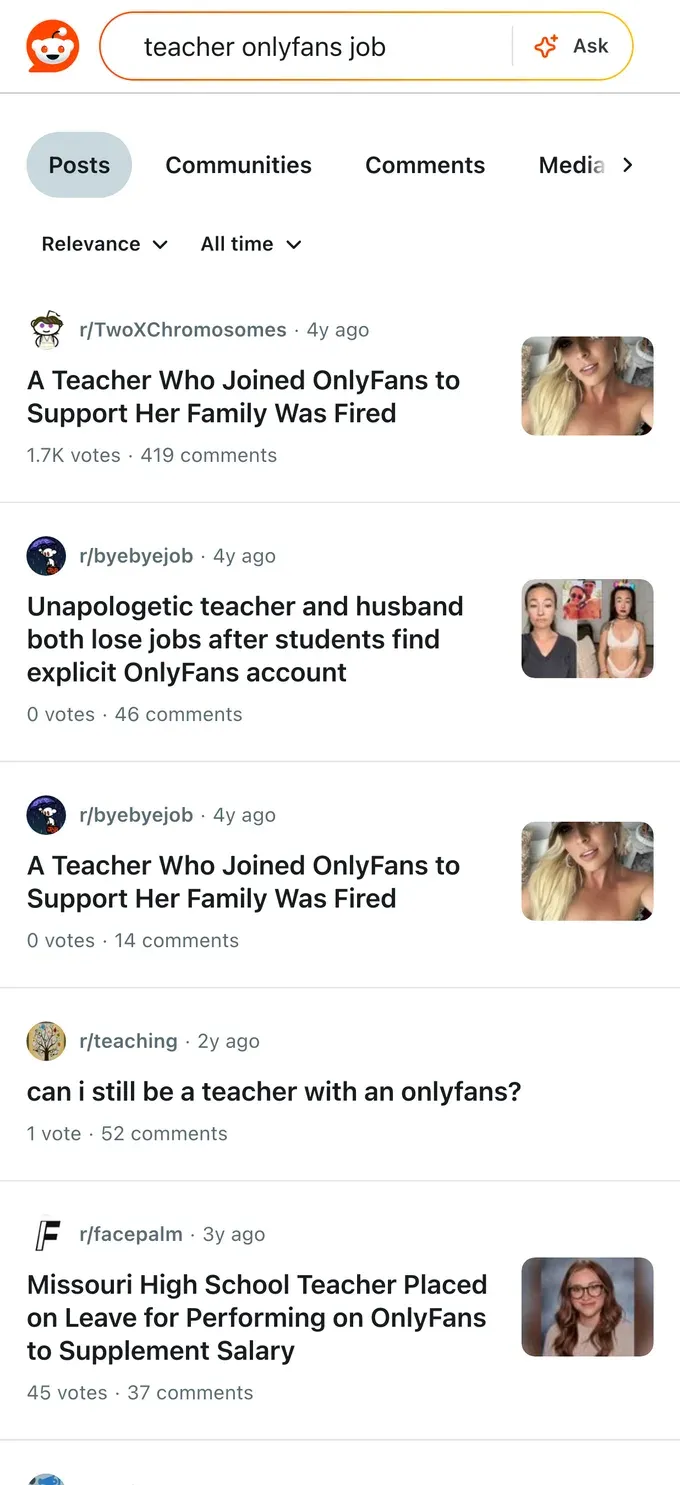
Recent cases illustrate how these risks materialize in practice. A teaching assistant in Iowa lost her position after using her personal phone to view OnlyFans content inside a middle school classroom. Two teachers at a rural Missouri high school resigned after their accounts were identified by community members. In Indiana, a teacher lost a position with a Department of Defense youth education program after creating an account. In Florida, a parent's OnlyFans complaint led to a school volunteer being removed. These cases share a common thread: recognition preceded every consequence. None of these outcomes would have occurred with a properly maintained anonymous account.
The typical sequence runs: someone recognizes the account, identifies the teacher, and either reports to the school district directly or posts the connection publicly, prompting the district to act. The district then applies its conduct policy or contract terms. In at-will or non-tenured situations, non-renewal follows. In tenured situations, a formal proceeding is initiated. State board complaints sometimes follow, sometimes independently.
For a licensed professional, the most important protective investment is not legal representation after the fact. It is anonymity discipline before and throughout.
Recognition and discovery: the real threat model for teachers
Teachers are among the most publicly-facing professions in any community. Your face appears in school newsletters, local newspapers, and parent social-media groups. Students and their parents know your name, know what you look like, and in many cases follow you on social platforms. The recognition-risk surface area for a teacher is genuinely higher than for most adult content creators.
The vectors that lead to discovery are consistent across reported cases:
Visual identifiers in content. A tattoo your students see in gym class. A distinctive piercing. A recognizable background (your apartment that a parent has visited for a school fundraiser, a local landmark). A classroom prop visible in the background of a photo taken at home. These details identify you to someone who already knows you far more reliably than your face alone.
Username and bio details. A username that is a variation of your real name, your school name, your subject area, or your town. A bio that references being a teacher as a subscriber hook. Any detail that narrows a motivated search to a manageable pool of candidates.
Platform and account cross-contamination. A social media account linked to your OnlyFans that also follows your school's official pages. A profile that uses the same photo you use on a professional directory. A payment account whose name appears in any public-facing professional context.
Community circulation. Content that circulates into local Facebook groups, community pages, or parent networks, even if you did not share it there yourself. Once a piece of content is associated with a teacher in a community, the connection travels independently.
The throughline: anonymity is not hiding your face. It is removing every identifier that connects your creator persona to your professional identity in the places where your professional contacts exist.
Identity-protection steps that actually work
Apply these before you post anything. Retroactively removing identifying details from published content is significantly harder than keeping them out from the start.
Build a pseudonym with zero professional ties
Choose a creator name with no phonetic, visual, or associative connection to your real name, your subject area, your school, or your town. Not your middle name. Not a name inspired by the street your school is on. Not a name that is two letters off your real surname. The pseudonym should be one that a motivated investigator who already knows your real name cannot generate as a plausible candidate from public information.
Create every creator account under that name. Platforms require your legal name and tax information for payout processing; that information sits in platform records under their data practices and is separate from your public creator identity.
Conduct a full visual audit before every post
Run through this checklist for every piece of content before publishing:
- No visible tattoos, birthmarks, or other identifying skin features your students or colleagues would recognize
- No visible jewelry (rings, watches, piercings) worn regularly at school
- No school-branded clothing, materials, or items in the frame
- Background is neutral and contains no identifiable location markers
- Nothing in the frame that appears in photos from your professional social profiles
Face-only masking is a common and costly error. A distinctive wrist tattoo or a background that appears in a school event photo is a more reliable identifier to someone who knows you than your face is to someone who does not.
Separate devices and accounts completely
Use a device that has never touched your school email, your district VPN, or any professional system. A separate physical device is the cleanest approach. If you use the same machine, a fully isolated browser profile with no shared cookies, autofill, or saved credentials is the minimum.
Your creator payment details should go to a bank account opened specifically for this purpose, separate from any account that appears in your professional or institutional life. OnlyFans will issue a 1099-K if your earnings exceed the IRS reporting threshold (the platform reports payments once you pass the dollar and transaction limits set by the IRS), so you need a compliant tax setup regardless. A dedicated account keeps the income stream cleanly partitioned.
Geo-block your district area
OnlyFans lets you block subscribers by country, state, or zip code. Block your home state and any adjacent states where students, parents, and community members are likely to be. If you can identify the specific zip codes for your district, block those too. Yes, this reduces your potential subscriber pool. For a teacher with a contract and a license, the trade-off is not a close call.
Keep your professional and creator identities completely separate
Do not reference your teaching background in your bio, even as a marketing hook. Do not post at times that are consistently tied to your school schedule in ways that could narrow identification. Do not follow any school-affiliated accounts from any account that has any connection to your creator identity, even a remote one. Your creator persona is a separate person with a separate life and no professional history in common with yours.
What to do if you are discovered
If a student, parent, administrator, or colleague identifies your account, the most important immediate rule is: do not react in a way that creates a record at school. Do not confirm the account is yours. Do not send emails about it from your school account. Do not discuss it in the building. Do not respond to informal pressure to resign before you have spoken to anyone.
Your first call is to an employment attorney, before you speak to HR, before you submit any written response to your district, and before you appear at any meeting about the matter. If there is any indication that a state board complaint may follow, a professional license defense attorney specifically is worth consulting. The sequence of actions before you speak in any official capacity matters more than most people realize.
If the situation stays informal and no formal proceeding follows, you may not need ongoing representation. But legal advice before you say anything in an official context is far less expensive than representation after you have made a documented statement.
This is general guidance and not legal advice. Every situation involves specific contractual terms, specific state law, and specific facts that only a licensed attorney in your state can evaluate properly.
Running your account safely without burning out
Once your anonymous identity is built correctly, the operational question is keeping that discipline intact under real daily pressure. A teacher managing a full classroom load and an OnlyFans account simultaneously is running two demanding schedules at once. Posting quickly from the wrong device when you are tired, replying to fans between classes on your school laptop, or logging into OnlyFans from the school WiFi are the kinds of small slips that create the exact cross-contamination that destroys anonymity.
This is where the tooling choice matters beyond convenience. Every major OnlyFans management tool, from Supercreator to Infloww to generic chatting agencies, takes your login and runs your account through their own systems (servers, proxies, or shared team sessions). Your creator credentials, your fan messages, and often your subscriber data pass through infrastructure you do not own, under terms you did not write, potentially accessible to contractors, subject to breaches, and sometimes subpoenaed in proceedings you are not anticipating. For a professional with a license at stake, that is a particular kind of exposure. A credential leak from a third-party tool does not just risk the account. It can create a traceable record connecting your creator identity to a server event, a legal proceeding, or a data disclosure.
The safer arrangement is one where your login never leaves your machine. FanClaw is a local-first app built exactly on that principle. It handles DM replies, posting, and monetization flows from your own laptop. Your fan data stays on your device. You are not personally logged into OnlyFans during your prep period or at midnight after a grading session. The agent runs routine operations; you review what matters. You can download FanClaw and run the full tool free for seven days before committing to anything.
Understanding why OnlyFans accounts get banned is also worth your time before you launch. The fastest way to lose the account is handing your login to a cloud tool that signs in as you from a shared server. The second fastest is triggering OnlyFans's own detection systems through patterns that look automated or off-voice. Both risks are reduced by the same approach: one agent on your own machine, operating under your identity and your control, without any third party in the chain.
The teachers who run this sustainably for years are not the ones who got lucky. They are the ones who built the identity separation correctly at the start and gave their account no surface area to trace back to a classroom.
Frequently asked questions
Yes. Running an OnlyFans account is legal in the United States, and no federal law prohibits teachers from creating adult content in their personal time. The real risk comes from two separate directions: your school district's code of conduct or employment contract may contain morality clauses that reach off-duty behavior, and in some states a professional conduct complaint could involve your teaching license. Neither consequence is automatic, but both are real and worth understanding before you launch. This article is general information, not legal advice.
Yes. Cases in Iowa, Missouri, Indiana, and Florida all involved teachers or school employees who lost positions or faced termination after their accounts were discovered. Most US teachers work under at-will or contract employment where a district can terminate for conduct it determines reflects poorly on the school. The specific risk depends on your contract language, your state's employment law, whether you are tenured, and critically, whether anyone recognizes you. A rigorously anonymous account removes most of the discovery pathway.
Potentially, depending on your state. State education agencies and standards boards have broad authority over professional conduct, and several states include language about moral character or conduct unbecoming a teacher in their license statutes. A license action almost always follows a formal complaint, which almost always follows recognition. An account that cannot be traced to your real name, employer, or school creates almost no surface area for a complaint to be filed in the first place.
Students, parents, and community members recognizing you. Teachers are public-facing in a way most professions are not. Parents attend school events, students search social media, and communities are often tightly connected. A background detail, a distinctive tattoo, a recognizable voice, or a username that is one variation off your real name is enough. Recognition, not proactive investigation by a district, is how almost every teacher case begins.
Many do, depending on how they are written. Morality clauses in teacher contracts typically forbid conduct that brings the school or district into disrepute or that is inconsistent with the moral standards of the community. Courts have generally upheld these clauses for public-school teachers when a district can show a real workplace connection, such as student or parent recognition. Private and religious school contracts can be broader still. Read your specific contract language, not a generic summary.
Yes, without hesitation. OnlyFans lets you block subscribers by country, state, or zip code. Block your own state and any surrounding states where parents, students, or community members are likely to be. Block your district's zip codes specifically if you can narrow it further. You will lose some potential subscribers, but for a teacher with a contract and a license at stake, the anonymity value is not close to debatable.
Do not confirm or deny at school, and do not discuss it on school devices or accounts. Your first call should be to an employment attorney, before you speak to HR, before you respond to any written inquiry, and before you submit anything to your district or state education agency. If your teaching license could be at stake, a professional license defense attorney is worth consulting specifically. The sequence of actions before you speak matters enormously. This is general guidance, not legal advice.
Yes. FanClaw is a local-first app that runs DMs, posting, and monetization from your own machine. Your login and your fan data never go to a third-party server. Because the agent handles routine fan interactions while you are at school, you do not need to be personally logged in during school hours or late at night when you are exhausted, which is when careless posts and device slips happen. No cloud tool holds your creator credentials.