

OnlyFans DMCA takedown: remove leaked content
Your content got leaked? Here is how an OnlyFans DMCA takedown works, your rights as the copyright owner, and a step-by-step to remove leaked content yourself.
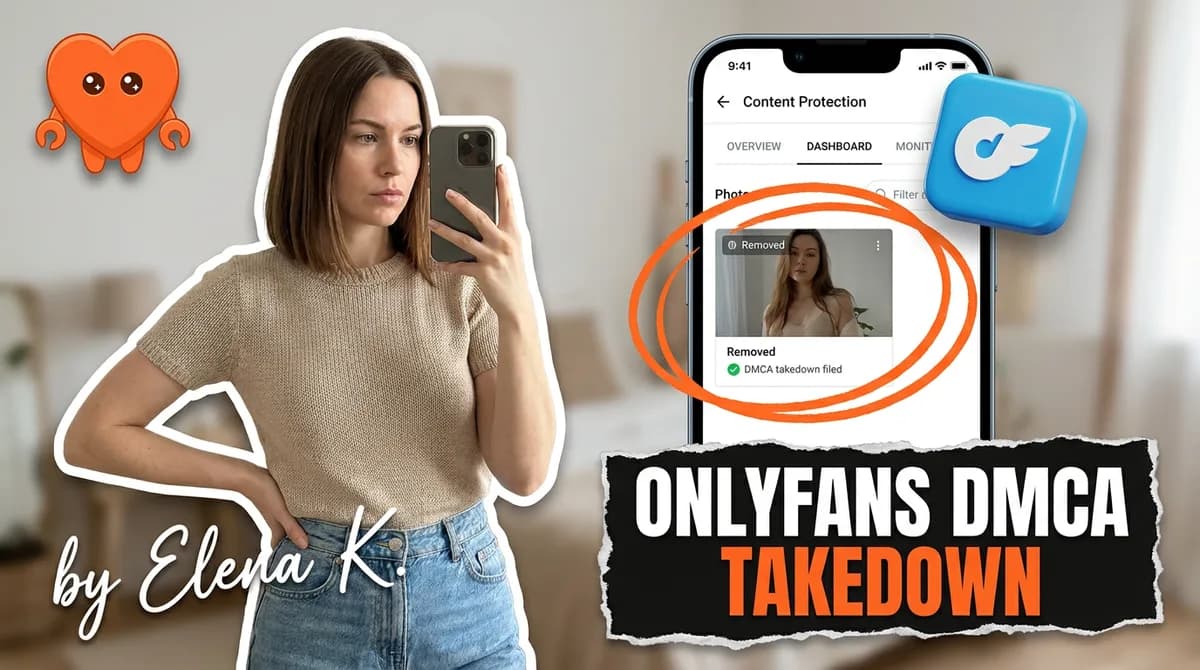
If your OnlyFans content was leaked, you have a real, free legal tool to get it removed: a DMCA takedown. As the person who created the photos and videos, you own the copyright automatically, and that ownership lets you demand any host, search engine, or platform remove unauthorized copies. You can file the notices yourself, the process is built for non-lawyers, and most legitimate hosts and search engines comply within a few days. This guide walks through finding the leak, gathering evidence, and filing, step by step.
This is general information, not legal advice. For a high-value case or anything involving threats, talk to a lawyer who handles copyright or online harassment.
What is a DMCA takedown and what are your rights?
A DMCA takedown is a formal notice that orders a website, host, or search engine to remove content that infringes your copyright. DMCA stands for the Digital Millennium Copyright Act, a U.S. law that requires hosting providers to act on a valid notice or risk losing their own legal protection. For a leaked OnlyFans set, it is the standard, free mechanism to force removal.
Your rights here are stronger than most creators realize. In most jurisdictions you own the copyright to a photo or video the instant you create it, with no registration and no fee. The U.S. Copyright Office confirms your work is protected the moment it is created and fixed in a tangible form, with no filing required. That automatic ownership is your standing: you do not need to prove anything elaborate, you need to show the work is yours and the copy is unauthorized. A leak is not just a privacy violation, it is copyright infringement, and the law gives you a tool to act on it.
One honest limit to set up front: a search-engine takedown removes a link from search results, it does not erase the file from the host. To remove the actual content you also notify the host. Used together, the two cover most of what a casual searcher would ever find.
It helps to think in two layers. The host layer is where the file physically lives, and a takedown there deletes the copy at the source. The discovery layer is how people reach it, mostly search engines, and a delisting there cuts off the traffic even when the file survives. A determined pirate can keep a file online, but if no search engine surfaces it and the link is buried, the leak stops spreading in practice. Your goal is not a perfect internet, it is making your work hard to find for the people who would actually look.
How to file an OnlyFans DMCA takedown, step by step
Filing a takedown is a sequence of small, concrete steps: find every copy, document it, send the notice to the host, delist it from search, and watch for re-uploads. Here is the order that works, from least to most technical.
- Find the leaks. Search your stage name, handle, and recognizable phrases on Google and image search. Use reverse image search on a representative frame. Check the usual leak forums and reposting sites. List every URL where a copy appears.
- Document and gather evidence. Take dated screenshots of each infringing page (the full URL must be visible). Save the exact infringing URLs in a spreadsheet alongside the URL of your original post. This is your evidence file and your filing checklist in one.
- Identify the host. For each leak, find who hosts it. A free WHOIS lookup or a "who is hosting this" tool gives you the hosting provider and an abuse or DMCA contact email. The host, not the anonymous uploader, is who you serve.
- Send the DMCA notice to the host. Email the host's designated DMCA or abuse address with a complete notice (the required fields are in the next section). Legitimate hosts are legally motivated to act and often comply within 1 to 7 days.
- File a Google search removal. Submit Google's free copyright removal form to delist the infringing URLs from search. Google asks for the specific URLs of the infringing content, not just a link to the site's homepage, so paste the exact pages from your evidence file. This is the single most effective step: even when a pirate site ignores you, delisting means almost no one finds the copy. Google typically processes these in 24 to 72 hours. Bing has an equivalent form.
- Use the platform's own report channel. If a copy is on a major platform (Instagram, TikTok, X, Reddit) or involves OnlyFans, use that platform's built-in copyright report tool. These tend to resolve in 2 to 5 days.
- Monitor for re-uploads. Leaks come back. Set a recurring search for your name and re-file as new copies surface. Persistence, not a single notice, is what actually keeps content down.
A quick reality check: pirate forums, offshore hosts, and some chat channels will ignore a notice no matter how perfect it is. That is expected. Your leverage there is search delisting and, in serious cases, a lawyer. Do not measure success by the worst actor, measure it by how few copies a normal person can find.
A few practical habits make this far less stressful. Batch your filings: gather a week of URLs and send them together rather than reacting to each one in the moment, which is calmer and just as effective. Keep your evidence file current, because a clean, dated record turns any escalation (a lawyer, a platform appeal, a police report in extreme cases) into a quick handoff instead of a scramble. And set realistic expectations with yourself. The first wave of takedowns clears the easy, high-traffic copies fast. The long tail of obscure reposts matters less than it feels like at 2am, because almost no one ever reaches a copy that does not show up in search.
What a valid DMCA notice must include
A DMCA notice is a short letter, but it must contain six specific elements or a host can reject it. Include all of them and your notice is legally complete, whether you send it by email or paste it into a web form. The wording can be plain. What matters is that every required element is present.
- Your contact information as the copyright owner (name, email, and a mailing address). You may use your stage name where the host allows it.
- Identification of your original work. Describe the photo or video and, ideally, link to where you legitimately published it.
- The exact infringing URLs. List every page hosting an unauthorized copy. Be precise; "somewhere on this site" is not enough.
- A good-faith statement that the use is not authorized by you, the copyright owner, or the law.
- A statement under penalty of perjury that the information in the notice is accurate and that you are the owner or authorized to act for the owner.
- Your signature. A typed full name counts as an electronic signature.
A common quotable rule: a takedown notice without the exact infringing URLs and the perjury statement is not a valid notice, and a host can ignore it. Get those two right and the rest is straightforward. Save a template once and you can file the next one in minutes.
DIY takedown vs a paid takedown service
Filing yourself is free and fully within reach for a one-time leak. A paid DMCA takedown service for OnlyFans earns its fee when leaks are constant and re-uploaded faster than you can keep up, or when you want your real identity kept off every notice. Both are legitimate. The right choice depends on volume, your time, and how much you value anonymity. Here is the honest comparison.
| Factor | Do it yourself | Paid takedown service |
|---|---|---|
| Cost | Free (your time only) | Roughly 59 to 69 dollars per month for unlimited filings |
| Best for | A one-time or small leak | Constant leaks and fast re-uploads |
| Scanning | Manual searches you run | Automated 24/7 monitoring and detection |
| Filing speed | As fast as you can write each notice | Bulk, automated submission |
| Re-upload handling | You re-file each time | Continuous re-detection and re-filing |
| Anonymity | Your name may appear on notices | Service files on your behalf, your identity stays off the paperwork |
| Control | Full; you see every notice | Less visibility into each individual filing |
If you only have a handful of URLs, do it yourself and pocket the money. If new copies appear weekly and chasing them is eating your week, a service buys back that time and shields your name. Vet any service before paying: confirm what they actually file, how they protect your data, and whether they lock you into a long contract.
Prevention: watermarking and owning your footprint
The best takedown is the one you never have to file, and prevention comes down to two things: making your content traceable and shrinking how many third parties hold your data. Watermarking does not stop a determined leaker, but a subtle mark with your handle makes copies easy to find, deters casual reposting, and strengthens every notice you send. Treat it as deterrence and evidence, not a lock.
The deeper principle is data ownership: the smaller your exposed footprint, the fewer ways your content and identity can escape your control. Two habits matter more than any single tool:
- Watermark and keep originals. Embed a discreet handle on previews and shared media, and keep your unedited master files dated. Originals are the cleanest proof of ownership in any dispute.
- Minimize who holds your login and your fan data. Every cloud tool you hand your OnlyFans password to is another company that stores your credentials and reads your fan messages on its servers. Each one is a separate place that can be breached or subpoenaed. The fewer third parties in the chain, the smaller your attack surface.
This is the broader version of protecting yourself, and it is where data ownership becomes practical, not abstract. FanClaw is a local-first app that runs your DMs, posting, acquisition, and monetization from your own machine, so your fan list and conversations never leave your device. It is one fewer outside party that can leak. If keeping your data on your own device matters to you, you can download FanClaw and run a full first day locally before deciding anything, and the same privacy-first thinking runs through the rest of the plan on the local-first OnlyFans tool page.
Removing leaks is only one half of protecting yourself. The other half is identity. If you are weighing how visible you want to be in the first place, read how to stay anonymous on OnlyFans and how to make money on OnlyFans without showing your face. And if you are deciding where to publish, is Fansly safe walks through how a second platform changes your privacy math. Takedowns handle what already escaped. These cover what you can prevent from the start.
Frequently asked questions
Filing a DMCA notice yourself is free. You send a written notice to the host or use Google's free copyright removal form. The only cost is your time. Paid takedown services charge a monthly fee (commonly around 59 to 69 dollars) to scan, file, and re-file at scale on your behalf.
It varies by where the content sits. Google search delisting usually lands in 24 to 72 hours. Mainstream file hosts often respond within 1 to 7 days. Social platforms typically process in 2 to 5 days. Pirate forums and offshore hosts may ignore the notice entirely, which is why delisting from search is your most reliable lever.
You can do it yourself. The DMCA notice is a standard letter, and Google's form is built for non-lawyers. A paid service makes sense when leaks are constant, content gets re-uploaded faster than you can file, or you want your identity shielded from the notices. For a one-time leak, doing it yourself is usually enough.
Yes. If you created the photo or video, you own the copyright automatically the moment you make it, in most jurisdictions, with no registration required. That ownership is what gives you the legal standing to file a DMCA takedown. Registration can strengthen a lawsuit later, but it is not needed to send a notice.
A valid notice needs your contact details as the copyright owner, identification of your original work, the exact URLs of the infringing copies, a good-faith statement that the use is unauthorized, and a statement under penalty of perjury that your claim is accurate, plus your signature (typed is fine).
It can, because a notice names the copyright owner, and some hosts forward the notice to the uploader. If anonymity matters, file under your stage name where the host allows it, or use a takedown service that submits on your behalf and keeps your real identity off the paperwork.
OnlyFans has its own DMCA process and a dedicated channel for reporting infringement of your content. They can act on copies that involve their platform, but most leaks live on third-party sites OnlyFans does not control, so you still file with those hosts and with search engines directly.
Watermarking does not stop a determined leaker, but it makes copies traceable, easier to find, and stronger evidence in a takedown. A subtle mark with your handle deters casual reposting and signals you actively protect your work. Treat it as prevention and proof, not a lock.