ManyChat review 2026: pricing, free plan, pros and cons
An honest ManyChat review for people who sell through DMs: what it does well, what ManyChat pricing really costs in 2026, whether it is free, and where it stops.
ManyChat is the best-known tool for Instagram comment-to-DM automation, and for that job it is very good. Someone comments a keyword under your reel, ManyChat sends them a private message with your link within seconds, through Meta's official integration. Since March 2026, paid plans start around $17 a month and grow with the number of people you message. The free plan still exists but is small. Where ManyChat stops is the real conversation: free-text questions, objections and follow-ups days later.
I sell coaching programs through Instagram DMs, and I ran my keyword funnels on ManyChat for a long stretch. This review is for people deciding whether to pay for it. If you already know ManyChat and want to compare it with other tools, our ManyChat alternative guide covers that side.
What is ManyChat, and who is it for?
ManyChat is a chat marketing platform that automates conversations on Instagram, Facebook Messenger, WhatsApp, TikTok, Telegram, SMS and email. You build flows: a trigger (a comment, a keyword, a story reply), then messages, buttons and tags. It is an official Meta Business Partner, so it connects through Meta's permission screen instead of your password.
It was built for businesses that talk to many people with similar questions:
- Coaches and course sellers sending a free guide or a waitlist link.
- Ecommerce brands answering "where is my order" and sharing discount codes.
- Service businesses collecting emails and booking requests.
- Creators running giveaways and lead magnets on reels.
The common thread is volume plus repetition. If a hundred people ask for the same link, ManyChat is the right shape of tool. If ten people each ask something different, it is a weaker fit, as you will see below.
What ManyChat is good at
ManyChat's strength is turning a public moment (a comment, a story reply) into a private conversation, instantly and inside Meta's rules. Nothing I tried does the keyword part more reliably.
Comment-to-DM keyword flows. You post a reel that says "comment PLAN and I'll send it". Every comment with PLAN triggers a DM with your link, and ManyChat can also reply publicly under the comment. Meta allows one private reply per comment, within 7 days, and ManyChat handles that rule for you.
Several channels in one builder. The same flow logic works on Instagram, Messenger and WhatsApp, which helps if your audience is split. Story replies, ad clicks and a follow-to-DM trigger are covered on Instagram too.
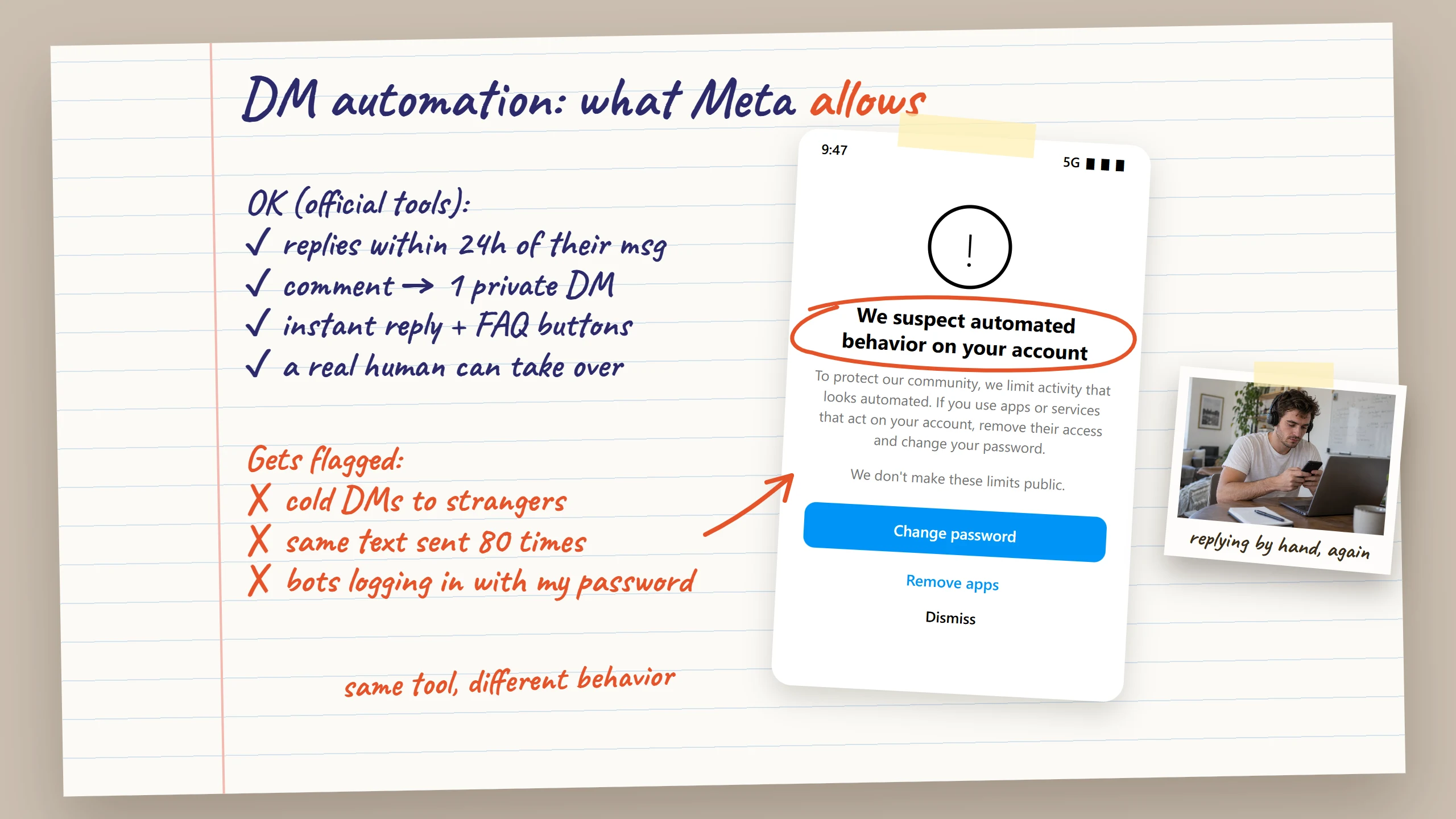
Official connection. Because ManyChat uses Meta's API, it works inside the 24-hour messaging window and never needs your login. For many people that alone settles the safety question. Our guide to Instagram DM automation explains those rules in detail.
Tags and basic segmentation. Each person who goes through a flow can be tagged ("asked about pricing", "downloaded guide"), and you can send them a broadcast later within the rules.
A huge template and tutorial library. It is easy to find a ready-made flow for almost any common funnel, which makes the first setup fast.
In my own account, a single keyword flow on a reel sent my free workshop link to a few hundred people in a weekend without me touching my phone. That is the job ManyChat is built for, and it does it well.
ManyChat pricing in 2026: what you actually pay
ManyChat moved to a new pricing model on March 2, 2026. You pay by plan and by active contacts: the people who send or receive a message through ManyChat in a billing month. ManyChat's own pricing page did not load for our checks, so the figures below come from detailed third-party breakdowns updated in August and September 2026. Treat them as "around" and confirm on your billing screen.
| Plan | Monthly price (billed monthly) | Active contacts included | Notes |
|---|---|---|---|
| Free | $0 | Around 25 | 2 channels, a few automations, ManyChat branding |
| Essential | Around $17 | Around 250 | Entry paid plan |
| Pro | Around $39 | Around 2,500 | AI conversations included on the new model |
| Business | Around $99 | Around 7,500 | Larger teams and volume |
| Advanced | Around $199 | Around 25,000 | High volume |
Annual billing lowers each paid plan by roughly a quarter. Above your included contacts, you pay a small overage per extra contact, cheaper on bigger plans.
Legacy pricing
If you signed up before March 2026, you may still be on the old model: a free plan of up to 1,000 contacts, and Pro starting around $15 a month for a small contact list, scaling up with contacts. On that legacy Pro plan, ManyChat AI is a separate add-on of around $29 a month. Check which model your account shows before you compare.
What a viral month costs
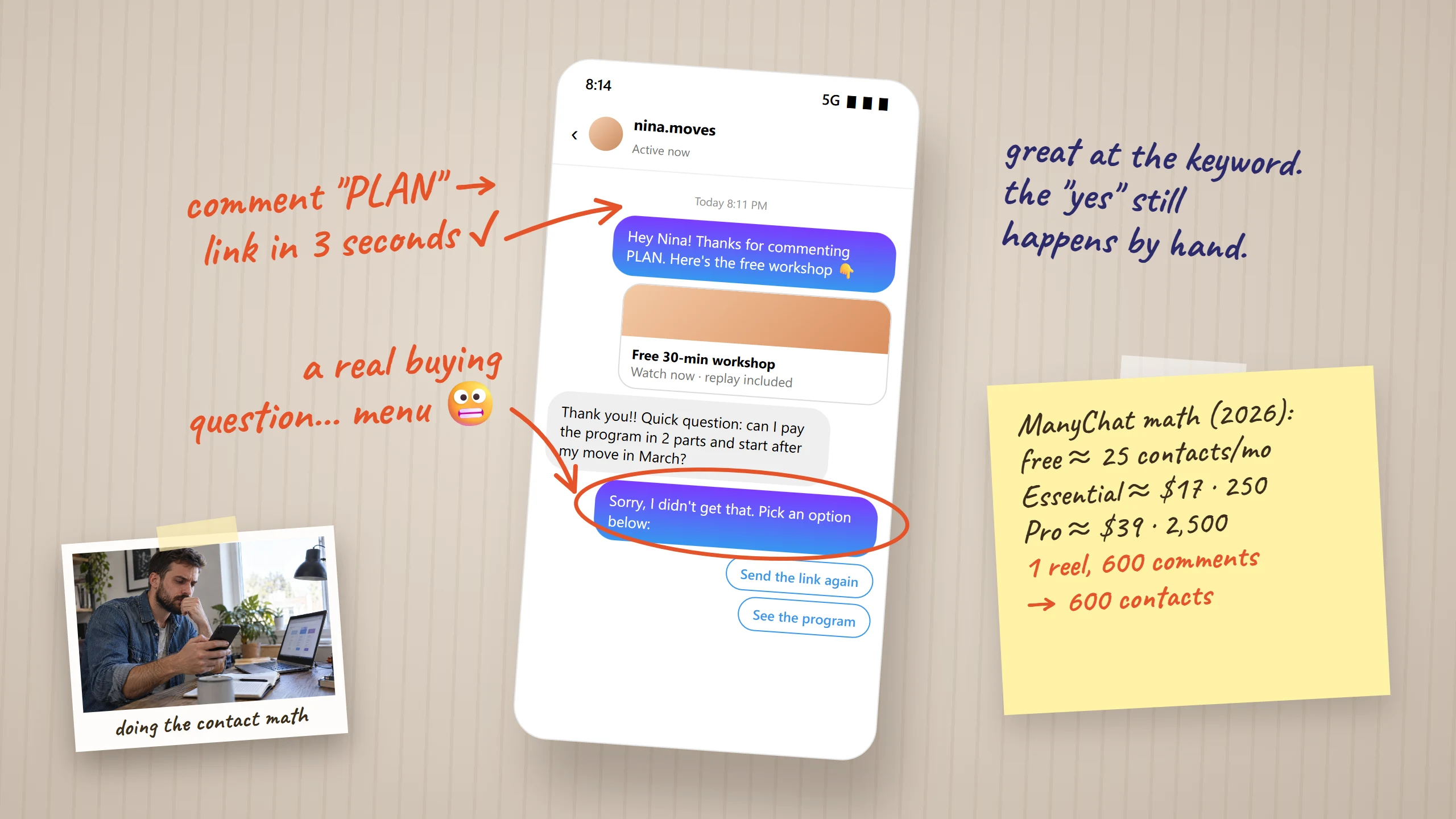
This is the part to understand before you buy. Say you post a reel with "comment PLAN" and 600 people comment. Every one of them receives a DM, so every one becomes an active contact that month. On Essential (around 250 included) you either pay overage on about 350 extra contacts or move up to Pro. The bill follows your reach, which is great when reach turns into sales, and frustrating when it does not.
Is ManyChat free?
Yes, ManyChat has a free plan, but under the March 2026 pricing it is a trial-sized plan rather than something to run a business on. Recent breakdowns list around 25 active contacts a month, two channels (chosen from Instagram, TikTok, Messenger and Telegram), a handful of live automations and one inbox seat.
What the free plan leaves out:
- ManyChat branding. The first message to each contact shows "Powered by Manychat".
- AI replies. Not included.
- WhatsApp, SMS and email. Paid channels only.
- Advanced automation. Conditions, longer sequences and integrations sit on paid plans.
My advice: use the free plan to build and test one keyword flow end to end, from a second account. As soon as a real reel goes live, expect to need a paid plan. Twenty-five people is one modest post.
How I would test it in one afternoon
- Switch Instagram to a professional account and turn on "Allow access to messages" in your message controls.
- Connect Instagram to ManyChat through Meta's permission screen. No password is involved.
- Build one comment trigger on a specific post with one keyword, such as GUIDE.
- Write a short first DM: thanks, the link, and one question ("what made you want the guide?").
- Add a public comment reply so people know to check their messages.
- Test from a second account, including a typo in the keyword and a free-text reply.
- Read what happens to the free-text reply. That is where you will see whether ManyChat covers your sales or only your first step.
Where ManyChat falls short if you sell through DMs
ManyChat automates the first step of a sale. It does not run the rest of it. For people who sell a service or a program through conversation, that gap is where most of the money is.
Rule-based flows, not conversation. A flow expects a keyword or a button tap. When a lead types "can I pay in two parts and start after my move in March?", the flow either misreads it, shows a menu, or waits for you. The AI features help with factual questions about your business, but they answer from what you configured, not from how you sell.
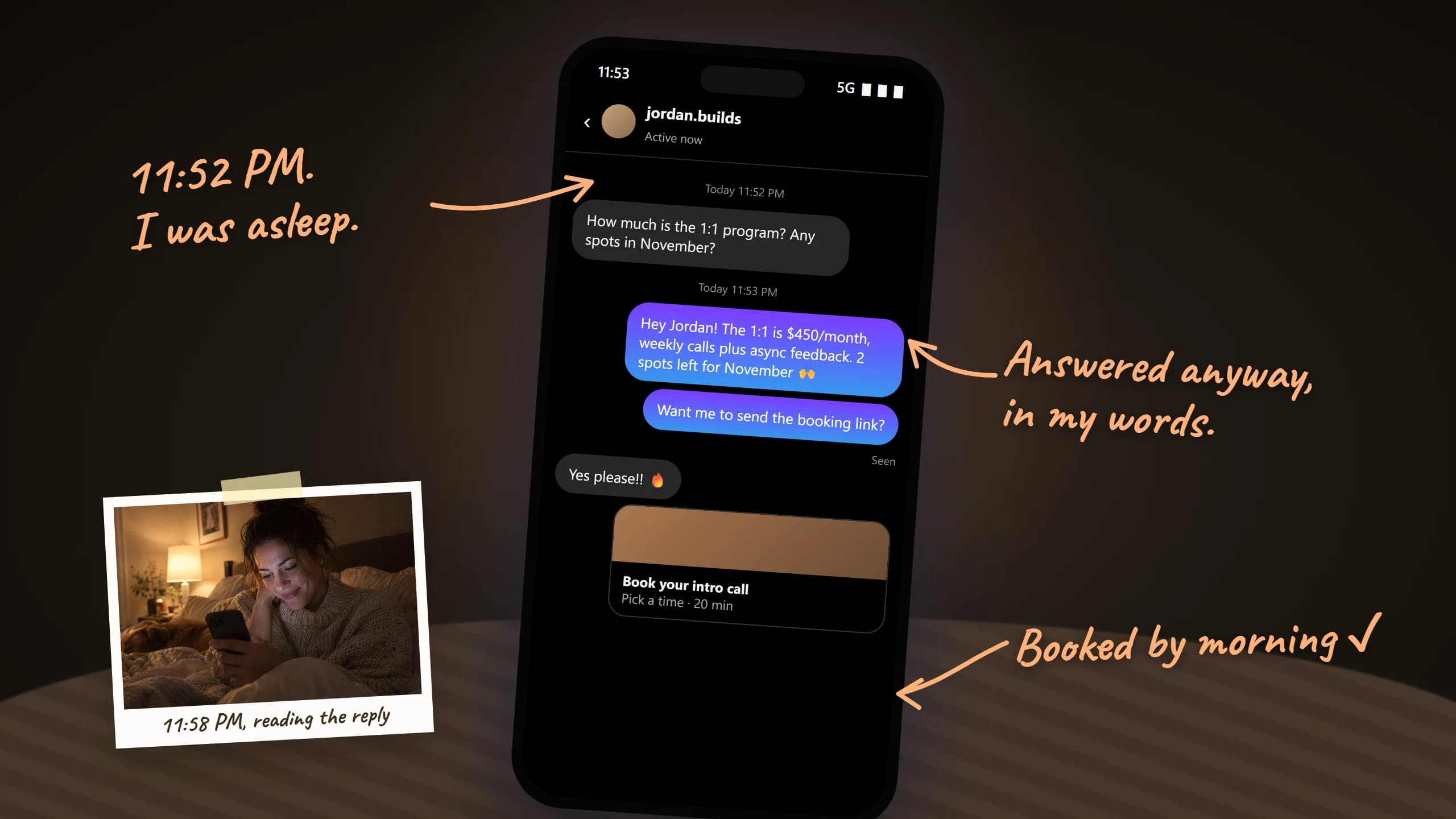
No follow-up after the window. Meta's API allows automated messages within 24 hours of the person's last message. The lead who said "let me think about it" on Monday does not get an automated, personal nudge on Friday. That follow-up, the one that closes most of my sales, is still mine to remember.
It does not write like you. Flows are text you wrote once, sent the same way to everyone. People who buy coaching notice the difference between a template and a reply that remembers what they said.
Pricing follows reach, not revenue. A viral reel full of curious viewers can push you up a tier in a month with few sales to show for it.
Instagram only for the big funnels. It covers Meta channels, TikTok and Telegram, but not X, where some of my clients first find me.
None of this makes ManyChat a bad product. It is a flow builder, and these are the limits of flow builders.
Is ManyChat worth it? The verdict by seller type
ManyChat is worth it when your funnel starts with a keyword and ends with a link. It is not enough on its own when your sales happen in back-and-forth conversations. Here is how I would decide, with the alternatives I considered.
| Option | Best for | Price | Pros | Cons |
|---|---|---|---|---|
| ManyChat | Keyword funnels, lead magnets, giveaways | Free plan, paid from around $17/month | Official Meta integration, reliable triggers, many channels | Flows not conversations, bill rises with contacts, no late follow-ups |
| Meta Business Suite | Instant reply, away message, FAQ | Free | Native, zero setup cost | No keyword flows, no follow-ups |
| Doing it by hand | A few leads a day | Free | Personal, flexible | Slow replies, forgotten follow-ups, evenings in the inbox |
| FanClaw | Real replies and follow-ups in your style | $49/month flat, 7-day trial | Answers free-text DMs, follows up days later, posts, covers Instagram, TikTok and X, logins stay on your computer | Not an official Meta integration (works through your own browser), desktop app must be running, no visual flow builder |
Buy ManyChat if you post offers with "comment WORD" calls to action, you send the same link to many people, and someone (you or an assistant) handles the conversations after.
Wait before buying if you post rarely or get only a handful of DMs a week. Instagram's free instant reply and FAQ buttons, plus a saved reply or two, will cover you until a reel actually takes off.
Skip it, or pair it, if most of your income comes from DM conversations that need judgment and follow-ups. That is the part FanClaw handles: a local agent on your Mac or Windows computer that answers your DMs in your writing style, follows up with leads who asked you to check back, and waits for your approval on prices and offers. It is not a CRM and not a flow builder. It is closer to an assistant that works your inbox.
What I run today: ManyChat for one keyword flow on reels, FanClaw for every conversation after the link. One owner per thread, so nobody gets two replies. If the follow-up is the part you keep dropping, you can download FanClaw and try it free for 7 days, $49 a month after that, cancel anytime.
Frequently asked questions
It is worth it if you run comment-to-DM funnels on Instagram, send a link or lead magnet to many people, and can live with rule-based flows. It is less worth it if your sales happen in long free-text conversations and follow-ups, because ManyChat hands those back to you.
ManyChat changed its pricing in March 2026. Paid plans start around $17 a month billed monthly, with higher tiers around $39, $99 and $199 according to recent third-party breakdowns, each including more active contacts. Annual billing is cheaper. Check ManyChat's pricing page or your billing screen, because older accounts can stay on legacy pricing.
There is a free plan. Under the March 2026 pricing it covers around 25 active contacts a month, two channels, a handful of live automations and ManyChat branding on the first message, with no AI or WhatsApp. Accounts on the older pricing may still have the legacy free plan of up to 1,000 contacts.
An active contact is a person who sends or receives a message through ManyChat during the billing cycle. Contacts who sit in your list without any messages that month do not count. The count resets every cycle, so a viral month costs more than a quiet one.
The connection is low risk: ManyChat is an official Meta Business Partner and uses Meta's permission flow, so it never sees your password. Accounts still get restricted for what is sent, such as spammy messages, misuse of the 24-hour messaging window, or content that breaks Instagram's guidelines.
Partly. Its AI features can answer free-text questions based on information you give it about your business, on higher plans or as a paid add-on on legacy plans. It is still built around flows and templates. It does not learn your writing style from your past messages or follow up with a lead a week later.