AI influencer marketing: how to grow one (2026)
AI influencer marketing in 2026: how to grow an AI persona's audience on Instagram, TikTok and X, and funnel it to a platform where you can monetize.
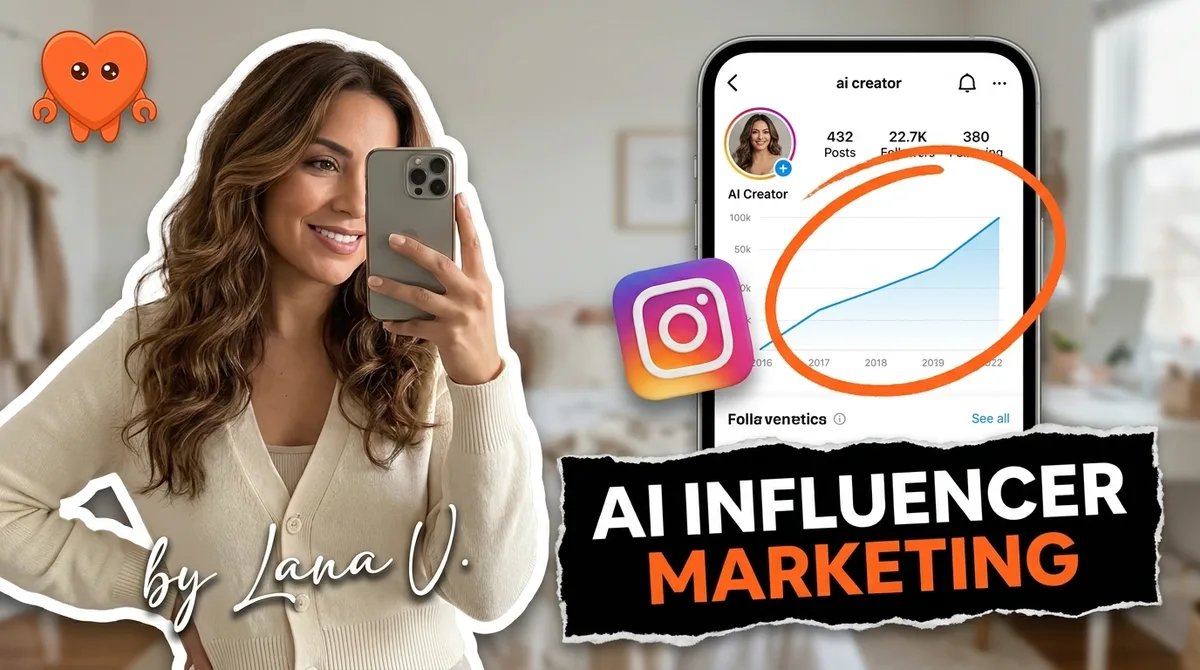
AI influencer marketing in 2026 means two different things. For brands, it means paying to place products alongside AI-generated personas with real audiences. For operators who own an AI persona, it means growing that persona's following on Instagram, TikTok, and X and converting that audience into subscribers on a monetization platform. This guide focuses on the second. Specifically: how to build the audience, which platforms work, how to disclose AI honestly without hurting growth, and how to run the operation without being online every hour of the day.
What "AI influencer marketing" actually means (and which question this answers)
AI influencer marketing is most commonly searched by two very different people. The first is a brand asking whether it should pay to partner with an AI creator for a campaign. The second is an operator asking how to grow the AI persona they have built so it earns real income.
The brand-side question is narrower than it looks. AI personas with large, engaged followings command meaningful sponsored post rates, and their availability is more predictable than a human creator's. But brand deals require an audience first. You cannot market an AI influencer that nobody follows.
This guide is for the operator: the person who has built or is building an AI persona and needs to grow its audience on social discovery platforms before funneling that audience to a subscription or monetization platform. Every tactic here serves that end.
For the revenue side of the operation, including which platforms allow AI content, how to structure a PPV ladder, and how to manage the inbox at scale, read the full guide on how to monetize an AI influencer.
Choose a niche that is specific enough to own
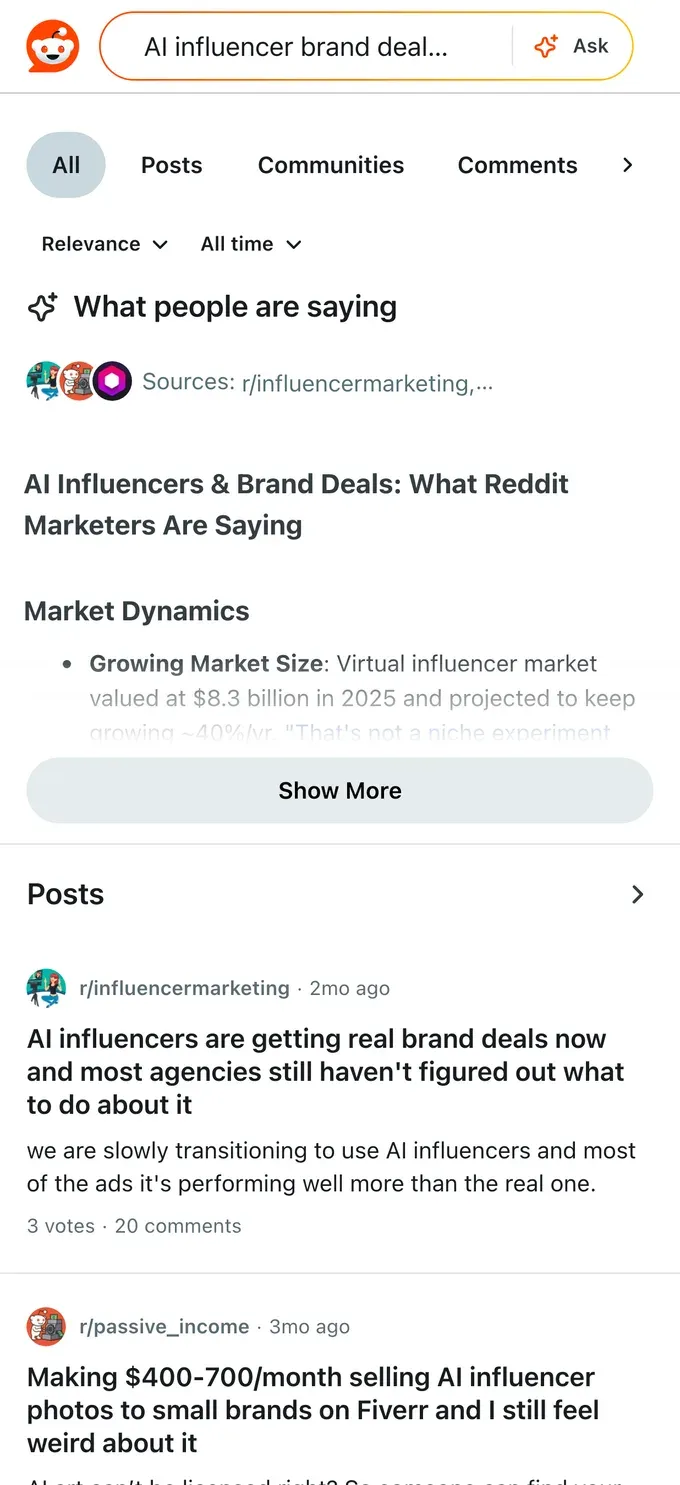
The fastest way to stall an AI influencer's growth is to make the persona generic. Algorithms on every discovery platform reward accounts that consistently attract a specific type of viewer. A persona defined as "beautiful woman who posts lifestyle content" is competing with tens of millions of accounts. A persona defined by a specific aesthetic, subculture, or interest niche has a viable path to ranking in that niche's feeds and searches.
Niche selection follows three criteria.
Audience size vs competition. A niche with consistent demand and relatively few dedicated accounts is where a new AI persona has the best opening. TikTok's Creative Center and Instagram's topic explorer surface this data. You are looking for a gap: viewer demand that is not already served by dozens of established accounts.
Content producibility. The niche must be one where AI image and video tools can generate compelling, consistent output. Highly stylized aesthetics (fantasy, dark romance, fitness, gaming culture) produce well. Highly dynamic content (live commentary, current events) does not.
Funnel compatibility. The niche's audience should be the type of person who subscribes to paid content. Niches adjacent to subscription platform categories convert better than general lifestyle or humor niches, even when the humor account has larger follower numbers.
Write the persona's niche in one sentence before building any social accounts. Changing it after the fact costs months of audience momentum.
Build a consistent posting cadence on Instagram, TikTok, and X
The single most common reason an AI influencer's social growth stalls is inconsistency. An algorithm learns an account by watching its behavior over weeks. An account that posts ten times in one week and then nothing for two weeks gets fewer impressions on its next post than one that has posted daily for 30 days without missing.
Three to five posts per week is the effective floor on each active platform. Below that, algorithmic reach decays between posts and you are rebuilding from scratch every time. Daily posting on TikTok, where the half-life of a post is shorter, accelerates growth during the early phase when you need the algorithm to learn your content type.
TikTok: the highest-ceiling discovery channel
TikTok's For You Page is the most powerful organic discovery engine available to creators in 2026. A single video optimized for the right niche can reach tens of thousands of people who have never seen the account before, at zero cost. That is not typical of other platforms.
The format rules are non-negotiable. Hook in the first two seconds: the first frame must contain a visual or text element that stops a scrolling viewer. Keep early content under 30 seconds, where completion rates are highest. Use on-screen text captions, both for accessibility and because TikTok's algorithm reads them for topic classification. Post three to five times per week minimum; the accounts that grow fastest on TikTok post daily in the first three months.
TikTok does not allow direct links to subscription platforms. Your bio contains a single link to a link-in-bio page, and your persona's content never mentions the platform by name. The audience builds around the niche, then migrates off-platform to subscribe. That funnel takes longer than direct traffic, but TikTok's raw reach makes the aggregate volume substantial.
AI content on TikTok must carry the platform's AI-generated label. Apply it to every post. This is covered in detail in the section below on disclosure.
Instagram: the conversion-intent platform
Instagram builds audience more slowly than TikTok, but the audience it builds tends to be more intentional about following creators. Someone who taps Follow on Instagram after watching three Reels has demonstrated more interest than a TikTok viewer who swiped past.
The playbook is specific. Use Reels for discovery (Instagram's algorithm pushes Reels to non-followers more aggressively than static posts). Use Stories for relationship maintenance with existing followers. Keep the main feed as a consistent, on-brand gallery that functions as a first impression for new visitors.
Instagram's content policies prohibit adult content, which means the persona's public feed stays SFW. That is not a limitation. The SFW feed is the funnel top. It builds familiarity and trust with the persona. Followers who like the SFW public persona are far more likely to convert to paid subscribers than followers acquired through explicit teasers on a platform that tolerates them once, then removes the account.
The bio should contain a single link and a clear reason to click it: "exclusive content" with a directional arrow pointing to the link. Do not paste subscription platform URLs directly in captions. Use a link-in-bio page.
X: direct traffic to your monetization platform
X is the platform where the content policies most directly align with subscription creator monetization. An age-restricted X account can post content that would be removed on other platforms, link directly to subscription pages in the bio, and build a following that is already primed for the subscription model.
For an AI influencer, X serves as both a discovery channel and a warm audience holding space. Post a mix of niche-relevant teaser content, persona-building posts (opinions, observations, humor that fits the character), and engagement posts that invite replies. The ratio that performs best is roughly two relationship or engagement posts for every one direct content promotion.
Tag other creators in adjacent niches. Reply to conversations in your niche's community. The X algorithm distributes posts from accounts that participate in conversations more broadly than posts from accounts that only broadcast. An AI influencer account that engages authentically within its niche builds social proof faster than one that only promotes.
Label AI content honestly: it builds the audience, not hurts it
The instinct to hide the AI nature of a persona to avoid scaring off followers is understandable and wrong.
TikTok's policy requires people to label AI-generated content that contains realistic images, audio, or video. Instagram's parent company applies the same standard: Meta requires people to use its disclosure tool when they post photorealistic content that was digitally created or altered, and can apply penalties when they do not. Subscription platforms that allow AI content require disclosure in the account bio or on individual pieces of content. These are not optional.
Beyond the rules, disclosure is a growth strategy. Audiences in 2026 are aware that AI influencer accounts exist and many actively seek them out. An account that is clearly labeled earns a specific kind of loyalty: fans who follow and pay know exactly what they are getting, and they chose it. They are far less likely to dispute charges or report the account.
The accounts that built durable audiences in 2025 and 2026 made disclosure part of the brand. "This is an AI persona, here is what makes her compelling" is a defensible position. Trying to pass as human while platforms improve their synthetic-content detection is not.
Practical execution: on TikTok, apply the built-in AI label on every video. On Instagram, state it in the bio. On X, put it in the bio and mention it periodically. On subscription platforms, follow the platform-specific requirements covered in the monetization guide.
Funnel your social audience to a monetization platform
Building a social audience is the top of the funnel. The bottom of the funnel is a subscription platform where that audience pays.
Every social bio points to a single link-in-bio page. That page lists the subscription platform and a brief description of what subscribers get. Keep it minimal: a photo of the persona, one line of copy, and the subscribe button. Each additional element reduces the conversion rate.
The transition from social follower to paying subscriber happens when the follower has enough context about the persona to decide it is worth it. That context is built over weeks of consistent posting. The persona's voice and aesthetic, expressed across dozens of posts, is what converts.
Once a subscriber arrives on the monetization platform, the inbox becomes the primary revenue channel. A welcome message that arrives within the first few hours sets the tone for the entire subscription relationship. Fans who receive a personal, on-voice message in the first session are significantly more likely to unlock PPV content, tip, and renew than fans who subscribed and never heard from the account. This is covered in detail in the guide on how to monetize an AI influencer.
Run the account at scale without being online around the clock
AI tools remove the content production bottleneck. They do not remove the operations burden. Posting consistently across three platforms, managing the inbox on a subscription platform, and sending PPV campaigns is a full-time operation if done manually.
The revenue opportunity exists at all hours. Fans in different time zones are active when you are asleep. A PPV send that sits unseen for eight hours costs real revenue. A welcome message that arrives 12 hours after subscription lands when the subscriber has already moved on.
The solution is software that runs the operations layer from your own machine.
FanClaw is a local-first app that handles DM automation, PPV sends, posting schedules, and fan re-engagement entirely on the operator's own machine. It does not generate images or video. It is the system that runs after content exists: scheduling posts, managing the inbox in the persona's voice, sending PPV campaigns, and tracking what is converting.
The distinction from cloud-based chatting services matters here. Those services sign in as you from their own servers. A company you have never met holds your credentials, reads your fan conversations, and can take action on your account. If their infrastructure is compromised, your account is exposed. The fastest way to create platform risk for an account you have invested months in building is handing your login to a third party.
Software that runs locally never creates that exposure. Credentials stay on your machine. Fan data stays on your machine. If the business you are building is worth protecting, download FanClaw and run the operations layer on your own terms.
Growing an AI influencer is a systems problem. The production bottleneck is solved by AI tools. The operations bottleneck is solved by software that runs locally. What remains is consistency: showing up on the right platforms, posting in the right format, disclosing clearly, and converting the audience you build into subscribers.
The full system in seven steps:
- Define the niche in one sentence before building any social presence.
- Create accounts on TikTok, Instagram, and X. Set disclosure labels from day one.
- Post three to five times per week on each platform. Prioritize TikTok for reach, Instagram for conversion intent, and X for direct platform-adjacent traffic.
- Label every AI-generated post on every platform. Make disclosure part of the brand.
- Point every bio to a single link-in-bio page: photo, one line, subscribe button.
- On the subscription platform, send a welcome message to every new subscriber. The inbox is the revenue channel.
- Run the operations layer on local software so the account stays active between your sessions, without handing credentials to a cloud service.
Frequently asked questions
AI influencer marketing refers to two distinct practices: growing and promoting an AI-generated persona to build an audience (the operator's perspective), and brands paying to place their products alongside AI influencer accounts (the brand's perspective). Most independent operators use the term to mean the first: how to market their own AI persona on Instagram, TikTok, and X so that audience can be funneled to a monetization platform.
Post SFW lifestyle, aesthetic, and personality-driven content consistently, three to five times per week. Keep your Instagram feed on-brand without revealing paid content. Use Reels for reach and Stories for intimacy. Your bio link should point to a link-in-bio page that bridges followers to your monetization platform. Instagram is a funnel, not a sales floor.
TikTok permits AI-generated content provided it is clearly labeled as synthetic under its AI disclosure policy. You cannot link directly to subscription platforms from TikTok, so the strategy is to build an audience around a broader niche, then funnel followers to X or a link-in-bio page that leads to your monetization platform. TikTok's algorithm can push a single video to tens of thousands of people overnight, which makes it the highest-ceiling discovery channel available.
Yes, and the requirement is broad. TikTok and Instagram both require AI disclosure labels on synthetic media as of 2026. Subscription platforms that allow AI content require on-content or in-bio disclosure. Beyond the rules, fans who discover undisclosed AI after paying drive chargebacks and platform reports. Disclosure-first is both the ethical and the practical strategy: audiences who know they are following an AI and choose to engage are far more loyal and less likely to dispute charges.
TikTok has the highest raw reach ceiling: one well-optimized video can land in front of tens of thousands of new viewers at no cost. Instagram builds slower but converts better into subscription fans because the audience tends to be more intent-driven. X is the best channel for audiences who are comfortable with subscription platforms. The standard playbook is to combine all three, each with its own content format, and funnel all of them through a single link-in-bio page.
The conversion happens at two points: the link-in-bio page (friction-free, one click to subscribe) and the DM inbox on the subscription platform (welcome messages, PPV campaigns, re-engagement). Traffic that arrives with intent converts; traffic that arrives cold and finds no follow-up goes cold. A welcome message sent within the first few hours of a new subscription can set the tone for the entire relationship and drive first purchases.
The content production bottleneck is removed because AI tools can generate visuals at scale. But the marketing work is identical: choose a defined niche, post consistently, disclose clearly, engage with your audience, and route traffic to a monetization platform. The operator's job shifts from content creation toward account operations, audience growth, and fan engagement management.
FanClaw is a local-first app that runs the operations layer of an AI influencer account entirely on the operator's own machine: DM automation, PPV sends, posting schedules, and fan re-engagement. It does not generate images or video. Credentials never leave the operator's machine, and fan data is never sent to a third-party server. Operators use AI production tools to create the content; FanClaw runs the business side.